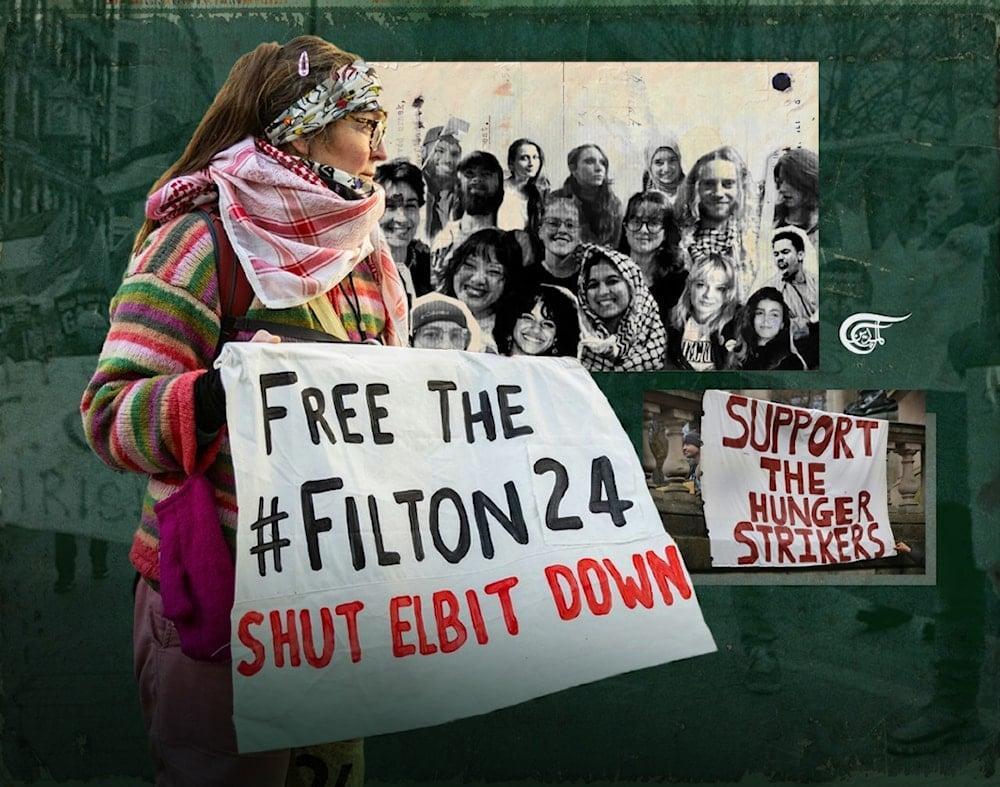
Eight prisoners alleged to have taken part in actions in support of Palestine are now in a critical phase of their hunger strike in British prisons, with some entering their 38th day without food. Medical professionals have warned that the activists face life-threatening health complications, yet the UK government has been accused of deliberately ignoring their plight.
Critical health deterioration
The hunger strikers, held across multiple facilities including HMP Bronzefield, HMP Pentonville, HMP New Hall, HMP Peterborough, HMP Bristol, and HMP Wormwood Scrubs, are experiencing severe health decline:
Qesser Zuhrah (HMP Bronzefield) – On her 38th day of hunger strike, Zuhrah has lost significant weight and is “unable to sleep,” according to friends. Despite her deteriorating condition, she remains committed to the strike.
Amu Gib (HMP Bronzefield) – Also 38 days into the strike, Gib has lost over 10 kilograms and is suffering from deep exhaustion. Green Party deputy leader Mothin Ali, who visited Gib on December 3, described them as being on their “last legs.”
Kamran Ahmed (HMP Pentonville) – Has been hospitalised twice, most recently on December 9, for the second time. Ahmed collapsed with dangerously low blood sugar levels, indicating hypoglycaemia, and has reported progressive dizziness, chest tightness, and an inability to stand steady. According to Prisoners for Palestine, his ketone levels reached dangerous heights before his second hospitalisation. Ahmed has lost substantial weight and continues his hunger strike despite medical intervention.
Jon Cink (HMP Bronzefield) – Has lost 12 kilograms since beginning his strike on November 6, now weighing just 47 kilograms. Doctors have expressed serious concern about his kidney function and strain. Close friend Joseph Knight reported that medical checks have been “inconsistent” and alleged that on one occasion the medical team failed to test Cink’s ketone levels because they lacked the necessary equipment, and a nurse “didn’t take his temperature because she didn’t feel like it.”
Teuta Hoxha (HMP Peterborough) – Was hospitalised on November 27 after 20 days on hunger strike. She is experiencing dangerously low blood pressure and breathlessness, and supporters fear she will require immediate re-hospitalisation. According to Prisoners for Palestine, the prison refused her multiple requests for masks and winter clothing, resulting in her developing a cold.
Heba Muraisi (HMP New Hall) – Joined the strike on November 5 and fears “hospitalisation is imminent.” She has lost over 10 kilograms and is experiencing severe deterioration.
Lewie Chiaramello (HMP Bristol) – The eighth and newest hunger striker, Chiaramello has been without food for 15 days. Due to his diabetes, his blood sugar levels are fluctuating dangerously between very high and very low. Prison doctors have expressed concerns about long-term implications for his health.
Muhammad Umer Khalid (HMP Wormwood Scrubs) – The 22-year-old joined the open-ended hunger strike on December 4. Despite being just five days into his strike, Prisoners for Palestine reports he is “struggling to sit up,” experiencing “a lot of pain,” and “deteriorating much faster than expected.” He has not yet received his medical checks.
Dr. James Smith, an NHS emergency doctor who has been in regular contact with the prisoners’ families, issued a stark warning: “For someone who was previously well, with no other underlying medical issues, [at] around six to eight weeks [on hunger strike], there’s a very, very high risk of death.”
Alleged medical neglect and inhumane treatment
The prisoners and their supporters have documented what they describe as systematic medical neglect and inhumane treatment:
– Medical teams were initially slow to respond when the strike began, refusing requests for electrolytes and medical attention for nine days, despite Ministry of Justice guidelines requiring “full initial medical assessment” for prisoners refusing food.
– When Ahmed was first hospitalised in late November, paramedics initially refused to take him from the prison, stating “there was nothing they could do if he wouldn’t eat.”
– During his hospitalisation, Ahmed was refused all communication with family and solicitors. When he requested to contact his next of kin before accepting treatment, an officer told him: “You either get treated or go back to prison, you can’t make a phone call.”
– Ahmed reported being forced to walk through gravel in his socks while handcuffed to an officer, after his shoes were taken away, leaving him to use shared hospital bathrooms barefoot.
– The entire hospital ward was locked down due to Ahmed’s presence, and doctors were allegedly “directed not to give any updates about anyone on the ward at all.”
– Both Zuhrah and Cink had their next of kin contacts changed to HMP Bronzefield when transferred to hospital on December 3, preventing their families from being notified of their whereabouts.
– Supporters report that medical checks have been “inconsistent and change day by day,” with some checks simply not being performed.
Lammy confrontation and accusations of lying
On December 9, Justice Secretary David Lammy was confronted by protesters and family members of the hunger strikers outside his constituency office. In video footage that has circulated widely, Lammy claimed he “didn’t know anything” about the prisoners’ cases.
Shahmina Alam, sister of hunger striker Kamran Ahmed, told Lammy directly: “We’ve been waiting for you to respond and the Ministry of Justice to respond.”
When presented with the letter that had been sent to him at the beginning of November, alerting him to the planned strike and outlining the participants’ demands, Lammy replied: “I didn’t know anything about this.”
MP Zarah Sultana, who visited Qesser Zuhrah at HMP Bronzefield on December 9, was unequivocal in her response: “I’ve written to David Lammy, so the fact he’s saying he doesn’t know about this is a lie.”
The Ministry of Justice later responded to the controversy, stating: “The reporting is wrong. The letter in question was delegated to an appropriate minister as is usual with departmental correspondence.” However, this response has done little to quell concerns that the government is deliberately avoiding engagement with the crisis.
In the video, as Lammy attempted to leave, protesters shouted after him: “There’s been four weeks of hunger strikes, why have you said nothing?”
Extended pre-trial detention and terror legislation
All eight prisoners are being held on remand without trial, with many facing nearly two years in detention before their cases are heard. Most are part of the “Filton 24” case, accused of involvement in an August 2024 action against an Elbit Systems factory in Filton, Bristol, where over £1 million in damage was allegedly caused. Three others face charges related to a June 2025 protest at RAF Brize Norton, where military supply planes were allegedly daubed with red paint.
Kamran Ahmed’s case exemplifies the judicial irregularities the prisoners face. Arrested on November 19, 2024, he has now been held for nearly 13 months. Judge Bobbie Cheema-Grubb ordered him to be bailed in February 2025 at Crown Court, but government prosecutors immediately appealed, and Ahmed was not released. Not only was his bail overturned at the High Court, but according to his sister, Judge Cheema-Grubb was immediately removed from judging similar cases.
Political visits and growing support
The hunger strike has drawn political attention, with Sultana becoming the second politician to visit the strikers, following Green Party Deputy Leader Mothin Ali’s visit on December 3. Jeremy Corbyn is scheduled to visit the prison on December 10.
Ali described the conditions as “inhumane” and “an affront to human decency,” telling Middle East Eye that both Gib and Cink were on their “last legs.” He emphasised that the activists are “only holding on because of their youth.”
MPs Jeremy Corbyn, Zarah Sultana, and John McDonnell met with families and friends of the hunger strikers on December 4, with supporters warning that “time is running out.”
Democratic Socialists of Your Party (DSYP) issued a solidarity statement on December 9, expressing “love, admiration and solidarity for the hunger strikers” and calling the action “the biggest collective hunger strike in the prisons of the British state since the Irish Republican hunger strike of 1981.”
Media blackout concerns
Supporters have raised concerns about what they describe as a deliberate UK media blackout on the hunger strike. Francesca Nadin, spokesperson for Prisoners for Palestine, told The Electronic Intifada that there has been “almost a complete blackout in the mainstream media about this story,” despite its historical significance.
Sultana echoed these concerns, stating: “I think there are editors who refuse to cover this, and they’ll use all sorts of reasons as to why, just because they don’t want to profile the hunger strike because of it being about genocide.”
The lack of coverage stands in stark contrast to the scale of the crisis and its historical significance as the largest hunger strike in Britain since 1981.
Historical significance and stakes
The Prisoners for Palestine hunger strike represents the most significant collective hunger strike in British prisons since 1981, when 10 Irish Republican prisoners died after refusing food in the H-Blocks of the Maze Prison in the north of Ireland.
Teuta Hoxha wrote in a statement: “Our demands are simple, and I want it stated for the record that our collective strike should only be interpreted as a will to live, using nothing but our hunger to resist the imperial war machine. We are prepared to push to the very end for these rights. Any harm we sustain lies at the door of the government.”
As the hunger strike enters its most dangerous phase, with prisoners reaching the point where medical experts warn of imminent risk of death, the British government faces mounting pressure to engage with the prisoners’ demands. The accusations of deliberate ignorance and the documented medical neglect have intensified calls for immediate action.
Prisoners for Palestine emphasises: “Our prisoners are reaching a critical point.”
The coming days will prove crucial as the health of all eight hunger strikers continues to deteriorate. Without government intervention, Britain may face its first hunger strike deaths since the 1981 tragedy that left ten Irish Republicans dead and scarred the nation’s conscience for decades.
Sul Nowroz
Source: Al Mayadeen