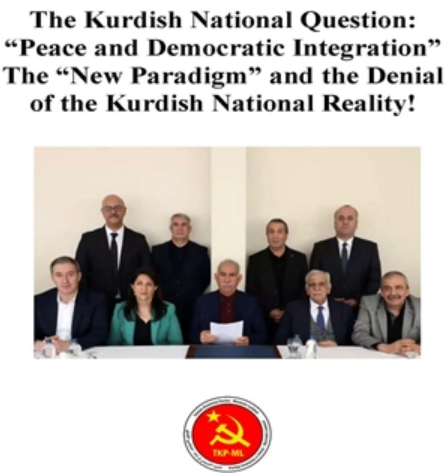
Following PKK leader Abdullah Öcalan’s “Call for Peace and a Democratic Society,” the PKK decided to end its armed struggle by dissolving itself at its Extraordinary 12th Congress held between 5 and 7 May. A. Öcalan prepared two separate documents sent to the PKK’s 12th Congress. Serxwebûn newspaper published the 21-page document written by A. Öcalan on 25 April in its 521st issue.
- General Introduction
Following PKK leader Abdullah Öcalan’s “Call for Peace and a Democratic Society,” the PKK decided to end its armed struggle by passing a resolution to dissolve itself at its 12th Extraordinary Congress held on May 5-7. A. Öcalan prepared two separate documents sent to the PKK’s 12th Congress. Serxwebûn newspaper published the 21-page document written by A. Öcalan on April 25 in its 521st issue.
In this “Perspective” document, consisting of an introduction and seven main sections, A. Öcalan addresses the theoretical, political, historical, and programmatic foundations of the new era from his and his organization’s perspective.
This article evaluates the “Perspective” letter sent by A. Öcalan to the PKK’s Extraordinary 12th Congress.
Idealism, as a Historical Perspective
Human history is filled with various variations of materialist and idealist ideas. Through a detailed examination of human history and by addressing the ideas of philosophers who came before him and his contemporaries, Karl Marx rescued materialism from its dead and soulless form and pulled dialectics out of the quagmire of idealism, putting dialectical materialism at the service of the proletariat. With the emergence of classes, idealism was imposed on the oppressed by the oppressors, and reality was always manipulated to produce a kind of consent.
For example, in ancient Greece, while citizens (slaves and women were not citizens) had various rights, and forms of government changed many times, with various laws being made and broken, what remained constant was slavery itself. Slavery was accepted as natural. Slaves themselves were made to accept it as natural.
We are now encountering a “new” definition of socialism by A. Öcalan. For example, we are faced with a ‘defense’ of socialism that rejects the dictatorship of the proletariat because it is not “democratic.” A. Öcalan says the following in his Perspective text: “This is why we are focusing on socialist ideology and attempting to democratize it. In fact, calling socialism democratic is not entirely accurate. Because socialism should already be democratic. However, real socialism is oriented towards seizing state power and proletarianizing the state, i.e., proletarian dictatorship, so its democratic essence is weak. That is why we felt the need to use the term democratic socialism.”
Much can be said about these expressions. We are talking about an approach that disregards for whom the dictatorship of the proletariat is democracy and for whom it is dictatorship, based on the claim of “democratizing socialism.” In fact, A. Öcalan’s way of thinking, regardless of his intentions, resembles that of the Bauer brothers.
In The Holy Family, the first joint work by K. Marx and F. Engels, an example of historical/social materialism is presented against the Bauer brothers, who put Christianity in their target sights as they were struggling to change the social mindset. According to this, although religion influences people in the ideological sphere, it did not descend from heaven as expressed in the holy book, but is rooted in social life and relationships. Theoretical criticism and ideological subjugation are not sufficient to eliminate religion; it can only be eliminated through practical criticism, that is, by changing the material relationships that create and nurture it. The Bauer brothers also seek the root of social problems in mentality, that is, in religion, and therefore base their struggle on opposition to religion. “Ideas can never lead beyond an old world order but only beyond the ideas of the old world order. Ideas cannot carry out anything at all. In order to carry out ideas men are needed who can exert practical force.” (Karl Marx-Friedrich Engels, The Holy Family)
From Spartacus to Sheikh Bedrettin, from Thomas Münzer to the Paris Commune, from the Celali Rebellions to the Kurdish Serhildans, from June 15-16 to the Gezi Uprising, there have been many practical criticisms, whether targeting power or not, armed or unarmed. Undoubtedly, these cannot all be considered in exactly the same way. Even the Kurdish uprisings are each a separate subject of analysis. What makes them the same is certainly not that they were defeated. Indeed, some even managed to seize power in certain time periods and regions. When these uprisings, some economically based, some democratically based, and some based on identity and religion, are examined, it will be seen that, regardless of their intentions, the thick scent of idealism permeated them due to reasons such as their historical processes and the failure to properly construct the foundations on which they rose.
From a certain point in history, we see idealism being imposed on the masses in a more conscious and organized manner. This process began with the successive national liberation struggles and revolutions in Bulgaria, Albania, Vietnam, Romania, Cuba, Laos, Chile, Burkina Faso, Cambodia, and many other places, particularly after the Soviet and Chinese revolutions and the defeat of Hitler’s fascism.
Reversals from Socialism and the End of History
National movements have different contents. We will discuss these again later. However, as if to confirm Lenin’s statement about “the era of imperialism and proletarian revolutions,” the past century was marked by the victories of the national liberation struggles led by the proletariat against imperialism. However, a process of reversals from socialism, a process of revision and improvement, began through modern revisionist powers, primarily the Soviets and China, giving rise to a new contradiction. Although attempts were made to resolve this contradiction with the Great Proletarian Cultural Revolution (GPCR) in China, in the long run, imperialism succeeded in creating a world in its own image.
However, this was not enough to quell the justified anger of the masses. Therefore, a more comprehensive wave of ideological attacks began with the rhetoric of “the end of history” and the manipulations of ‘democratization’ and “the end of classes.” Especially with the collapse of social imperialism and the dissolution of the remnants of the Soviet revolution, a great wave of pessimism began to engulf the world. The campaign against communism, led by US imperialism and with the cooperation of Western imperialists, began to include ideological subjugation along with physical attacks.
The First and Second Imperialist World Wars were a product of the capitalist mode of production, imperialist relations, and contradictions. However, Khrushchev’s modern revisionism distorted this reality and rejected revolutions and wars in practice. It eliminated the distinction between just and unjust wars. He argued that the objective laws and the whole set of relationships that caused wars and revolutions had now disappeared. According to Khrushchev, imperialism had lost its aggressive nature and it was now possible to speak of “permanent peace” and the resolution of international problems through “mutual understanding.” (Which question is central? Revolution and war, or peace and coexistence? – People’s Fedayeen Organization of Iran, translated by Leman Meral Ünal, Sendika.Org)
This deviation, which captivated the Communist Party of the Soviet Union and many other communist parties at the time, caused the communist and revolutionary movement to take serious steps backward under the guise of “reducing tension.” These parties rejected the truth clearly stated by Lenin in The Military Program of the Proletarian Revolution: “Only if we overthrow, defeat, and dispossess the bourgeoisie not only in one country but throughout the world will wars become impossible.” We can interpret Lenin’s approach as follows: “Social peace is only possible through the elimination of classes and the full equality of rights for all strata of society.”
Again, Lenin states: “As long as capitalism and socialism coexist, they cannot live in peace; one or the other will eventually triumph, and either a funeral will be held for the Soviet Republic or for world capitalism.” (V.I. Lenin, “Speech Delivered at a Meeting of Activists of the Moscow Organization of the R.C.P.(B.)-December 6, 1920”)
Despite Lenin’s quite clear and explicit warnings, Khrushchev’s modern revisionism had emerged with its thesis of “permanent peace” and its claim that international problems could be solved through “mutual understanding.” Such an approach was significant in showing how modern revisionism revised MLM science, as well as being one of the concrete steps backward in socialism. (Of course, the origins of this regression must be sought deeper and earlier.)
In summary, while revolutionaries and communists generally approached the issue of “peace” in this manner, today A. Öcalan, as if he had discovered something new, expresses surprise in his letter, stating: “Strangely, it was not our side, but a Turk who was relentless against me and did everything to have me executed at any moment, Devlet Bahçeli, who opened this new era as the most authoritative voice and hand of the Turkish sensibility of the time, which had become a party and even a proto-party state. In other words, Bahçeli, as the relentless leader of the war against us, is saying this directly to the DEM delegation. ‘I have devoted my entire life to this, but now I want to start a new era.’ In my opinion, this is a clear call for peace and a democratic solution. It is both a call for peace and a consistent call for peace with democratic content. Developments seem to indicate this.”
The “peace” mentioned by A. Öcalan in this statement has been expressed in different ways at different times, as seen in the example of Khrushchev. Despite all their differences, the only place this type of peace rhetoric serves is the interests of the bourgeoisie.
Lenin, however, advanced the thesis of coexistence in peace as a revolutionary policy serving the goal of strengthening revolutionary movements worldwide. According to Lenin, this theory should be used to accelerate the proletarian revolutions of the world’s peoples, not as the foundation and essential element of a socialist country’s foreign policy.
An Organized Wave of Attacks: Neo-Liberalism and Postmodernism Hand in Hand
The betrayal initiated from within by people like Kautsky and Khrushchev, combined with the attacks of petty-bourgeois socialism and the imperialist- capitalist system, naturally resulted in a horribly distorted understanding of “democracy and socialism.” Figures, such as Bookchin and Negri, overturned the entire historical consciousness, even attacking from outside, as revealed by MLM science. Of course, we must not forget that ideological diseases such as patriarchy, hetero-sexism, and chauvinism had a major impact on accelerating this process. Because of these diseases, the masses were organizing against the revolutions they had created with their own hands in the name of “democracy.”
Imperialist-capitalists turned the sectarian policies implemented under the name of “socialism” into material for their own politics. Similar attacks, of course, existed from the very beginning. The personal slanders against K. Marx, F. Engels, and V. I. Lenin remained as rumors that no one took seriously because they were baseless.
However, in this process, which we now define as social imperialism, a series of policies implemented in the name of “socialism” had led to disastrous consequences for the masses. The participation of the masses in the revolution was being prevented, and the progress of the revolution was being halted. Under these conditions, figures like Khrushchev easily seized power. The bourgeoisie, which had been severely weakened by the working class’s seizure of power, was being restored.
Indeed, due to the manipulation of the imperialist-capitalists, these events were sold to the world’s working class and oppressed peoples under the guise of “democracy and freedoms.” Those who wanted to criticize these events lacked the clear information and ideological-theoretical background necessary to analyze the concrete conditions in a concrete way, resulting in a “criticism of real socialism” that lacked a real foundation.
The NGO approach was introduced under the guise of “humanitarian aid” to the colonies and semi-colonies where Soviet imperialism and Western imperialists were waging power struggles. The masses were bombarded with the idea that problems could be solved within the system. Crumbs of freedom, band-aids, painkillers… Just like the capitalist system’s understanding of health, an understanding that would never heal and would always keep people dependent on it was normalized. The slogan “either an honorable peace or a glorious resistance” gave way to the understanding that “there are no winners in war, no losers in peace.” However, even considering that the number of UN Peacekeeping Forces, which was 13 during the “Cold War” period, began operating in 20 regions between 1988 and 1993 and in 63 regions in 2008, it is clear that conflicts around the world have increased in parallel with neo-liberalism and how possible “peace” is in this system.
In his letter to the PKK, A. Öcalan wrote: “And the only conclusion we can draw from this is that only those who fight can make peace. In other words, not secondary or third powers, not allies, but those who bear the responsibility for the war itself can take on the responsibility for peace. Because peace is as serious an event as war. And the responsibility for such a serious event can only be assumed by its primary bearers. Therefore, realistically, the state is waging this war. I feel the need for the state to transform this war into a new beginning as an attempt at peace. This has been voiced over the last six months. We, too, were convinced that this hand should not be left hanging in the air, that indifference should not be shown to this voice, and we responded immediately. As the primary responsible party and executor of this struggle, we felt a sense of responsibility and responded without delay. This has also been shared with the public. The expression is as follows: only those who fight can achieve peace. Other parties do not have the power to achieve peace. They are secondary or auxiliary. The main initiative lies with those who spearhead this work. We have embarked on such a path, which I believe is a sound approach. Based on this approach, we have expanded the scope of the beginning somewhat and are preparing our program with this meeting under state supervision.” While saying this, he both glosses over the reasons why the war started and ignores the inevitability of wars in the imperialist capitalist system.
The greatest trap of postmodernism is that it blurs the distinction between the super ordinate identity and subordinate identities. Indeed, in his recent writings, A. Öcalan, who has not mentioned “imperialism” in the slightest, has, as seen in the above quote, glossed over the “causes” of the war and spoken of an imaginary spring.
The main point of living together in peace is democracy. So what does this mean? The denial of revolution and class struggle! If living together in peace means democracy, and if “the most important arena of struggle is the democratic arena,” that is, if the ultimate resolution of existing contradictions is possible through democracy, then there is no longer any need to talk about proletarian revolution, class struggle, or the role of revolutionary struggle. Where there is no revolutionary struggle, weapons are not needed. In this sense, the issue of the PKK laying down its arms is not such an urgent matter. The path outlined by A. Öcalan is clear.
Neo-liberalism, the ideology of globalization, and postmodernism, the cultural structure of globalization, found their field of application during the period known as the “Cold War,” which was waged between Western imperialists and social imperialists. Political and social life, the role of the state, and the existence of the nation-state are being reinterpreted.
“In the second half of the 20th century, faced with labor movements and socialist struggles that interrupted liberalism, liberalism began to establish its epistemological basis in order to redefine itself. Frederich August Von Hayek, who defended liberalism against the rising socialist movements, is an economist and political scientist who won the Nobel Prize in 1974 for his views defending the free market economy. Neo-liberalism can be defined as a capital project, an aggressive class domination project, designed to reorganize the role of the capitalist state in relation to class power, and thus the power relations and forms of power it represents.” (Güler Kalay, Neo-Liberalism and Identity Politics)
Neo-liberalism, whose epistemological foundation is based on postmodern theory, emphasizes diversity and differences, highlighting multiculturalism by addressing identities in terms of differences rather than similarities, criticizing modernism’s nation-state model, and opposing nation-state nationalism with micro-nationalisms. Micro-nationalism, created by emphasizing cultural differences based on ethnicity and belief, has become the determinant of neo-liberalism’s identity politics.
Postmodernism creates the illusion of multiculturalism by reducing all cultures and traditions to a single sphere. According to Terry Eagleton, postmodernism, “Despite boasting about being open to the Other, it can be just as exclusionary and censorious as the orthodoxies it opposes. For example, human culture is generally discussed, but class is not; the body is addressed, but biology is not; jouissance (pleasure) is mentioned, but justice is not; post-colonialism is discussed, but the petty bourgeoisie is not. This is a completely orthodox heterodoxy, like any imaginary form of identity, which needs bogeymen and false targets to do its job.“(The Illusions of Postmodernism)
Indeed, A. Öcalan also states: ”A society based on war, that is, on plunder, is a male-dominated society. Its business is surplus value. Marx links this to class division, but there is no need for that. If a surplus value opportunity begins to emerge, a plant society forms around the woman, and if there is an increase in food, the man sets his sights on it. He hunts animals, but he also seizes the food gathered by the woman. He seizes both the food and the woman; that’s how the story begins. He kills two birds with one stone.”
In this way, A. Öcalan obscures the concept of “class” while once again defending his famous thesis that “classes have ended”! It is precisely the production of surplus value and the appropriation of this production—which he himself admits—that turns women and men into two separate identities, oppressor and oppressed classes, bourgeoisie and proletariat…
- Understanding of Materialism
Historical Materialism and the Problem of Social Nature
While A. Öcalan claims that the bourgeoisie is a class with which compromise is possible, he also overturns the terms, definitions, and analyses that are closely linked to MLM science. One of the most important of these is historical materialism.
A. Öcalan states: “The act of sanctification kills even a woman’s lover. Why? Because she knows what will happen to her. She has to kill him to prevent this disaster from befalling her. That is the essence. That is historical materialism. This is the most useful idea we can take from Marxism. Dialectical materialism explains it this way. But men also put an end to this female rule in Sumerian society.”
In this way, A. Öcalan reduces historical materialism to a single point. While doing so, he addresses the emergence of classes but also continues with a terrible class denial. His aim in doing so is, of course, an effort to “transform” the irreconcilable fundamental class antagonisms in society through a peace policy based on humanist discourse. This post-modern policy is one of the foremost forms of liquidation in history.
This form of liquidation, which purges the ideological and political sphere of revolutionary elements, has achieved significant successes today. The fact that a thought that has lost its revolutionary essence by reconciling with the bourgeoisie still maintains its mass base does not mean that it has not undergone ideological liquidation. In today’s revolutionary society, where the level of political consciousness has declined, taking pride in the continued existence of an organization is not a sign that things are going well. Unlike those who have succumbed to the idealistic illusion of “social peace,” MLMs know that the revolutionary and the counter-revolutionary cannot coexist in harmony. Concrete experiences in the history of class struggles clearly show that a parallel sphere of social consensus cannot be established in spite of the state.
F.Engels said that nature is the testing ground of dialectics. Similarly, the history of societies is the testing ground of historical materialism.
“Just as, according to the Pauli exclusion principle, two electrons cannot coexist in an atom at the same time and at the same energy level, the proletariat and the bourgeoisie cannot coexist without conflict in social history. Rejecting the necessities of matter and the social sphere is a bourgeois illusion of freedom. Even recent experiences show us that the bourgeois utopian understanding of freedom is actually a shackle that binds the feet of slaves. In Latin America, Mexico, and Nepal, class and national liberation organizations that joined the order through bourgeois social contracts after exhausting their revolutionary powder were eventually crushed by the wheels of the capitalist system. Thus, it became clear that the normal cultural, legal, and political flow of bourgeois society served as a mill for revolutionary organizations. These political movements, which resisted firearms for more than half a century, could not escape melting away like a candle within the normal flow of bourgeois social life. Some of the bureaucrats of these revolutionary organizations, later found privileged political opportunities for themselves within the system. But the poor workers and peasant children who were once guerrillas were mostly thrown out of the process of social realization, suffering from the high cost of living, poor living conditions, murders by drug cartels, and existential annihilation. Their final attempt to rebel was resolved without a single shot being fired, under the siege of civil society, the voluntary ideological executor of bourgeois civilization… Historical Materialism has shown us that a neutral sphere of thought, isolated from the economic infrastructure, is impossible throughout the history of class society. This includes the period of primitive animistic thought. Traces of economic activity can even be found at the origin of the first totem cults. The fact that plant and animal species beneficial to the continuation of species existence were sacralized and tabooized tells us that the fundamental element determining consciousness in the transition from animal to human was human self-activity. All these historical materialist findings inform us that the democratic transformation of society cannot be achieved through bourgeois compromise.” (Anton Ekmekçi, The Story of the Wolf in Sheep’s Clothing in Aesop’s Fables)
In this sense, “democratic socialism” seeks the codes for creating a new life not in the transformation of areas that are the subject of political economy, but rather in thought. Yet correct thought is based on changing reality through practice. It is not possible to acquire knowledge of objectivity through “mental transformation” alone. This amounts to reshaping objective reality with ghosts summoned from beneath the ground. However, knowledge of reality is obtained, precisely as Marxism predicts, by changing its own object through praxis.
- The National Question
Why Does It Exist?
“It is an indisputable fact that the Kurds in Turkey constitute a nation and that anyone who has not been blinded by raging Turkish chauvinism will accept it. Kurdish workers, poor and moderately well-to-do peasants, semi-proletarians, urban petty-bourgeoisie, the entire Kurdish bourgeoisie and landlords are included in the Kurdish nation.
National oppression is applied not only to the Kurdish people, but to the entire Kurdish nation, except for a handful of feudal lords and three or five big bourgeoisie, who are fused with the Turkish ruling classes in every way. Kurdish workers, peasants, urban petty-bourgeoisie, small landlords suffer from this oppression.
In fact, the main target of national oppression is the bourgeoisie of the oppressed, dependent and subordinate nation. Because the capitalists and landlords belonging to the dominant nation want to be the unrivaled owners of all the riches and markets of the country. They want to retain the privileges of forming a state. By banning other languages, they want to achieve “language unity”, which is extremely necessary for the market. The bourgeoisie and landlords belonging to the oppressed nationality stand in front of these ambitions as an important obstacle. Because they [the bourgeoisie and landlords of the oppressed nationality], too, have the ambition to own their own market, to control this market as they wish, to exploit the material wealth and the workforce of the people themselves.
These are the powerful economic factors that set the bourgeois and landlords of the two nations against each other; this is where the bourgeois and landlords of the dominant nation engage in uninterrupted national oppression; This is why national oppressions is aimed also to the bourgeois and landlords of the oppressed nation.” (Ibrahim Kaypakkaya, Selected Writings, Nisan Publishing)
Nationalism, is a class ideology adopted by the Turkish, Arab, and Persian bourgeoisie, defined by A. Öcalan as the “Turkish, Arab, and Persian ruling elites,” to secure their economic and political dominance in their own regions and protect their class interests. In order to ensure the stable preservation of these interests, they regularly attempt to impose this ideology on the oppressed classes and strata. The fact that the working class and poor peasantry have been influenced by “nationalist poison” or have become its advocates does not change the fact that nationalism is not an “external poison” but a bourgeois class view.
The rationale for viewing nationalism not as a class ideology and policy but as a poison injected into the “elites” from outside and a pathological disease of the people is that the ruling classes of Western European countries increasingly embracing multiculturalism and European citizenship, at least officially, in the 1990s (which coincided with the most concrete manifestations of the retreat from socialism and the collapse of social imperialism) and their criticism of nationalism can be cited. The German and French monopoly bourgeoisie defended multiculturalism as a necessity of the European Union project, which they undertook to consolidate their dominance in Europe and create a powerful imperialist center against imperialists, primarily the US.
A. Öcalan and the national movement, starting from this point, view nationalism not as a bourgeois ideology, but as a poison that is either chosen or injected. The German bourgeoisie, relying on the anger and hatred of the people against fascism, as well as the internationalist instincts of the working class and laborers, has not abandoned its “national” and “imperialist” interests and is trying to shape the European Union in line with these interests. Today, as seen in the form of the “rising far right,” it also begins to defend nationalism again when its interests require it. Undoubtedly, not only A. Öcalan but also a much broader segment that argues that the national question can be solved within the system has been affected by these erroneous assessments.
The national question belongs to the capitalist system by its very nature and cannot be resolved without the destruction of this system. A reformist approach to the national question does not end all the privileges of the oppressor nation, nor does it eliminate all forms of fascist tyranny over the oppressed nation. Ultimately, it alleviates the pain but does not and cannot eliminate it. The fact that the Western European bourgeoisie and other imperialists defend a multicultural ideological line to one degree or another does not mean that nationalism can be reduced to a mentality independent of classes, poisoning the “elites,” or to a matter of free choice.
Nationalism is not a poison injected from outside, but a bourgeois “mindset” that must be fought against on an internationalist front based on the unity of the working class and peoples. The fact and necessity that it must be fought with an internationalist “mentality” (i.e., that it is a question of mentality), demanding full equality of rights, cannot justify ignoring the social and class foundations of nationalism.
The Reality of the PKK
“The PKK is a movement to prove the existence of the Kurds and open the door to freedom,” says A. Öcalan. Although the PKK has been defined differently in each period, this is where it has ultimately arrived. The historical denial of the Kurdish nation coincides with the continuation of the First Imperialist War of Partition. The Kurds, who are mentioned in many places throughout history, from Ancient Greece to the Persian Empire, were subjected to denial and annihilation in the four parts of Kurdistan, primarily by the fascist Turkish Republic, as a result of agreements made with the imperialists after the First Imperialist War of Partition. The situation is slightly different for Soviet Kurdistan, also known as the fifth part of Kurdistan, or Kûrdîstana Sor (Red Kurdistan).
After the emergence of national consciousness among the Kurds, many different Kurdish national organizations were established. With the collapse of the Ottoman Empire, none of the promises made by the imperialists and the reactionaries of the region were fulfilled, and a policy of denial and annihilation began. A. Öcalan describes this situation in his letter with a quote: “…Sheikh Sait’s words: ‘Prosecutor, you promised we would have a feast together. What happened to the lambs and goats?’” He quotes this as a question. In fact, massacres against Kurds had already begun long before Sheikh Sait. In particular, Alevi Kurds were targeted in the early stages in the Turkish Republic. The most important reason for this was that the Alevis had historically been a thorn in the side of the Ottoman Empire. “Infidelity” was an important propaganda issue in the massacre of Alevi Kurds. Muslim-Shafi Kurdish tribes were prevented from speaking out against these massacres and, beyond that, took part in them. This influence continues in subsequent years and even today. For this reason, the Turkish state can easily cite the example of Idris-i Bitlisi, who collaborated in an Alevi massacre in the historical process. They are aware that these religiously reactionary sentiments are still alive among the Shafi Kurds. They harbor the hope that they can rebuild their divide- and-rule policy from here. However, the PKK’s organization among Alevi Kurds has prevented this effort from yielding the results desired by the Turkish state at this time.
A. Öcalan, in the continuation of the paragraph where he mentions the examples of Sheikh Sait and Seyid Rıza, states, “And these leaders actually express this; it is very important that they are on the gallows. A dead reality, not sick, not wounded, but dead. A transitional period associated with this, experienced in the persons of Qadi Muhammad, Mustafa Barzani, Qasimlo, Jalal Talabani… What we know as traditional feudalism, we call transition, personalities who are half-bourgeois, half-aristocratic, who have come down to us from there. What we mean by bourgeois is a period that began after World War II and continues to this day, that is, the capitalistization and bourgeoisification of Islam… Did such a period occur, could it occur? But it exists. There is such a capitalism, a nationalist entity, and a fundamental consciousness of nationalism. This is evident from the representatives. After all, Qadi Muhammad has a tradition of statehood. Barzani is still experiencing an attempt at statehood. Talabani is also a partner in this. But there is no Kurdish nation-state that has yet left its mark on the era, or it is questionable no matter how hard one tries,” he continues.
He does not consider other Kurdish organizations that have fought or are still fighting to be significant. He does not see them as equals or rivals. The PKK was founded precisely within this Kurdish reality. Throughout its nearly fifty years of existence, it has constantly fought to be the sole ruling power in all four parts of Kurdistan. Although it has collaborated with other Kurdish or revolutionary organizations from time to time, like all organizations engaged in power struggles, its main goal was to consolidate its own power. It is a fact that it did not always use revolutionary methods to achieve this.
Along with all this, the PKK followed an ideological development path from the demand for a Free Kurdistan to the demand for democratic socialism and populist municipalism. It created a charismatic leadership model around A. Öcalan. While cultivating this leadership model into a cult, it also applied various methods to silence dissenting voices within its own ranks. During the same period, it advanced itself in developing military-political maneuvers in line with its own goals, establishing organizations quickly when necessary and dissolving others, and making B and C plans. With the dissolution of the remnants of the Soviet Union, it strengthened its relations with Western imperialists. This same period is also when the Palestinian resistance was forced into the Oslo talks…
The basis of these relations developed with Western imperialists, primarily US imperialism, was the discourse of “democracy.” In this period, when the EU was established and post-modern attacks on revolutionaries intensified, guerrilla warfare was elevated to a higher level, while at the same time a conciliatory ideology matured.
The intense participation of Kurdish workers and laborers plays a significant role in the continuation of guerrilla warfare. The epic images of the war further increase the PKK’s influence within the Kurdish nation. The charismatic leadership approach develops a will to fight among militants, who sacrifice themselves for their leader. Organized around this reality, the PKK requires that any steps taken when A. Öcalan and the rest of the organization disagree must be in line with A. Öcalan’s wishes and ideas. Even when A. Öcalan declared that his relationship with the PKK was over, the reality of the “leadership” that had been created pushed the organization to continue to shape itself according to A. Öcalan’s wishes.
Even when the PKK used rhetoric such as socialism, Stalin, the Turkish bourgeoisie, and the Kurdish poor until the 1990s, it was not actually talking about the liberation of the Kurdish proletariat. In the letter mentioned above, A. Öcalan states: “This is an interim period… that is, Kurdish nationalism, Kurdish capital, we call it primitive comprador bourgeoisie, some may be more developed, centered in Diyarbakır, Erbil, Sulaymaniyah, even Mahabat. But in my opinion, these are extremely temporary, artificial counter-revolutionary elements, imposed as instruments of liquidation. Both their ideological content and their practical implementation are like this.“ Although he tries to show that he still retains his ”revolutionary content,” throughout its history, the PKK has produced policies aimed at winning over its own feudal lords rather than fighting against the feudal system, which has had a significant impact in Kurdistan.
The PKK clearly demonstrated in the ’94 period that the Kurdish bourgeoisie, facing obstacles to its development, embraced socialist rhetoric while fighting for a share of capital due to the powerful winds of socialism at the time. From this point onward, it has more openly attacked MLM science. (Although it had previously belittled and disparaged the revolutionary movement, seeking to discredit it, it began to do so more openly after this date.) While doing this, it also developed various collaborations with the revolutionary movement because it could not resist the attacks of the Turkish state alone, and within these collaborations, it developed policies to impose its own ideas. Its approach in the unions and confederations it was organized in was also essentially indexed to concrete demands for the Kurdish nation.
The Solution to the National Question
Idealistic ideas that view everything through the lens of “mindset” explain the existence of the Kurdish national question in this way, which is why they are able to sign a peace agreement with the Turkish state, which they are currently fighting against, on the basis of “a thousand years of brotherhood.” Of course, the reasons for signing this agreement are different. Due to pressure exerted in line with the interests of imperialist monopolies, the parties were forced to sign this agreement. Undoubtedly, considering power relations and material gains, the losers of this agreement in the medium and long term will be the PKK, which has elevated the guerrilla war to an epic dimension, and more fundamentally, the Kurdish workers and laborers who have sacrificed their children and their lives for the liberation struggle, saving every penny they have earned over the years. This is why the worldview that will solve the Kurdish national question cannot approach the issue from a “mentality” perspective.
However, the “democratic socialism” project places the emphasis not so much on production and exploitation relations as on “mentality” and the ‘state’ as the institutionalized form of this mentality, defending a “democratic socialist” project that does not foresee a radical transformation of exploitation relations. It states that Marxism and the socialism it envisions are statist, and therefore a supposedly stateless society must be established. In this approach, the “statist mentality” is primary; exploitative relations, which largely determine/influence the entire social and class structure, are not even secondary but insignificant. From this perspective, the liquidation of the market and capitalist private property is not even mentioned, but is explicitly defended.
Individuals have played a decisive role in the history of the Kurdish national movement, its formation, tactics, and strategy. However, the fact that the Turkish Republic is governed by a fascist regime that has not resolved the national question and has imposed a “single nation” identity on the entire society conditions the Kurds’ struggle on the basis of national equality. It would be incorrect to address it in isolation from its political and historical foundations, explaining it based on the will of one or a few individuals, independent of historical conditions and circumstances. Of course, in many actions and events, individuals can be critically important; they can determine its direction, course, and sometimes even its existence. However, all these actions are not carried out in a weightless environment independent of space, time—history—but within historical conditions that are diverse and initially beyond the individual’s will, with their military, organizational, political, and ideological structure; their culture, sociology, and psychology, which they face and set out to change. They are positively or negatively affected by these historical conditions. To consider the individual as if they had no relationships, connections, or place, independent of the historical conditions and environment in which they exist; to explain “great events” with “great wills” is not a serious analysis.
In reality, a socialist struggle that eliminates capitalism is rejected as “statism,” “Marxist dogmatism,” “economic reductionism,” and “support for capitalist modernity from the left.” The collective organization of the people and their participation in political processes are indispensable for democratic governance, but it is unrealistic to claim that an organization that does not aim to abolish feudalism and socialize bourgeois-capitalist private property has overcome capitalism, let alone socialism.
It is true that MLMs do not seek the foundations of society’s ideological and political relationship forms solely in the “mind,” nor do they limit the struggle against them to a struggle to change the “mindset”; rather, they target the social foundations that give rise to them.
After examining the nature of the national question in Turkey, Kaypakkaya concludes that workers and laborers belonging to oppressed nations are subject to double exploitation, adding that: “The oppression of the workers of minority nationalities thus acquires a multiplicative character. First, for class purposes, to exploit more and suppress the class struggle against the workers; the second is the national oppression applied to almost all classes of minority nations and nationalities for the purposes we have mentioned above, that is, for national purposes.
Communists have to distinguish between these two oppressions. For example, while Kurdish bourgeois and small landlords oppose the second kind of oppression, they are in favor of the first kind of oppression. We, on the other hand, are against both oppressions. We support the struggle of the Kurdish bourgeois and small landlords for the elimination of national oppression; but on the other hand, we have to struggle against them for the elimination of class oppression.” (Kaypakkaya, Selected Writings, Nisan Publishing)
- Approach to Patriarchy
“So the task of history is to reveal the truth of this world after the other world of truth has disappeared.” (K. Marx, Critique of Hegel’s Philosophy of Law)
A.Öcalan’s way of thinking, which places him above everything and everyone, brings with it many problematic statements. Particularly when it comes to women, the harshness of his discourse, the masculinity of the language he generally uses, the way he explains examples from his own life, and his careful selection of examples and words that emphasize male superiority when choosing general examples reveal his problematic stance on patriarchy.
There are many examples in the letter discussed in this article that prove this. Some of the statements used in the article and why they are problematic can be listed as follows:
– “How can a hermaphrodite man be both masculine and feminine?” (Intersex people have been defined as ‘hermaphrodites’ despite declaring that they do not accept this definition. Even when giving examples, the term “man” is used, assigning a gender to hermaphrodites.)
– “I have tremendous power of speech and action.” (As a man, he is boasting about his own power, positioning himself above all collectively created values.)
– “Yes, female superiority will develop, let’s explain it a little. The other rose as a counter-thesis, saying that the superior one is male.” (The sin of the emergence of patriarchy is attributed to women.)
– “Male-specific thinking, female-specific thinking, these definitely express problematicity.” (It rejects the shaping created by concrete conditions. This can extend to the idea that women’s positions within the current system can change without changing the material basis. Thousands of years of the relationship between oppressor and oppressed have, of course, developed a certain way of thinking in both men and women. This must, of course, change, but it cannot be changed simply by rejecting it.)
– “A frozen opposition is a dilemma, an abyss. In this abyss, blows are struck; this reality also lies beneath family murders.” (The patriarchal system of exploitation lies beneath murders committed within the family. It is not a “frozen opposition.” Expressing it this way obscures the subject that must be fought against, leading the struggle into a dead end.)
– “In that murder, from the perspective of the one who did it, the woman is frozen, the woman is absolutely woman, the man is absolutely man, but if there is a dialectical flow of thought, one will inevitably betray the other. One shoots the other, the other shoots the one.” (He wanted to refer to gender roles and the consequences of these roles, but he defined the perpetrator of the murder as “the one who did it.” The vast majority of murders and rapes of women occur within the family. Different forms of violence are also most intensely experienced within the family. The predominant direction of this violence is from men to women. The reason for this is the dominance of the patriarchal system throughout the world.)
– “Now, a woman is a being who gives birth; there is no need to discuss this. Birth occurs in women; as a human species, the correct difference is in women, and this must be well understood.” (By emphasizing women’s fertility at every opportunity, it suggests that this is a woman’s most important function and, therefore, her place is “at home, with her children.” Furthermore, not every woman is “fertile.” Trans women or women who cannot or choose not to give birth for other reasons are also women.)
– “Without sexual instinct, there is no reproduction; without reproduction, there is no life.” (Human sexuality is not focused on reproduction. Sexuality can be experienced for reproduction or for pleasure. In fact, unlike many animals, humans mostly experience sexuality for pleasure. This is why there is diversity in sexual relationships and different methods of orgasm. At this stage, reproduction does not only occur through sexuality. In fact, in some living beings, reproduction can occur without the need for a male. Scientific studies are ongoing on the possibility of reproduction without the need for a man or a woman at the technical level humans have reached.)
– “ The village-city develops along with the state-class. What is important is that the social nature develops around women.” (Much information about the emergence of villages and cities has changed with the discovery of Göbeklitepe and other ancient cities in the surrounding area. These show that humans transitioned to a settled life before agriculture. What is important here is that after production began, men took control of the means of production and began to exploit reproductive labor as well.)
– “I’m amazed that if someone as desperate as me has noticed this, why haven’t all those men of science noticed it? I’m astonished.” (As a typical feature of patriarchy, on the one hand, he sees tremendous power in himself, while on the other hand, he defines it as helplessness. At the same time, by referring to the men of science as “men,” he assumes that they are male.)
– “Gilgamesh sends a prostitute to Enkidu (who is most likely the proto-Kurd in those mountains). It’s an epic, but there is also a culture of obtaining men through prostitutes.” (The idea of men “falling into women’s traps” is repeated.)
– “Such special women were sent to divide and fragment the PKK. It is very striking. We experienced this; I may have even experienced it myself.” (By saying “I may have,” he again emphasizes his power.)
– “As far as I remember, there was an incident where I hit my sister Eyne. She said something here too: ‘Your strength is only enough for me.’ It stuck in my mind, and I guess I was a little stronger than her. And I remember there was an incident where I raised my hand because she wasn’t doing her job properly or correctly. Strangely, Eyne didn’t even feel the need to visit me.” (While downplaying the violence he inflicted on the woman, he again felt the need to emphasize his own power.)
– “In a matriarchal society, the mother’s brother, the uncle, is influential in the clan.” (It is true that matriarchal societies exhibit different characteristics in different tribes. However, he has not presented any scientific data regarding the influence of the “uncle,” and he has spoken clearly because he believes this cannot be questioned.)
– “Not only are the first values taken from her, but she also makes her sons and husband work like slaves. The woman kills the man with a sacred marriage ceremony. Just like the killing of the man in the Epic of Gilgamesh, the roots go back that far. Horrible. The act of sanctification kills even her lover. Why? Because she knows what will happen to her. She has to kill him to prevent this disaster from befalling her. That’s the essence. That’s historical materialism. That’s the most useful idea we can take from Marxism.“ (Marxist science does not explain the emergence of patriarchy in this way. And historical materialism is not ”this.”)
– “The next stage is the stage of property.” (He does not feel the need to define the nature of property. He is repeating Proudhon’s ideas. Property also exists in a matriarchal society. However, this is communal property. Patriarchy, on the other hand, is intertwined with private property.)
– “Moreover, in the domestic situation, such confinement to the home is a dangerous ideology, a major problem. As I mentioned, this is how problems begin in society. This is the core issue in society. It gives rise to class and the state.” (Confinement to the home is a consequence.)
– “We laid the foundation for women’s freedom.” (Women lay the foundation for women’s freedom. They initiate everything they see as positive themselves and disregard thousands of years of struggle.)
– “I said that, as a matter of respect for women, freedom must begin in the mind. I said, ‘Live however you want. If you have the power, of course.’” (He has graciously granted respect to women(!) and chooses a threatening ending to his sentence.)
– “Women create the economy, so aren’t they now in need of bread, in need of men?” (Women are not in need of men. However, the current system wants to create this perception. In response, women are organizing and resisting.)
– “If the man doesn’t work, the woman goes hungry.” (In many working-class families, the opposite is true. Without the woman’s domestic reproductive labor, the man would go hungry.)
-“In modern times, women’s relationship with the economy has been reduced to zero.” (Because women’s relationship with the economy continues unabated, the system attacks women’s labor most intensely.)
– “The economic transition to male dominance originated in the West and was tremendous.” (The claim that patriarchy originated in the West is as false as the claim that patriarchy has disappeared in the West.)
-“You will take control of your body. The body that is completely controlled by men is your body. How will you do that? He has set all your limits, he has set your schedule. If he doesn’t give you money, he leaves you hungry. I don’t want to make the picture even darker. All of this has been established. For example, what did I say? Socialism passes through the liberation of women.” (The power that women have fragmented is as real as the power that men try to establish over women’s bodies. The issue is whose eyes we look at the world through. However, the claim that socialism passes through the liberation of women is based on Kollontai, who came long before it.)
-“What amazes me is that even Marx sells his clothes to live with his wife. Capitalism cannot support the author of its greatest book, its critic, who sells his coat because he cannot support his wife and children. ‘I’ll write this book so that it will bring in income and save this marriage,’ he says.” (Criticisms of Marx are often the opposite. They claim that Marx did not think enough about Jenny and the children, did not care about housework, and placed the burden of supporting the family on Jenny’s shoulders. Jenny and all the other members of the family are aware of the importance of Marx’s work and play important roles in the writing of his works, both intellectually and physically. However, despite all this, the truth has been turned upside down here. Instead, in order to discredit and caricature Marxism, it has been claimed that Marx wrote Capital to support his family. Because, from a patriarchal perspective, doing such work for one’s family is considered beneath one’s dignity.)
-“My friend, my most valuable friend, definitely wanted me to kill him. I was cautious around him. I struggled with him for ten years. But I am cautious. Let him do what he will, I told his story. And when he ran away, it was a tremendous relief for me.” (While describing his relationship, he claims that despite all his social superiority, he was still the one who escaped. Regardless of all the characteristics of the person who ran away, this reveals how a man sees himself in a relationship. He blames his partner for his own weaknesses.)
-“This way of standing my ground is what makes me who I am. While everyone else was condemning me, saying ‘the man’s wife ran away,’ and people were either sad or killing him, I said ‘I escaped.’”
-“Unmarried women like you are a big problem for me.” (Although he does not fully explain why unmarried women are a “problem,” as mentioned above, it is clearer that he blames the woman for his weaknesses. However, we see that a married woman does not cause a problem because she “belongs” to another man.)
-“At least we gave them the opportunity to think freely as individuals.” (He claims to have granted women the “opportunity to think freely.”)
Is the Oppression of Women the Guilt of Women?
When addressing patriarchy in general, avoiding its traps requires special effort. The observation that “dominant ideas are the ideas of the dominant” reveals what we must avoid. The Kurdish women’s movement, which took shape around the “Apocu Movement,” has accumulated important experiences in terms of the women’s movement in Turkey and the Middle East. While part of this experience is significant in a positive sense, another part is significant in a negative sense. It is clear that there is much we have learned and will learn from this movement, which took shape around a non-trans, heterosexual male charismatic leadership. The “Apocu Movement” generally not only attacks historical materialism by initiating the struggle for women’s liberation from itself, but also adds fuel to the fire of patriarchy in terms of the objectification of women.
Alongside all these general aspects, the reality that emerges in this letter in particular is the insistence that women’s oppression is again the guilt of women. The idea behind the emphasis on the matriarchal era, which ultimately leads to the conclusion that “men reacted to this,” is a reflection of the bourgeois justice system, where the perpetrator and the victim become intertwined and blurred, and the perpetrator is legitimized. For bourgeois courts always find an excuse to establish the justice of the oppressors and apply “good conduct” discounts.
When patriarchy itself is attempted to be addressed without historically tracing a series of developments such as the development of the means of production, private property, inheritance law, the family, and the emergence of the state, the result will inevitably be another “mental revolution” issue. Patriarchy is intertwined with private property and is essentially the first concrete manifestation of the oppressor-oppressed relationship in the male- female dichotomy.
A. Öcalan, who accepts that men appropriated the surplus value created by women, renders invisible many practices of the matriarchal period, such as the shared use of property, by saying, “men were also killed in the age of goddesses,” as if blaming women.
Again, with his assessments, he has hinted, though not directly stated, that women are “naturally” confined to the home because they can bear children. He also denies the fact that women, who were largely confined to the home under feudalism, re-emerged due to the development of capitalism and the need for cheap labor.
While discussing the contributions of Marxism on the one hand, on the other hand, the same patriarchal discomfort lies beneath his claim that Marx sold his coat to support his family and print Capital, and that he supported his family with the money he earned from the sales of this book. By confessing that he once worshiped Marx like a god, he expressed his discomfort with the “sacrifice” of a man who claimed to have made this sacrifice “for his wife.” In this way, he sought to expose and devalue Marx, whom he considered to be from the more “effeminate, housewife-like” class.
Of course, this is not the reality. All of Marx’s works, as we know them, are the product of serious collective effort. Jenny Marx, in particular, made an enormous contribution to all of Marx’s works, both intellectually and physically. Marxism is the dialectical product of collective effort. The same is true of Capital, which was later completed by Engels. Marx and his comrades created these works not to “make livings” but to change the world.
Unlike A. Öcalan, MLMs have correctly addressed the origins of patriarchy in Engels’ book The Origin of the Family, Private Property, and the State, defining the first bourgeois-proletarian relationship in history as the male-female relationship so that it can be understood in our time. The matriarchal period, however, has not been presented as a justification for patriarchy in this work or in any other Marxist work.
It is a fact that everything arises from its opposite. Nevertheless, it should be noted that the opposites of patriarchy and matriarchy contain a complete opposition on many issues, such as private property and domination over the means of production. In short, patriarchy, as A. Öcalan also states, is based on the appropriation of the means of production and surplus value, while matriarchy or matrilineal society is based on collective production and the sharing of surplus value according to need.
The Man Who Will Liberate Women
The issue of women’s liberation is, of course, in one sense the issue of subjectification. This subjectification is possible through an uncompromising stance against patriarchy. It also requires a struggle against hetero-sexism, private property, and all forms of reactionary ideology, which have historically been intertwined with patriarchy. However, this struggle will not be realized through a worldview “bestowed” or to be bestowed upon women by A. Öcalan or any other man. However, as in all his speeches and analyses concerning women, A. Öcalan expresses the perspective of “either you do as I say or you continue to live as a slave” as a threatening element in this letter, as a representative of the oppressing gender.
A. Öcalan, who previously used phrases such as “do you have the courage to look me in the eye?” to women, also states here, “At least we gave you the opportunity to think freely as individuals. That is what keeps you standing, to some extent. If the idea of freedom is taken away from you, you will inevitably perish.” In doing so, he draws the women gathered around him into a different variation of patriarchal bargaining.
The historical defeat of women against men is the appropriation of surplus value by men and, in order to do so, the confinement of women to the home by exploiting their fertility. Over time, as structures such as law, culture, and education were shaped around this system of exploitation, the phenomenon known as the state was invented as a result, a means of control.
The presence of the goddess figure in the early forms of the state does not mean that they were not forcibly confined, as he himself pointed out when quoting from the Epic of Gilgamesh. Because patriarchy was still in a very primitive state, women were depicted as goddesses on the one hand and enslaved on the other.
In this sense, the man’s seizure of power did not happen overnight and with all its structures, but gradually, and has become a state that produces the most insidious policies in the name of “women’s liberation,” as it does today. It has mastered the art of holding power in the class struggle.
Just as no bourgeois can pave the way for the proletariat’s liberation from its chains unless he betrays his own class and sacrifices his life for the proletariat’s power, no man can serve women’s liberation unless he betrays his own gender and sacrifices his power in the ranks where women are the subjects in the war against patriarchy.
History has never recorded a proletarian leader who established the power of the working class by wagging their finger at the working class, threatening them, looking down on them, or giving advice from the outside. And it certainly never will! The masters of MLM science and their successors have demonstrated this most subtly in their assessment of the Paris Commune, in writing the April Theses, in addressing the betrayal of the Social Democrats in Germany, in analyzing the classes in China, and in addressing the national question in Turkey.
Those who claim to defend the liberation of a class or the oppressed but do the opposite have revealed their true faces both in their personal lives and in the counter-revolutionary terrain where they lead the revolutionary struggle. The successors of leaders like Proudhon and Bakunin today assert themselves in this terrain with the most libertarian rhetoric. While attacking the oppressed more than the oppressor, and those fighting against the capitalist-imperialist world order more than the order itself, they claim that women’s liberation is possible within the limits of the existing order.
They talk about “social equality” or “mental revolution” without ever addressing issues such as surplus value exploitation, reproductive labor, the common use of the means of production, or the just resolution of the contradictions created by particularities. Undoubtedly, the issue of women’s liberation is related to women’s masses taking history out of the hands of hunters. Hunters can show at most “mercy” to their prey. Therefore, liberation will, at best, be “merciless.”
- Labor-Surplus Value-Property
Why Do Classes Exist?
A. Öcalan actually admits the answer to this question in his letter. Even while addressing the foundations of women’s exploitation in a distorted manner, as the MLM science he opposes also reveals, the exploitation of surplus value and the issue of ownership of the means of production form the basis of the problem.
However, classes have undergone many qualitative and quantitative changes throughout history, and with capitalism, the working class and the bourgeoisie emerged. Since this system continues today, it would be unrealistic to say that these classes have disappeared. However, it would be useful to see the material basis for the constant creation of this kind of mental confusion.
In contemporary class society, power is multi-layered and multi-dimensional. It can be understood as a unity that occurs in all economic, political, and ideological spheres. It is sustained both by coercion and consent. Broadly speaking, the power of capital is expressed not only in the state’s fundamental political institutions such as the government, parliament, parties, police, army, courts, and prisons, but also, in addition to these, not only in more “public” state institutions such as the tax office, the registry office, and religious affairs, but also in countless official or “civil” institutions that are spread throughout society like a network, from schools to mosques, municipalities to families, shopping malls to media, stock exchanges to companies, unions to cinemas. In this sense, power is relational. It is the contradictory unity of coercion and persuasion, domination and hegemony, exclusion and inclusion.
The bourgeoisie objectifies the individuals that make up society within this relationality. The general class interest of the bourgeoisie is presented as if it were the interest of the whole society and is engraved in the minds of individuals through production and market relations, state activities, political and social spheres, and cultural and intellectual interactions. However, this relationality is not merely a one-sided imposition of data. In the individual objectified by power, a kind of illusory subjectivity is also created, which in turn produces the continuity of power. The individual’s subjectification through their rights and freedoms in this order is, paradoxically, due to their subjugation to the bourgeois power that actually objectifies them. In their daily practice, thoughts, behaviors, beliefs, and preferences, objectified individuals adopt a way of being that accepts the legitimacy and immutability of power, even supporting its implementation.
Power, which surrounds social life and seeks to control minds and bodies, establishes norms that are identical to the economic, political, and social interests of the ruling class, the bourgeoisie. Political tendencies, sexual orientations, cultural practices, lifestyle choices, and everyday behaviors are shaped according to these norms, which are ideologically and politically imposed on society. Those who are governed believe they define themselves by their individual freedom, but in reality, they are objectified by the ideology and politics of power, their way of existence seemingly constructed by norms. This is the categorization of society.
Those who conform to the norms are considered normal, while those who show nonconformity are labeled abnormal. Thus, the suppression, isolation, or elimination of the labeled individual is presented as the legitimate duty of the ruling power and is also legitimized by those who have been made compliant with the order through the norms.
One of the greatest damages caused by postmodernism is the weakening of class consciousness in this sense. Undoubtedly, different layers of society are made up of different identities, and there are also unique characteristics brought about by these differences. However, these different identities are presented as “classless” realities. Not only that, but all differences are ‘othered’ and turned into rivals. This can also change in line with the interests of the ruling class. In a country where yesterday saying “I am Kurdish” was declared treason, discourses of “a thousand years of brotherhood” may begin to rise.
Neo-liberalism makes unprincipledness a principle, as if it were a modern version of Machiavellianism. This is because the approach to concepts such as “freedom, equality, justice, truth” varies according to interests, individuals, time, and place. Strikes, marches, exposés, etc. are supported if they are against the enemy or rivals, but if they occur “in their neighborhood,” they are now a threat and a lockout is required.
Various examples clearly show how circles that constantly talk about socialism and democracy have developed reflexes that are pro-capitalist and seek to reconcile the oppressor and the oppressed in the practice of class struggle. Yet a just policy requires defending the interests of workers and the oppressed, regardless of which “neighborhood” they are in. However, the justified anger of the masses is being turned into rumblings that can be used against “enemies” or “rivals” because of such understandings.
What Does Labor Produce as an Invisible Value?
In his letter, A. Öcalan states that “the proletariat has existed since the beginning of history” and that Marx did not discover anything new in this sense. Although he exaggerates and distorts the truth again and again to justify himself, he is right on this point: Marx did not make a new discovery when analyzing the existing system of exploitation.
Indeed, he himself writes this. When discussing Value, Price and Profit, as well as in the first volume of Capital, he analyzes the existing cycle of exploitation. He explains, one by one and in the simplest form, what wage labor produces. He reveals what productive labor produces and why it is “productive labor.” While revealing what alienation from one’s own labor means, he also explains how workers are persuaded to think, “these belong to the boss, thank goodness he gives us work here so we can feed ourselves.” Indeed, labor has not been treated this way in every era of labor history. The difference between slavery and labor is that one is paid.
In the ancient city of Athens, where paid labor was rare, those who rented their labor could not influence the social class structure. These people worked as artists, craftsmen, teachers, and consultants. The concentration of artists and those who received wages in exchange for knowledge in the city shows the developments in citizens’ leisure time and income. This indicator also supports the perspective of the Athenian citizen, who owned certain property, towards working in labor-intensive jobs. As conveyed in the ideal governance ideas of Plato and Aristotle, it was recommended that citizens engage in political activities or city-related work. The ideal citizen should not engage in labor-intensive work and should devote their energy to political activities. This is because working with one’s hands was considered a shameful activity. The prevailing belief was that ideal and valuable citizenship could be achieved through politics and cultural activities. The most important factor that can be presented as evidence of this belief is the Laws of Solon.
A similar situation existed in Sumer, Brahmanism, and different societies in the Middle East and much of the world. Of course, none of these are exactly the same. Although there are differences in the approach to artists and artisans in different regions and at different times—including in different cities of Ancient Greece—slavery law is more or less the same. The Draconian Laws were drafted entirely in favor of the ruling and wealthy classes and focused on the protection of property. The Hammurabi Laws are also explicitly about property. The heavy burden of Brahmanism still rests on the shoulders of South Asian workers and peasants.
Although the laws have undergone formal changes due to shifts in production methods and major uprisings, they essentially fulfill their role of protecting property owners and their interests.
This is precisely what A. Öcalan tries to conceal when addressing the women’s issue, the national issue, and socialism. A. Öcalan, with a class-based reflex, obscures a glaringly obvious truth, lumping the worker and the boss together. The view in Ancient Greece that others should serve them with endless sacrifice so that some could produce philosophy or “manage society better,” and that they should not take part in government, did not provide democracy to either women or slaves. Despite the fact that labor is still devalued and the right to own the means of production still lies with those who exploit the produced, not those who produce, how have classes disappeared? There is no explanation for this.
- Contradictions
Is it a Conflict between the Commune and the State?
“The ideas of the ruling class are in every epoch the ruling ideas; that is to say, the class which is the dominant material force in society is at the same time the dominant intellectual force.” [(Marx-Engels, The German Ideology (Feuerbach)]
The dominant ideology throughout the world has undoubtedly become that of the bourgeoisie. As the ruling class, the bourgeoisie organizes the idea that “there is no such thing as class” in different forms in every era and/or paves the way for those who defend this idea in order to conceal its own exploitation and oppression and to protect itself from the anger of the oppressed.
Indeed, Abimael Guzman Reynoso, leader of the Peruvian Communist Party, who never took a single step back from the reality of the most ruthless class wars, was held in a cell at a submarine base until his death. Although the organization he led suffered a severe blow, his ideas remained ‘dangerous’ to the bourgeoisie until the very end.
What makes the ideas of İbrahim Kaypakkaya, founder of the Turkish Communist Party Marxist-Leninist, the ‘most dangerous form of revolutionary communism’ for the Turkish state is not that he refers to Kurds or Armenians as an identity or that he speaks of massacres. It is his revealing of which class’s interests the organization serves and his refusal to renounce this truth even under the most severe torture.
The burning of the body of Basavaraj, General Secretary of the Communist Party of India (Maoist), is also a conscious choice of the same class hatred.
Today, while many truths, such as the rejection of classes and the origins of the state, are manipulated, this is not enough for the bourgeoisie. All concepts belonging to MLM science must be distorted, emptied of their meaning, and re-marketed in a form suitable to their own image. For the Paris Commune experience, one of the cornerstones of class struggle, and historical materialism are also affected by this.
In his letter ‘Perspective’, A. Öcalan states: ‘Historical materialism should replace class struggle with ‘commune’. Isn’t this not only a realistic approach, but also the healthiest way to transition to socialism in the science of sociology, through free thought and action?’ Instead of historical materialism and socialism based on class conflict, I believe that historical materialism and socialism based on the dilemma of state and commune is more accurate. I find it more correct to review Marxism and implement this concept instead. In other words, history is not a history of class struggle, but a history of conflict between state and commune.”
To prove the correctness of his own thinking, he states, “We can learn about the connection between the word ‘kom’ in our Kurdish language and the commune from our own language. Kom means “to gather”, i.e. commune. It is a word we still use today, which shows that the Aryan language originated from here and has at least 10,000 years of history. It is clear that the Aryan language group also developed around this commune. The Kurdish word “kom” proves this. Word derivations also explain this. Komagene is the name of a state. The head of the tribe creates the state. Tribe members whose interests are harmed also form the commune. That is actually how it really is. It’s very simple,” he says.
The fact that Kurdish, which belongs to the Indo-European language family, and other languages from the same family have many common roots and words is, of course, a subject for philology. Instead, we need to focus on the reality. A. Öcalan wants to, if possible, ‘condemn’ the observation that, while all forms of social relations are taken into account, production relations play a decisive role ‘in the final analysis’. Because accepting this role means:
1- Defining capitalism as an exploitative system in which the bourgeoisie appropriates the surplus value produced by the working class,
2- It requires advocating for the elimination of this fundamental mechanism of exploitation and the transformation of production relations on a social basis in order to fundamentally resolve other social contradictions and forms of exploitation.
A detailed critique of ‘democratic autonomy’ presented as an alternative model to socialism is beyond the scope of this article. However, it can be said that the rejection of the ultimately decisive role of production relations and the economy in general is closely linked to a political programme that does not envisage a fundamental change in exploitative relations. At best, it is in complete harmony with it. In essence, therefore, it is more a matter of defending the imperialist-capitalist system than of ‘criticising Marxism’.
Clearly, the bourgeoisie of any country and those sections that collaborate with international capital will not allow ‘opponents’ they cannot have any control over into their national parliaments. At the same time, they do not allow ‘opponents’ whom they cannot control to operate in their own parliaments. Whether in the world’s most “democratic” country or any other country, this is the general view of the capitalist classes, the ruling power, towards governments and alternative governments. Likewise, the attitude of the ‘privileged class’ is the same everywhere in the world.
The armed workers of Paris, not being represented in such bourgeois assemblies, finally turned against the bourgeois state apparatus on 18 March 1871, chanting ‘Vive la Commune!’ and proclaimed the Commune, the ‘workers’ power’. The Commune was a class dictatorship just like the bourgeois state apparatus, but what distinguished it from the old dictatorship was that it relied on the majority of society, namely the working class, in whose interest it was to abolish all classes. The difference between this new state and the old one was that it was ‘the political form of social emancipation, that is, the emancipation of labor from the slavery of those who monopolize the means of labor created by workers or bestowed by nature,’ and it aimed to dispossess the dispossessors. (Karl Marx, ‘Selected Passages from the Drafts on the Civil War in France’)
In other words, the Commune sought to organize all production relations on the basis of social ownership, in opposition to exploitative relations and private property. It was precisely for this reason that, as ordinary workers shattered the social fabric they had believed to be indestructible and filled the void with new relationships, the bourgeoisie and landlords were seized by ‘fits of rage at the sight of the symbol of the Labor Republic, the Red Flag, waving above the town hall.’ (ibid., p. 89)
Although the Paris Commune fell, it achieved critical theoretical and practical gains for the working-class movement that developed after it. It can be said that: “Thanks to the struggle waged in Paris, the working class’s struggle against the capitalist class and the capitalist state entered a new phase. Regardless of the outcome of this struggle, it created a new starting point of historical importance on a global scale.” (Karl Marx, “From Marx to Ludwig Kugelmann in Hanover”)
Anti-Capitalism
When examining the idea of ‘democratic socialism,’ it is useful to highlight two fundamental points: the qualitative difference between capitalism and socialism, which are irreconcilable with each other; the former is an economic system based on surplus value production and the capitalist exploitation of labor power, while socialism is committed to the elimination of class differences along with exploitation.
When the concept of ‘democracy’ is used in relation to socialism, if socialism’s fundamental qualitative characteristics and specificity are ignored, the result will be the positions of the liberal bourgeoisie. The fundamental binding
‘principle’ that determines socialism’s democratic nature is the elimination of exploitation through the transfer of the means of production to collective ownership. Capitalism’s political oppression, privilege and attacks are determined by the exploiter-exploited relationship in the economic sphere. It is anti-democratic in that it is a hegemonic system of a minority—a privileged class—over the majority of society.
Based on A. Öcalan’s analysis of the conditioning/determining effect of production relations and the economy in general, one can discuss some of the reasons why he dismisses the MLM worldview as a form of capitalism, stating that it ‘does not even need to be criticized’ or accusing it of inadequacy. Alongside factors such as the bourgeois character of the movement, the international imperialist-capitalist ideological hegemony, and the partial backwardness of the world working-class movement, it is worth highlighting just one point relevant to our topic: A. Öcalan proposes a new paradigm of ‘democratic modernity’ that transcends ‘state-based and class-based capitalist modernity,’ targeting Marxism.
He does not really target the system he describes as ‘capitalist modernity’ at all. We are not even talking about a system that survives through coercive apparatus being destroyed by force and replaced by a new system, or about the role of force in this context. There is not the slightest indication that he advocates changing the system through ‘parliamentarism’. This is essentially what we are talking about.
As he states in his letter, capitalism and its current stage, imperialism, are not mentioned. Because A. Öcalan talks about establishing a Swiss-like structure integrated into this system, but what he misses is the capital in Switzerland’s hands and the hegemony it has established through it…
Of course, it is not because he does not know that for the realization of ‘democratic’ capitalism, once presented as ‘smiling socialism’, it is necessary to drink the blood of the peoples of other countries.
Eco-Economy
“ Here, as in natural science, is shown the correctness of the law discovered by Hegel (in his ‘Logic’), that merely quantitative differences beyond a certain point pass into qualitative changes.” (Marx, The Rate and Mass of Surplus Value)
When emerging under the banner of the ‘new left’ discourse, the most important foundation of this intellectual current, which overturned all previous scientific theories, was the crimes of social imperialism. It is no coincidence that a wave of attacks on MLM under the guise of ‘criticism’ emerged, particularly in the 1960s and 1970s, when the ecological crisis began to make itself felt.
There are, of course, concrete conditions for attributing the crimes committed by the social imperialism of modern revisionist powers to MLM science. In particular, the inadequacy of current studies and information on previous studies on the highly pressing issues of patriarchy, hetero-sexism and ecology, which closely concern all the peoples of the world, has strengthened this basis and the attacks have been supported by the imperialists.
A.Öcalan also uses terms such as ‘ecological paradigm’ or ‘eco-economy’ in his letter and in many other writings. He is aware of the impact of the ecological crisis, one of the most pressing issues of our century, on the lives of the masses. In this sense, he also treats the ecological crisis itself as a tool for organising his thoughts.
However, this ‘ecological’ perspective, like his other ideas, is based more on a ‘mental transformation’ than on concrete grounding. Bookchin’s ideas have particularly influenced his theses on ecology. Since he denies the existence of classes, he argues that all of humanity is equally affected by this crisis. Marx and Engels, even at a time when the ecological struggle had not yet progressed this far, demonstrated that not everyone is affected equally by the problems that the ecological crisis will create. They also identified the root cause of this problem…
Day by day, the urgency of the ecological problem is increasing. It is an issue that the proletariat and the oppressed peoples of the world must focus on more. Until now, the fact that the main problem is the culture of consumption and the form of production has always been swept under the carpet. The discourse of the ‘ecological struggle’ was similarly constructed with an anti- socialist understanding.
Indeed, capitalism, which cuts down trees it cannot sell the shade of, has boasted about how ‘environmentally conscious’ and even superior a culture it has built through its “greenwashing” policies. In countries such as Germany, the Netherlands, and Denmark, these policies are also used as an important weapon of ‘white supremacy,’ i.e., racism. Claims that immigrants do not separate their rubbish, throw rubbish on the streets, and do not pick up after their dogs form the most basic arguments of anti-immigrant sentiment.
However, no one talks about how much water, land, and sky in the countries immigrants were forced to leave was sold off to mining or tourism companies.
The question of how issues such as global warming, pandemics, and environmental disasters should be understood from an MLM perspective naturally raises the question of how Marx and Engels addressed these issues in their own time.
Marx systematically focused on ecological issues and accorded particular importance to ecology in his critique of political economy. Marx’s examination of environmental problems dates back to the mid-1840s. After the publication of the first volume of Capital (1867), ecological issues continued to form a focal point of Marx’s work. Marx did not leave behind a complete written work as a result of these studies, but his notes and compiled sources on the subject are known. Marx’s general understanding of nature and his specific perspective on ecological issues do not contradict Engels’ dialectical philosophy of nature; rather, they confirm it.
“In short, the animal merely uses external nature, and brings about changes in it simply by his presence; man by his changes makes it serve his ends, masters it. This is the final, essential distinction between man and other animals, and once again it is labor that brings about this distinction.
Let us not, however, flatter ourselves overmuch on account of our human conquest over nature. For each such conquest takes its revenge on us. Each of them, it is true, has in the first place the consequences on which we counted, but in the second and third places it has quite different, unforeseen effects which only too often cancel out the first. The people who, in Mesopotamia, Greece, Asia Minor, and elsewhere, destroyed the forests to obtain cultivable land, never dreamed that they were laying the basis for the present devastated condition of these countries, by removing along with the forests the collecting centres and reservoirs of moisture. When, on the southern slopes of the mountains, the Italians of the Alps used up the pine forests so carefully cherished on the northern slopes, they had no inkling that by doing so they were cutting at the roots of the dairy industry in their region; they had still less inkling that they were thereby depriving their mountain springs of water for the greater part of the year, with the effect that these would be able to pour still more furious flood torrents on the plains during the rainy seasons. Those who spread the potato in Europe were not aware that they were at the same time spreading the disease of scrofula. Thus at every step we are reminded that we by no means rule over nature like a conqueror over a foreign people, like someone standing outside nature – but that we, with flesh, blood, and brain, belong to nature, and exist in its midst, and that all our mastery of it consists in the fact that we have the advantage over all other beings of being able to know and correctly apply its laws.” (Engels, F. (1977) The Dialectics of Nature)
Here, the element that is important in terms of Engels’ dialectical understanding of nature is the contradiction that human labor, as a social activity, transforms nature, or more accurately, exploits natural resources at the expense of depleting them, thereby eroding the natural-material conditions that make human social life possible.
Like Engels, Marx certainly defends the knowability of objective reality and the objective dialectic in nature. However, in Marx’s ecology, a dialectical concept of nature becomes evident in the dialectical interaction between nature and society. (Kaan Kangal; Marx, Engels and Marxist Ecology, Theory and Action)
In this context, Marx’s concept of ‘metabolism’ (Stoffwechsel) is of key importance. Going beyond a philosophical problem analysis, Marx’s concept of metabolism forms a component of the critique of political economy. Based on the concept of material exchange, Marx will formulate the concept of the ‘irreparable rift’ (unheilbarer Riss), which forms the backbone of his ecological critique. (ibid)
“… large land ownership reduces the agricultural population to a constantly declining minimum, while in contrast there is a constantly growing industrial population concentrated in large cities. This creates conditions that cause an irreparable rift in the social exchange unity dictated by the natural laws of life. As a result, the vitality of the land is wasted, and this waste is carried far beyond the borders of a particular state through trade.” (Marx, K. Capital, Volume III)
Marx’s observation is a product of his critical perspective on the impact of modern agricultural industry on environmental conditions in cultivated areas, viewed within the framework of a critique of political economy.
“The capitalist mode of production, by constantly increasing the proportion of the urban population in the total population, which it concentrates in large centres, on the one hand intensifies the historical movement of society, on the other hand, it violates the material exchange between man and soil, that is, the return to the soil of the elements that man takes from it and uses as food and clothing, and thus the eternal condition necessary for the continuation of the soil’s productive power. Thus, the capitalist mode of production simultaneously destroys the physical health of the urban worker and the mental life of the agricultural worker. However, by destroying the conditions that ensure the continuity of the aforementioned material exchange and that arise spontaneously, the capitalist mode of production also necessitates the re-establishment of this material exchange as a system, as a law governing social production, and in a form appropriate to the full development of humanity. … Furthermore, every advance in capitalist agriculture is not merely an advance in the art of exploiting the worker, but also an advance in the art of exploiting the soil; every advance in increasing the soil’s productivity over a given period of time is also an advance in the destruction of the permanent sources of that productivity. (Marx, Capital, Volume 1)
Marx demonstrates that soil degradation is not only a national but also an international problem, using the example of England and Ireland: he states that England, for the past one and a half centuries, “has indirectly exported Irish soil, refusing even to provide the tools necessary for those who farm it to replace the depleted elements of the soil.” (Marx, ibid.)
In the third volume, he proposes a positive solution to the phenomenon of material exchange between nature and society, which he critically examines in the first volume of Capital: an ecologically sustainable relationship between nature and society can be achieved not through the spirit of capitalist production, which aims to make immediate profits, but through the efforts of a social ‘chain of generations’. (Marx, op. cit., p. 546, n. 27, cited by Kaan Kangal, ibid.)
The issue of overcoming the ecological crisis has undoubtedly been a problem addressed not only by Marx and Engels, but also by many other communists. However, there is still a significant lack of understanding and misinterpretation regarding the comprehension and handling of this issue, its transformation into general organizational programmes, and the production of politics based on this. This hinders the development of all these efforts, that is, the progress of the revolution. However, the ecological crisis is a reality that cannot be overcome by living as in the primitive communal period, as A. Öcalan claims. Nor is the Kurdish tribal system an ‘ecological society’; this is merely speculation.
Overcoming the ecological crisis and removing the antagonism between humans and nature is possible, as Marx put it, ‘… only when social man, the common producers, rationally manage the interaction of human metabolism with nature, not as a blind force subject to the domination of nature, but by bringing nature under their collective control…’ (Marx, ibid)
LGBT and Hermaphrodite Issues
“In the practical questions that arise in the politics of any particular or specific historical moment, it is important to single out those which display the principal type of intolerable and treacherous compromises, such as embody an opportunism that is fatal to the revolutionary class, and to exert all efforts to explain them and combat them.” (Lenin, Left-Wing Communism)
The issue of approaching hetero-sexism is, in general, a wound that continues to bleed for the revolutionary movement, but the experiences of LGBT+ masses in struggle and organization have forced revolutionaries to take steps forward on this issue. A threshold was crossed, particularly after the 2000s, and any movement insisting on remaining at or behind that threshold has been dragged into an increasingly reactionary position with each passing day.
The stance of the ‘Apocu Movement’ on this issue has been shaped by opportunism. However, in the recent period, with the rise of the ‘radical right,’ i.e., the re-consolidation of fascism in line with imperialist interests, hetero-sexist attacks have increased, and these increasing attacks have revealed how much many organizations have ‘overcome’ the issue. PAJK, an important component of the ‘Apocu Movement,’ has finally officially expressed its true views on this issue, as if it were the only institution and decision-making body that should speak out. At its last congress, PAJK defined LGBT+ people as ‘a disease created by capitalism’ and emphasized the need to fight against it. Subsequently, the TJA published brochures stating that LGBT+ people must be fought against.
As the class struggle intensifies, it has become clear which side such organizations will take, and their stance in the increasing attacks on LGBT+ people has been on the side of the oppressors. The fact that some ‘Apocular’ have developed a more ‘amicable’ relationship with the LGBT+ movement in Europe or in certain places in Turkey and Turkish Kurdistan and at certain moments in the struggle does not represent the general line of the organization. Although examples such as DEHAP, HDP and Sebahat Tuncel are often cited, the true line of the movement has repeatedly manifested itself and continues to do so, both in Turkish Kurdistan and in Rojava.
In the letter discussed in this article, A. Öcalan’s failure to see that Gilgamesh’s declaration of his own death upon Enkidu’s death is an emphasis on homosexual love, and the omission of any mention of the bisexual identities of the Sumerian goddesses, among many other details, demonstrate the validity of these views. it would be more concrete to address the section where the term ‘LGBT’ is directly mentioned.
“This was approximately three hundred million years ago. Such developments occur in both plants and animals. Some animals are both female and male, depending on temperature. Therefore, this is not a rigid thing; it is a transformable, dialectical reality. As you know, LGBT is a major topic of debate. There are many people who possess both masculine and feminine characteristics (hermaphrodites). Some even undergo surgery to become male or female. Such surgeries are common. The noteworthy point here is that there is no unbridgeable chasm between female and male. Of course, the philosophical and sociological aspects of this are very different. There is a moral dimension to it, and it has implications for society. These can be overcome with dialectical thinking. I don’t want to get into the role of women here. The distinction between male and female is not miraculous; it is a necessity of nature’s dialectic. It does not imply superiority. Being female is not superior, nor is being male sacred. These are not events from which a particular conclusion can be drawn. They will happen, they are happening, as required by nature’s dialectic. Indeed, we call this differentiation; without differentiation, there would be no life. The meaning of life is connected to differentiation. How can a single person be both feminine and masculine? It’s clear that they cannot live that way today. How can a hermaphrodite man be both masculine and feminine? Traditional morality condemns these people. But in my opinion, this is a problem. Through surgery, the masculine side can be emphasized, the feminine preference can be emphasized; let’s say both are valuable. If nature divides you into two, you will see this division as an opportunity for freedom, as a difference, and that difference has meaning. Femininity has meaning, masculinity has meaning. This has also taken shape in society; the important thing is not to make them opposites. Making them opposites is where the problem begins.”
The statements made by A. Öcalan in his letter to the PKK are in serious contradiction with his actual views. He frames homosexuality within the context of ‘hermaphroditism’ and seems reluctant to engage with the issue directly. He devalues the ideological, political, philosophical, scientific, and social progress made by LGBT+ communities today by stating that ‘some living beings may become hermaphroditic due to temperature changes.’
Again, while stating that there is no such thing as an ‘ideal’ male or female being, that every body has different characteristics, and that there are variations on the gender spectrum, they also state that, with advancing technology, hermaphrodites can be assigned to one of the two genders, ‘whichever they are scientifically closer to,’ and thus made ‘compatible.’ He argues that intersex individuals must undergo surgery with the goal of assigning them a gender identity. By reducing everything to ‘biological proximity,’ he not only nullifies the individual’s right to have a say over their own body, but also otherizes those who, despite being closer to the ‘male’ gender, do not identify as male, do not live in accordance with their assigned gender, and, moreover, choose to undergo gender reassignment.
A. Öcalan’s views on this matter are firmly rooted in the binary gender system and are based on the idea that the ‘mental revolution’ repeatedly expressed by hetero-sexism, which materially surrounds every moment of the lives of LGBT+ communities, can overcome this. However, there is no obstacle to continuing to defend the view that trans activists are essentially the ones who create opposition. This is because it has rendered the perpetrator and the victim ambiguous and equal.
- What is Öcalan Really Opposed To?
Marx and Communism
“In no period, therefore, do we find a more confused mixture of high-flown phrases and actual uncertainty and clumsiness, of more enthusiastic striving for innovation and more deeply rooted domination of the old routine, of more apparent harmony of the whole of society; and more profound estrangement of its elements.” (Marx, The Eighteenth Brumaire)
The experiences of the world proletariat in its struggle for power to date have shown what should and should not be done, in short, enabling progress by drawing lessons from the positive and negative aspects. The greatest proof that the existing state structure cannot be changed without touching it and through ‘peaceful methods of struggle by disarming’ is the Paris Commune.
In his work The Civil War in France, Marx reveals the true secret of the Paris Commune experience as follows: ‘The true secret of the Commune was this: the Commune was essentially a workers’ government, the product of the struggle of the producing class against the exploiting class, the political form finally discovered that would bring about the economic emancipation of labor.’
In his 1891 introduction to this work, Engels refers to a very important feature that a communist type of power must possess, not only in relation to the past but also in relation to the future. When the working class comes to power, it must not only dismantle the old oppressive state apparatus, but also take measures to prevent the emergence of new masters:
“From the outset the Commune was compelled to recognize that the working class, once come to power, could not manage with the old state machine; that in order not to lose again its only just conquered supremacy, this working class must, on the one hand, do away with all the old repressive machinery previously used against it itself, and, on the other, safeguard itself against its own deputies and officials, by declaring them all, without exception, subject to recall at any moment… Against this transformation of the state and the organs of the state from servants of society into masters of society – an inevitable transformation in all previous states – the Commune made use of two infallible expedients. In this first place, it filled all posts – administrative, judicial, and educational – by election on the basis of universal suffrage of all concerned, with the right of the same electors to recall their delegate at any time. And in the second place, all officials, high or low, were paid only the wages received by other workers… In this way an effective barrier to place-hunting and careerism was set up, even apart from the binding mandates to delegates to representative bodies which were also added in profusion”.
Communists have learned a great deal from the Commune experience. The most important lesson is to aim to seize the entire state apparatus, without limiting oneself to specific areas, and to destroy it, creating a system that prevents the bourgeoisie from reproducing itself.
Indeed, what prompted Lenin to make his famous roll in the snow was not that the Bolshevik Revolution happened to outlive the Paris Commune by one day, but that the correctness of their policy had been concretely proven.
After the Commune, everyone undoubtedly drew lessons in line with their own worldview. A. Öcalan is one of them. However, what makes A. Öcalan different is that, as he explicitly states in his letter, even when referring to Marx’s assessment of the Paris Commune, he resorts to historical distortion to justify himself.
Although Marxists were an important part of the Commune, they can easily be declared ‘anti-Commune’ because they were fewer in number than the Proudhonists and Blanquists. Yet, with their positive and negative assessments, they held up the Commune as a beacon for the working class.
On the one hand, Marx may have intuitively regarded the Paris Commune as a premature birth, yet on the other hand, he organized the journey of many individuals, including Élisabeth Dmitrieff, to Paris to join the Commune. However, when we think of the ‘women of the Commune,’ the person who most often comes to mind is Louise Michel, and it is no coincidence, but rather a deliberate choice, that Élisabeth Dmitrieff is often forgotten. The fact that Marx and the MLMs were declared ‘anti-Commune’ despite everything that was written and done is also a result of this choice.
A. Öcalan, based on this choice, states in his letter, “It is striking that many people Marx knew well in his later years died during the Paris Commune. It is said that nearly 17,000 communards died. He also wrote an assessment called The Paris Commune in their memory. He abandons Capital. Because his predictions have suffered a major blow. In my opinion, he has suffered an internal breakdown. He focuses on the idea of the commune. He does not use the class much, he also uses the concept of the commune.”
Marx and his followers made a rigorous assessment when addressing the Commune. They demonstrated that the way for the proletariat to seize power was to take over the state in a more comprehensive manner. Indeed, the Bolshevik and Chinese Revolutions were the result of these assessments.
Based on this, it would not be unreasonable to say that although he places himself on an equal or even transcendent level, Marx was a parrhesiastes [‘a person who speaks the truth without any hesitation or fear’], while A. Öcalan is the exact opposite. A. Öcalan’s views not only fail to correspond with reality but also attract the attention of the ruling class. For, as Greek philosophy often emphasized, ‘truth’ is not our own thoughts. And only when truth coincides with our own thoughts is it correct to express this truth, which will disturb the rulers, by taking a risk: this is an example of speaking the truth/parrhesia [‘speaking the truth courageously’].
Lenin and the National Question
Lenin did not discover anything new when he addressed the national question. Debates on the national question were quite lively at the time. The solution to this problem fell on the shoulders of the proletariat. For this reason, we see that the period of lengthy debates and deliberations on the national question even became the subject of novels. These examples, which sometimes appear positive and sometimes negative, also show that even long before the revolution, there were conflicting understandings within the Bolsheviks themselves. The best example of this can be seen in Bogdanov’s work The Red Star, written ten years before the revolution. Lenin and then Stalin, in their writings on this subject, present the issue in the clearest way possible in line with the interests of the proletariat.
This problem, as A. Öcalan points out in his letter, seems to be that the Kurdish movement confuses the concept of the state with the nation-state and equates the two. The idea that if there is a state, it will logically be in the form of a nation-state, forms the spirit of all the texts.
However, the ideological orientation presented by A. Öcalan ‘does not take sufficient account’ of these historical realities and codes the Soviet Union experience as ‘capitalism feeding from the left.’ This approach leads to an abstraction that obscures the contributions socialism has made to the national question, even reducing them to the ‘statist’ category. Yet both the federal model and the principle of self-management are important elements of the socialist movement’s theoretical and practical openings towards oppressed nations. The setbacks experienced by socialism are not simply the result of nation-state building, but rather the outcome of much more complex economic, political and ideological processes.
In this sense, it should be remembered that in the MLM worldview, the Right to Free Secession (RFS) is not equated solely with statehood. The RFS is essentially a principle that guarantees the political equality of oppressed nations. The right to secession is merely the most advanced expression of this equality; whether a nation chooses to statehood or not is a matter to be determined within its own historical and social conditions. The claim of MLMs is that all nations have this right. ‘Full rights equality,’ including the right to secession, is the minimum condition for national equality and voluntary union. Therefore, interpretations that the right to secession conflicts with alternatives such as stateless democracy, confederal structures, or radical self- management fail to grasp how the MLM worldview grounds this right.
Mao and the Role of Violence
When the PKK emerged within a specific ideological framework, it was influenced by Maoism, much like many national liberation movements of its time. Although rarely mentioned in recent years, numerous writings from earlier periods contain references to the theories of People’s War and Democratic People’s Revolution. And while rejecting many of the things they had previously defended, they did not overlook the Democratic People’s Revolution.
In his earlier writings, A. Öcalan attacked Lenin and Stalin but did not oppose the rising Chinese social imperialism, claiming that they still defended Mao’s line. Moreover, while Maoists around the world denounced Chinese social imperialism…
While utilizing the strategy of Protracted People’s War, they gradually felt the need to draw clearer lines between themselves and Maoism. To such an extent that the terms Democratic People’s Revolution, Great Proletarian Cultural Revolution, and Mao were no longer mentioned in any form. They only referred to the war they were waging as the Revolutionary People’s War. Now, they have abandoned even that.
Finally, when A. Öcalan addressed the struggle against the imperialist- capitalist system, which he defined as ‘modernity,’ he reduced Mao’s theses to a very narrow field in his perspective text, stating, ‘Mao tried to adapt this theory to the liberation struggles of the colonies, but he was limited. He could have developed a comprehensive system analysis and alternative solutions, but he fell short.’
Starting from ‘the role of violence in Kurdistan’ and arriving at this stage, he could not fully reject the role of violence in history without attacking Mao. In particular, he found a way to both strike at Mao and render him insignificant through his theses, which had become the nightmare of imperialism.
Imperialism and Internationalism
“Imperialism is the epoch of finance capital and of monopolies, which introduce everywhere the striving for domination, not for freedom. Whatever the political system, the result of these tendencies is everywhere reaction and an extreme intensification of antagonisms in this field. Particularly intensified become the yoke of national oppression and the striving for annexations, i.e., the violation of national independence (for annexation is nothing but the violation of the right of nations to self-determination).” (Lenin, Imperialism)
Every political movement requires not only rhetoric but also a leadership vision to be effective and achieve its goals. Today, the leadership vacuum experienced by the working class and the oppressed in the Middle East is also preventing the masses from building their revolutionary identity. While imperialism is ravaging the Middle East today, those who speak out ‘against imperialism’ are imperialism’s number one collaborators, such as R.T. Erdoğan. Or they are religious-reactionary organizations and gangs organized by imperialists against revolutionary forces. Instead of channeling their anger against imperialism into the revolutionary movement, which is struggling with the leadership problem, the peoples of the Middle East are aligning themselves with the programmes of nationalist-religious-reactionary organizations.
This negative positioning of the revolutionary movement has dulled its ability to produce valuable leaders or practices from within, legitimizing reactionary responses rather than policy-making. The crises experienced by the revolutionary movement in the Middle East make it difficult for a movement that will inspire enthusiasm among the masses to emerge, but concrete conditions keep the search alive.
Particularly in the context of the Kurdish national question, an effective leadership concept has been created in the Middle East. However, this leadership does not even mention imperialism, let alone speak out against it. Even on the issue it addresses as ‘neo-colonialism,’ it attacks MLM science instead of targeting the imperialist-capitalist system. On the other hand, as mentioned above, it uses terms associated with MLM science to subject them to ‘deconstruction.’ For example, evaluating D. Trump and his decisions without considering the social conditions he finds himself in, the influence and pressure of monopoly capital on US politics; reducing war to mere personal ambitions or limiting it to a ‘warrior mentality’ by ignoring these foundations is not analysis.
Of course, it is a fact that as imperialist attacks increase, so do the searches of the masses. Marx’s famous thesis reveals itself here once again: life abhors a vacuum. This crisis of leadership that revolutionaries are experiencing cannot be reduced to individuals alone. It is a deeper problem: a consistent political identity has not been established among the masses; rather than offering the masses a direction aimed at power, it has offered them reactivity. The replacement of political affiliation with temporary excitement perpetuates the crisis; in a structure where position is sanctified rather than leadership ability, institutional memory and social response are gradually weakening.
The most devastating manifestation of political polarization is the loss of ethical consistency. Today, many organizations in the Middle East resort to the principles they defend only to judge their opponents. Discourses that are particularly prevalent around more mass movements show that ethical and scientific claims have become mere tools. There are millions of practical examples where violence against women is covered up and the voices of LGBT+ people are silenced and ignored.
When positioning themselves in the Iran-Israel war, principles can give way to daily interests. The reactions of the masses to the poverty experienced in Rojava or Palestine, where they are forced to wage war to survive, also reveal a similar situation. Similarly, in Turkey, examples such as the suppression of municipal workers’ voices from time to time due to ‘attacks by the ruling power’…
In this sense, the question of how post-modernism has shaped the Middle East can be understood by examining pragmatism and positivism. Communist leader İbrahim Kaypakkaya stated: “When the interests of the people and the interests of the party conflict Marxist-Leninists always stand for the interests of the people. This is not factionalism. Taking a position against the interests of the people for the sake of the party’s interests, that is factionalism”, thus pointing precisely to these understandings. This also shows that this problem is not limited to the present day. (Kaypakkaya, Selected Writings, Nisan Publishing)
The rhetoric of ‘social peace’ and so on, which has been revived in recent years, is supposedly being promoted for the ‘will and interests of the people.’ However, the reactions of A. Öcalan and other PKK leaders to those who have exposed the current process reveal the truth. It has been exposed that the politics being pursued have little to do with the interests of the people.
They have also overturned the understanding of internationalism, particularly with the opportunities they gained with the Rojava Revolution. The very establishment of the International was made possible by the struggles against the ideas defended by A. Öcalan. The International was founded thanks to the struggle against figures like Proudhon and Bakunin, and it was re-established through the struggle against Kautsky. What internationalism advocates is the removal of imperialism from colonies and semi-colonies and the organization of the people in imperialist centres along these lines, yet today we are seeing the reappearance of scenes we have witnessed before.
Those who say that peace cannot be built without waging war against imperialism and capitalism are accused of ‘war mongering’, while internationalism is discredited with a false ‘peace’ dream.
- Conclusion
While imperialist-capitalists are making preparations for a new war of division, they are also strengthening their own fronts. In such a process, the existence of a power that has weapons and is outside the control of the state does not suit their purposes. At the same time, all the national oppression and violence to which the Kurds are subjected in the four parts are being skillfully exploited by Western imperialists, primarily US imperialism. They skillfully exploit a bleeding wound as one of the ways to break the influence of Russia, China and Iran in the Middle East. However, in doing so, it is essential that powerful forces such as the PKK and PAJK do not find themselves in a position to escape their control. For this reason, A. Öcalan’s messages have made headlines in the imperialists’ best-selling newspapers worldwide. Following examples such as ETA and IRA, and then the Tamil Tigers and FARC, the idea that ‘systemic methods of struggle’ also existed became ingrained in the minds of the oppressed peoples of the world. What happened after all this proved the reality that problems within the imperialist-capitalist system would not be resolved in favor of the oppressed.
The difference between A. Öcalan’s call and the examples given above was that he had been moving step by step in this direction from the very beginning. The issue is not merely organizational stagnation, the war reaching a deadlock, etc. (which are possible developments in a war), but where the foundations of his ideas lie.
A. Öcalan’s views resemble those of many revisionists, reformists and anarchists, from Proudhon to Kautsky, Negri to Foucault, Khrushchev to Bookchin. What matters more than which of these he resembles most is that his ideas are not based on overthrowing the existing system and establishing a new one. He reiterates that it is possible to live together peacefully within the system.
The process we are going through shows the exact opposite. While disarmament is being ingrained in the minds of the world’s proletariat and oppressed peoples, the imperialists and their collaborators are investing in armament. While the idea that ‘autonomous-democratic’ structures can be established within the system is constantly repeated, massacres continue in Palestine, throughout the Middle East and around the world. It is a fact that these will increase in scale. As the Soviet and Chinese revolutions have shown, only proletarian revolutions and democratic popular revolutions can put a stop to all this.
Source : https://www.tkpml.com/notes-on-a-ocalans-perspective-perspective-for-whom-and-for-what/