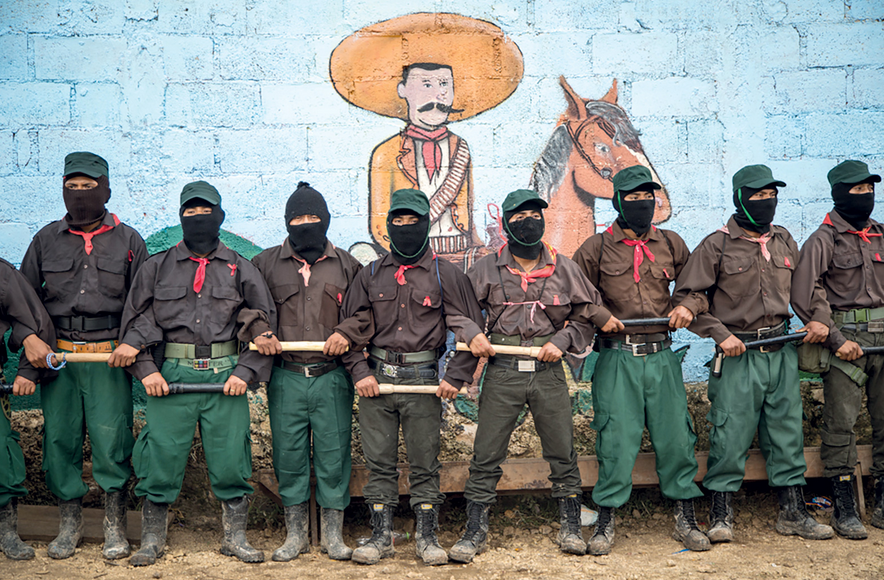
The “¡Ya basta!” (Enough is enough!) launched by the EZLN on January 1st, 1994, resonated throughout the world. And rightly so: the uprising of thousands of Zapatista Maya people, challenging neoliberal integration, the end of history, and the unipolar world, represented a turning point in the history of Mexico, of Indigenous peoples, and of the planet. Invited to this dream, many writers, artists, and public figures traveled to Zapatista Chiapas; men, women, and otroas — as the Zapatistas call gender and sexual minorities — who wished to meet firsthand the peoples at the heart of such an important rebellion. “I am a communist, but in Mexico I am a Zapatista,” José Saramago used to say. “There are many of us Zapatistas everywhere, even if we don’t know it,” Eduardo Galeano affirmed. “Instinctively, I know I must defend this cause, because sometimes there are living conditions that force people to rebel,” said Danielle Mitterrand. And Mario Benedetti added: “I have great sympathy for the Zapatista cause. I also think it is an extraordinary guerrilla movement, because it is the only one in Latin America that has handled things with a sense of reality.” Gabriel García Márquez, John Berger, Juan Gelman, and Elena Poniatowska, to mention just a few famous authors, exchanged correspondence with the insurgent Subcomandante Marcos or interviewed him. Manuel Vázquez Montalbán wrote ‘’Marcos: The Lord of Mirrors.’’ The list grew with the years and the change of generations.
Something similar happened in music. Manu Chao toured Zapatista communities and then sang about and told the story of the rebellion in Mexico. Óscar Chávez, extended his song and embrace of solidarity with the EZLN. Rage Against the Machine composed “Zapata’s Blood,” Ska-P denounced the counterinsurgency with “Paramilitar,” and Todos Tus Muertos featured a Zapatista wearing a sombrero on the cover of their album Subversiones (1996). León Gieco composed and performed “El Sr. Durito y yo” (Mr. Durito and I), a song dedicated to the Zapatista beetle and the greatest knight-errant. The student movement in Mexico City relied on massive concerts to organize and spread the Zapatista cause. Bands like Maldita Vecindad, Santa Sabina, Panteón Rococó, and Tijuana No included songs alluding to the insurgent peoples in their repertoires. As in the world of literature, the list was renewed with Joaquín Sabina, Amparanoia, Fermín Muguruza, León Chávez Teixeiro, Nina Galindo, Leticia Servín, Lengualerta, Paco Barrios “El Mastuerzo,” and many more.
Since its public emergence in 1994 and throughout almost thirty years, the EZLN has been the subject of numerous investigations. In the catalog of the General Directorate of Libraries of the National Autonomous University of Mexico, for example, the acronym EZLN yields 4,326 results, including theses, books, news articles, videos, reports, interviews, etc., while the same search on Google Scholar returns 32,400 results. Among these texts are investigations by Mexican state intelligence agencies, which, directly or through other actors, have disseminated adverse or defamatory information against the EZLN. From the early years, this information became a source for certain sectors of public opinion that have sought to undermine the legitimacy of Zapatismo on several occasions.
An essential way to delve into neo-Zapatismo (and one that is often overlooked) is to examine the materials the Zapatistas themselves have produced as theoretical reflections on their own activities, as well as their analyses of the global situation. They have generated thousands of public documents, many of which are housed in the historical archive of the Enlace Zapatista website. Undoubtedly, the six Declarations of the Lacandon Jungle are necessary to situate the EZLN historically and politically. The first was published on January 1st, 1994, and was a declaration of war against the Mexican Federal Army and the government of Carlos Salinas de Gortari. It is a fundamental document in Mexican history and offers a glimpse into the struggles of the people at the bottom, those who were never included in official history: “We are the product of five hundred years of struggle,” the rebel Zapatista Maya declared.
One collection for understanding at least the first seven years of Zapatismo is ‘’EZLN. Documents and Communiqués’’, published in five volumes by Era Publishers, compiled many of the texts produced between January 1st, 1994, and April 2001. These collections also include prologues, interviews, and chronicles by authors such as Carlos Monsiváis, Julio Scherer García, Antonio García de León, and Elena Poniatowska.
Among the communiqués, pronouncements, letters, declarations, and initiatives drafted by Subcomandante Marcos, a series of fantastical characters appeared who, in addition to aiding our immersion in the Zapatista Maya world, served a pedagogical function. Don Durito de la Lacandona, the pipe-smoking beetle who gives discourses on neoliberalism, captivated Nobel laureate José Saramago. Thousands of people became politically aware of Old Antonio, that wise man who helped the mestizo world understand the rebel peoples. With La Magdalena and Elías Contreras, the Zapatista spokesperson invited us to reflect on the loves of gender and sexual dissidents. Thus, dozens of characters from a fantastical world—which is also a real world—became indispensable for learning about the EZLN: Gato-Perro, the warrior Sombra, the horse Choco, the Zapatista girl Esperanza, Pedrito, Defensa Zapatista, Calamidad…
In 2001, the political class canceled the possibility of a profound constitutional reform that, by incorporating the San Andrés Sakamch’en de los Pobres Accords, would have paved the way for rebuilding the relationship between Indigenous peoples and the Mexican state. Consequently, the Zapatistas decided to continue their resistance and rebellion without expecting anything from the real and formal powers of Mexico. Thus, they set about advancing the practical construction of their autonomy, which in 2003 was reflected in the creation of the Zapatista Caracoles and the Good Government Councils, the territorial and administrative forms of linking the network of Zapatista Autonomous Rebel Municipalities and their Municipal Councils. In the Sixth Declaration of the Lacandon Jungle (dated June, 2005), the EZLN defined itself as an anti-capitalist force and issued a call to organize with other collectives of the same orientation.
In 2013, ten years after the creation of the Caracoles, the call for applications was launched for the first level of the course “Freedom According to the Zapatistas,” popularly known as the Zapatista Little School. In this course, the Zapatista support bases shared “their thoughts and actions regarding freedom according to Zapatismo, their successes, their mistakes, their problems, their solutions, their progress, what is stalled, and what is still lacking, because there is always something missing.” For that occasion, they presented four books called by the students “Zapatista Little School Notebooks”: Autonomous Resistance, Autonomous Government I, Autonomous Government II, and Women’s Participation in Autonomous Government. These are fundamental materials for understanding how autonomy works and its challenges, problems, and solutions; they are testimonies from those who sustain this process day after day.
In May 2015, the seminar “Critical Thinking in the Face of the Capitalist Hydra” was held at the Caracol of Oventic. Participants included Immanuel Wallerstein, Michael Löwy, Silvia Federici, Pablo González Casanova, Fernanda Navarro, Adolfo Gilly, Juan Villoro, Sergio Rodríguez Lazcano, Rosa Albina Garavito, Óscar Chávez, Alicia Castellanos, Gilberto López y Rivas, Sylvia Marcos, and Márgara Millán, among many others, who attended in person or submitted their writings. The new official spokesperson for the EZLN, Subcomandante Insurgente Moisés, gave a series of lectures on “Political Economy: A View from the Zapatista Communities” and “Zapatista Resistance and Rebellion.” Subcomandante Insurgente Galeano, who emerged after the ‘’death’’ of Subcomandante Marcos, spoke about how the Zapatista communities view the capitalist hydra. The commanders Miriam, Rosalinda, and Dalia, along with support base Lizbeth and listener Selena, traced the genealogy of the Zapatista women’s struggle. All of these texts, fundamental to understanding Zapatista theory, were compiled in the book ‘’Critical Thought in the Face of the Capitalist Hydra’’, Volume I.
In this concise selection of documents, three others are essential. First, the ‘’Revolutionary Women’s Law’’, which has charted a new course in the struggles of women in Mexico and around the world. Second, the communiqué “Between Light and Shadow,” released after the assassination of Zapatista teacher Galeano, which explains, among other things, how the Zapatistas decided to create and maintain the character of Marcos; it also announces the death of Subcomandante Marcos and the birth of Insurgent Subcomandante Galeano. This is a gesture of rebellious memory that unearths its dead to continue fighting; never forget, never forgive. The third is the ‘’Declaration for Life’’, signed by thousands of people around the world, which also serves to communicate the Zapatistas’ journey across the globe: the Journey for Life.
I would add one more book: the compilation of texts by the late Subcomandante Marcos, ‘’Writings on War and Political Economy’’ (2017), edited by Sergio Rodríguez Lascano. It contains theoretical reflections on war and political economy, and the importance of this relationship in shaping the world today. This volume demonstrates the maturity and theoretical rigor of the Zapatistas, their global reach, and the scope of their information and analysis network, which undoubtedly has a presence in much of the world.
The Zapatistas not only reflect on their own practice, contributing concepts, theses, hypotheses, and images to understand the world, but they also engage in theoretical reflection on theory itself. As Subcomandante Marcos wrote in 2003: “Theoretical reflection on theory is called ‘metatheory.’ The Zapatistas’ metatheory is our practice.” Zapatista theory and metatheory are built upon their political praxis. They seek to transform the world. The old mole constantly rears its head.
Postscript
Among the epistolary exchanges that Subcomandante Marcos established with hundreds of people, his correspondence with the philosopher Luis Villoro stands out, particularly the letters on ethics and politics that were compiled in ‘’The Alternative: Perspectives and Possibilities of Change’’ (Luis Villoro, 2015). Also noteworthy are the works of Paulina Fernández, ‘’Zapatista Autonomous Justice’’. ‘’The Tseltal Jungle Zone’’, or the books by Márgara Millán and Sylvia Marcos on Zapatista women, and those by Bruno Baronnet and Lía Pinheiro on Zapatista education. The reflections of Pablo González Casanova, Adolfo Gilly, Fernanda Navarro, Andrés Aubry, and Immanuel Wallerstein hold a special place. Gilberto López y Rivas, Alicia Castellanos, Juan Villoro, Luis Hernández Navarro, Magdalena Gómez, Mariana Mora, and many others have also written valuable essays. It must be emphasized that the struggle of the Zapatista peoples is a living dream, a text that is constantly being rewritten and still has many chapters to be written, but which is already a classic in the history of grassroots struggles.
Original article by Raúl Romero, Revista de la Universidad de México, December, 2023.
Translated by Schools for Chiapas.