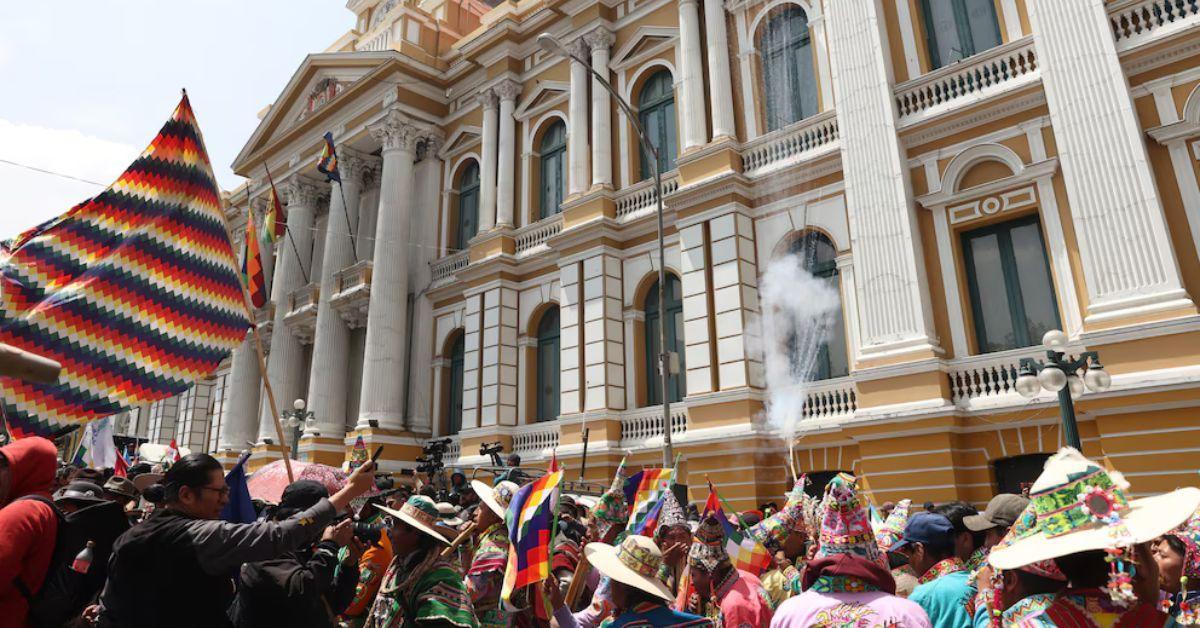
The streets of Bolivia’s largest cities, La Paz and Santa Cruz, were brought to a standstill on Friday as public transportation workers went on strike against a 100% fuel price increase ordered by the new far right government in power.
The Bolivian Workers’ Central (COB), the country’s main labor union, confirmed on Sunday that it will maintain the national strike called for Monday againstDecree 5503, which eliminates the fuel subsidy that has been in place for more than two decades.
The decision comes despite partial agreements reached by the government with other local and national organizations to avert the protest movements rise.
“We will not back down; we will not negotiate without the consent of our people,” stated Mario Argollo, executive secretary of the COB, in a recorded message alongside other union leaders.
The leader rejected claims of an alleged “unilateral and secret” pact with the government and reaffirmed that marches and blockades would begin early Monday morning.
Argollo described the decree as an “arbitrary” measure that, in his view, benefits “a privileged, business, and bourgeois sector.” In this context, he called on various organizations to join the protest and asserted that the mobilization is not merely political but a demonstration of demands for the populace.
The strike was initially called on Friday by the Bolivian Confederation of Drivers’ Unions as a “general and indefinite” strike to demand the annulment of Decree 5503. The COB (Bolivian Workers’ Central) and coca-growing farmers aligned with former president Evo Morales joined the action.
Decree 5503, issued on Wednesday, sets new fuel prices: 6.96 bolivianos per litre for regular gasoline, 11 bolivianos for premium gasoline, and 9.80 bolivianos for diesel. This represents an 86% increase in gas prices and a 162% increase in diesel prices compared with subsidised prices that had been in effect for more than 20 years.
The ratification of the strike by the Bolivian Workers’ Central leaves the government facing a scenario of high social conflict at the start of the week, with questions over how severely the blockades will affect supply and economic activity. The movement may succeed in forcing back the repressive regime and gain new momentum for the left.