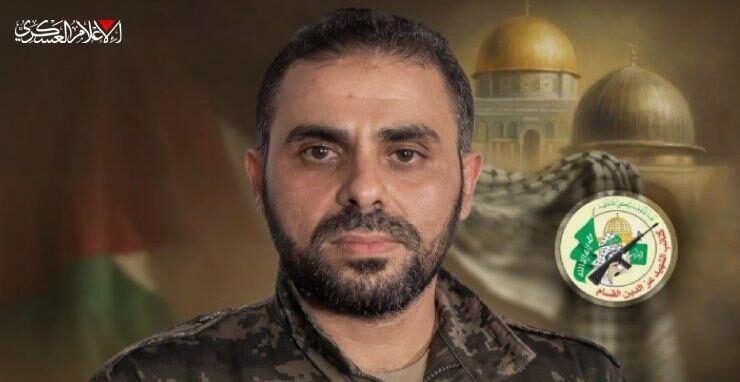
He conveyed the message of the resistance in his red kuffiyeh for many years. He announced the good news of famous operations, promising the prisoners their awaited freedom, a promise fulfilled by the grace of Allah. He also conveyed the developments of the battlefield to the world, exposed the criminality of the enemy’s leaders and soldiers, and established the proof for the Arab and Islamic nation.
He is the great martyr commander Hudhayfa Samir Abdullah Al-Kahlout “Abu Ibrahim,” the spokesman for the Al-Qassam Brigades, known as “Abu Obeida,” the roaring voice of the nation, the man of the word and the stance, and the pulse of Palestine, its Al-Quds, its people, and its resistance fighters. This knight, who was never cut off from his people in the darkest circumstances, addressed them from the heart of the battle, bringing them good news, patience, and consolation. The audience of the enemy often waited for him even before the sons of his own people, to hear from him the decisive speech and the certain news.
A Quranic Upbringing
Our martyr commander was born in the Kingdom of Saudi Arabia on February 11, 1985, into a conservative and committed Palestinian family whose origins trace back to the village of Na’aliya, whose people were displaced by the zionist enemy during the war of 1948. After returning from Saudi Arabia, his family settled in the Jabalia refugee camp in the northern Gaza Strip.
He was known from a young age for his intelligence and quick wit, enabling him to memorize the entire Holy Quran at a tender age. His parents raised him, like his brothers, to love religion and Jihad for the sake of Allah.
Hudhayfa excelled in his early studies, obtaining a grade of distinction in his high school certificate, which qualified him to study in scientific colleges. However, he chose to study Sharia knowledge, enrolling in the Faculty of Sharia at the Islamic University of Gaza, from which he graduated with distinction.
He did not stop at a bachelor’s degree but continued his studies to obtain a master’s degree from the Faculty of Fundamentals of Religion at the Islamic University of Gaza. His thesis was titled “The Holy Land between Judaism, Christianity, and Islam.” He then applied for a doctoral program at more than one university outside Palestine, but his work circumstances and the siege on Gaza prevented him from pursuing his PhD.
A Unique Personality
Our martyr commander was dutiful to his parents and maintained his kinship ties. He married in 2005 and formed a committed, believing family. He loved his wife and children, cared for them, and was keen on raising them well, until most of them memorized the Book of Allah. His personality was characterized by unique qualities; he was known as a divine, Quranic man, a person of religion and morals. Allah granted him wisdom and insight, so it was as if he saw with the light of Allah.
Everyone who dealt with him and knew him closely testified that he was humble, tactful, shy, and possessed of great politeness and high morals. He was also forgiving, loyal, and affectionate towards his brothers, sincere in his feelings, and carried the concerns of others, including his neighbors, loved ones, and friends. He was also known for his cheerful face and light-heartedness despite his high seriousness and great burdens, all in addition to the beauty of his appearance and the splendor of his presence.
Our martyr Hudhayfa excelled in the Arabic language and was distinguished by rhetoric and eloquence from a young age. He loved poetry and wrote literature, accompanied by the beauty of his voice in reciting the Holy Quran and Islamic anthems (Nasheed).
He was a sheikh, a preacher, and an educator, and at the same time a fighter in the field among his brothers, keen to be in the front lines of Jihad and not to miss nights of Ribat (guard duty) on the frontiers. He was proud of his Islamic and Palestinian identity, considering the issue of Al-Aqsa and the Night Journey (Isra’) as a matter of doctrine. He was also an educated reader in various fields, including the experiences of peoples and nations, their revolutions against injustice, and their march toward liberation from occupation.
In the Ranks of Hamas and Al-Qassam
Our martyr commander joined the ranks of the Hamas movement in his early youth, coinciding with the outbreak of the Al-Aqsa Intifada. He grew up in the mosque and then raised dozens of young men at his hands, instilling in them solid doctrine, understanding, awareness, and love for religion, the homeland, and Jihad for the sake of Allah. His qualities qualified him to hold many jihadist, organizational, security, and preaching positions within the Hamas movement, rising through its ranks, which brought him close to the first tier within the movement and the Al-Qassam Brigades.
He soon joined the ranks of Al-Qassam and proved his merit, rising through many jihadist positions to become a field commander. He participated in many field activities and combat specializations and was involved in confronting zionist incursions into the northern Gaza Strip. He was also an active Mujahid in the artillery corps of the Northern Brigade and participated in shelling occupation sites, in addition to accompanying a number of martyrdom-seekers in their final moments.
Abu Obeida
In 2004, Abu Ibrahim joined the Military Media apparatus, which was then in its beginnings, and became a spokesman for the Al-Qassam Brigades. His first appearance was in Jabalia camp during the “Days of Wrath” battle in October 2004.
Over the course of 20 years, until the moments of his martyrdom, “Abu Ibrahim” remained a spokesman for Al-Qassam. During this journey, he was in direct contact with many founding leaders, foremost among them the martyr leaders Abu Muhammad al-Jaabari, Marwan Issa, and others. He was also close to and favored by the great martyr of the nation, Mohammed Deif “Abu Khaled.” He worked with hundreds of fighters, leaders, and martyrs who accompanied him on the path of jihad and resistance. For two decades, with his strong presence and truthful words, he formed an icon for free people and a nightmare for the occupation.
The commander rose in media work, initially specializing in drafting military statements, statistics of martyrs, and military operations. He led psychological operations directed at both friend and foe, later assuming the position of Deputy Commander of Military Media.
In 2017, he assumed command of the Military Media Department until the day of his martyrdom. He had clear fingerprints in advancing the Al-Qassam media system, leading the Military Media Department with his brothers with merit and competence. They worked to instill awareness, faith, belonging, and conviction in the role and importance of media within the corridors, components, and levels of the military apparatus. This was reflected in the performance of Al-Qassam’s media, as they translated this practically and on the ground in all battles with the occupation—the latest chapter of which was the Battle of Al-Aqsa Flood and the distinguished performance of the military media components within it. Our martyr commander was at the forefront as a soldier, a commander, and a spokesman.
The Discourse of Revolution and the Word of Resistance
Through the persona of the masked man in the red keffiyeh, our martyr commander established an authentic symbolism for the state of resistance and the Palestinian revolution and its sacred right to defend its people and land. His appearance in that keffiyeh and the Al-Qassam headband represented an extension of the path of the martyr fighter leaders such as Imad Aqil, Yahya Ayyash, and others, continuing their path of holy Jihad, and expressing deep pride in our Palestinian identity and our cultural and historical heritage.
He was able to formulate speeches in a unique and balanced language, building intelligently on the directives, determinants, and ideas of his leadership. His words gained the acceptance and passion of the Palestinian masses wherever they were, and the support of the sincere sons of the Arab and Islamic nation and the free people of the world. His language was a light and a guide to the path of glory and dignity, and a fire that enraged enemies and hypocrites.
The discourse of “Abu Obeida” stemmed from Islamic doctrinal pillars and religious, historical, humanitarian, and legal foundations, addressing the origin of the conflict with the zionists on the land of Palestine, exposing their corruption and criminality, and the complicity of major world powers that supported this usurping entity at the expense of Palestinian rights and criminalized its valiant resistance.
His discourse was characterized by constant emphasis on the unity of the Palestinian rank, bringing together the factions of resistance work and the sons of our people of all spectrums and orientations, reinforcing national constants and central issues, foremost among them Al-Quds and the prisoners.
In every speech, the military spokesman documented important pillars for the fighters of Palestine on various levels. His words carried confidence and steadfastness, as his strong voice was linked to the glories of our people and the heroism of their resistance. Through his masterful performance, he demonstrated the strength and vigor of the resistance, and exposed the humiliation and brokenness of the zionist enemy and the fragility of its entity, often spreading terror among its internal public and army.
His speech was mixed with feelings of love, emotion, and loyalty to our patient and steadfast people. He always instilled hope in their hearts, offering praise and support, so his speech enjoyed the trust and deep respect of our people, and his roaring voice was a source of hope for the oppressed.
In the face of the zionist enemy’s lies, the discourse of “Abu Obeida” became an undeniable reference. The enemy’s media would publish it as the most truthful source, thereby belying the narrative of their zionist leaders. Thus, the narrative of the Palestinian resistance was strengthened in the consciousness of the enemy’s public, who began waiting for Al-Qassam’s announcements to document facts and verify the news. The enemy’s public often relied on his instructions to determine their steps in emerging from shelters and knowing the developments of the battle.
The commander and his family suffered for years from the woes of pursuit, persecution, and direct targeting by the occupation and its agents, just like all the leaders and resistors of our people. This did not deter him from his main and prominent role in all stations of Jihad, and his family offered hundreds of martyrs, wounded, and prisoners on the path of glory and dignity.
He lived through the suffering, pain, displacement, and hunger with his people, like other fighters and leaders of our people, which increased his closeness to hearts and acceptance in the souls of his grieving people.
He was subjected to several assassination attempts during the Battle of Al-Aqsa Flood, from which Allah saved him. They did not deter him from continuing his jihadist role, and despite this, he insisted on appearing in periodic speeches to address his people and the masses of his nation and to deliver the voice of the resistance from inside the battlefield.
The Departure of the Leader
Our martyr commander dismounted after two decades of enraging the enemies and soothing the hearts of the believers, meeting Allah in the best state. And what sign is more indicative of truthfulness with Allah than for Allah to raise his mention among the worlds and grant him acceptance on earth?
He departed after leading the Al-Qassam media apparatus with all competence, recording with his brothers what both friend and foe saw of honorable performance. He conveyed to the world the events of the Al-Qassam Flood in their most splendid forms, and the heroism of the fighters of Gaza that astounded the world and enraged the enemies.
Our martyr commander Hudhayfa Al-Kahlout ascended following a cowardly assassination operation on August 30, 2025, accompanied by his wife and children Layan, Minnatullah, and Yaman, after a jihadist journey full of great achievements that accumulated and formed a consciousness and firm certainty in the minds of our people and future generations regarding the correctness of the choice of jihad and resistance, and that the occupation is vanishing, and that victory is our ally by Allah’s permission and His true promise.
He was absent from this world, leaving behind a great media legacy, a solid structure, and a skillful work system containing hundreds of sincere media fighters that relies on institutionalism, where a commander is succeeded by commanders, Allah willing.
Peace be upon you, our martyr, among the immortals. We pledge to continue the path.