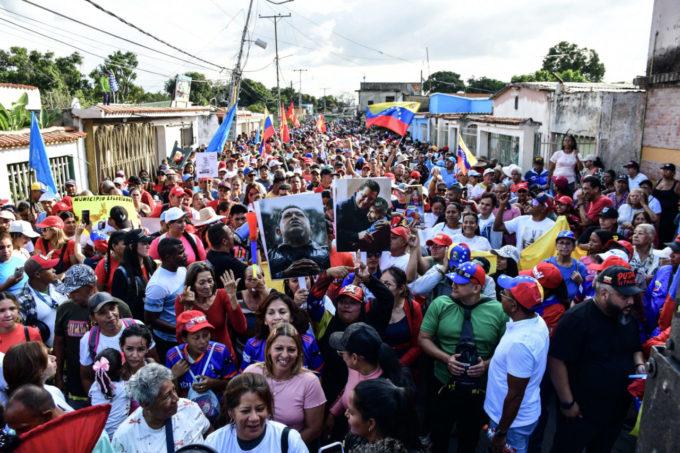
Popular mobilization and food production are the foundation of Venezuelan communes after the kidnapping of Nicolás Maduro.
Ten days after the US bombing of Venezuela, the country’s communes gained even more prominence within the political process that Chavismo calls the Bolivarian Revolution. Even after an attack that shook Latin America, the communes continued working under the principles that formed the basis of this new social structure: food production, popular mobilization, and the preservation of the ideology that seeks to transform the Venezuelan political system.
Characterized by self-management, the communes are spaces where some of former President Hugo Chávez’s main ideas for a national project with participatory democracy and the direct involvement of the population in solving the problems of life in society are developed.
In recent years, the communes have become the epicenter of Chavismo in Venezuela and, after the US attacks, have proven to be an essential element of Venezuelan society, primarily for supplying the country’s markets.
Since the attack on Caracas, the communes have not wavered and have maintained food production. The Venezuelan government is proud that 97% of the food produced in the country is domestically produced. And a significant portion of that amount is the responsibility of the communes, especially the rural ones.
Although precise data on production is lacking, Venezuelan communes have grown since the formalization of this process in 2010 and have begun to receive investment and autonomy to plant and harvest various foods. Coffee, for example, is produced mainly in the communes. Corn, rice, beans, vegetables, and fruits also have a large share of communal production.
The moral and productive reserve of the communes became even more evident after the US attacks. Anaís Márquez, spokesperson for the March 5th Commune, states that the bombings represented an attack on Venezuela’s morale and that this hinders their work, but that the communes are an important part of the Venezuelan resistance.
“Despite what happened, the work in the communes continues. We are resuming communal assemblies and productive work. Undoubtedly, we were morally affected, and continuing to work in this context is more difficult because morale is low. We need to see what strategies to use to move forward, how to reorganize the territory in light of what happened. All of this needs to be discussed, but production continues,” she told Brasil de Fato.
According to the government, Venezuela has 5,336 active communes that occupy approximately 90% of the national territory. These communes have transformed the country’s productive structure, since, although large companies are still responsible for a significant portion of Venezuelan production, the government’s focus has shifted toward family farming and small producers.
Hernán Vargas, Vice-Rector of the University of the Communes, affirms that the communes restructured the Venezuelan economy and placed collective organization at the center of the formation of an alternative mode of production.
“It is vital to strengthen this structure as a key element at this time and to have a central structure for productive development. Production has increased in the country, and the communes are fundamental. The communal mode of production has strengthened the mechanisms of distribution, self-management, production, the production chain, and a logic of production based on use value, not centered on market exchange value, but on guaranteeing what the country needs,” he told Brasil de Fato.
The communes were institutionalized in the Organic Law of Communes, created in 2010 during Hugo Chávez’s government. Over the past 14 years, the comuneros have witnessed abrupt changes in Venezuelan society, from attempted coups to the implementation of US sanctions in 2015 against the Venezuelan economy, which undermined the state’s capacity to invest in various sectors.
Following the US attacks, the comuneros understand that the role of the communes in building the Venezuelan state has become even more evident, especially as spaces for preserving Chavismo and a political line that has socialism as its cornerstone.
Anais affirms that one of the communes’ responsibilities is also to politically educate their members, especially those who are not directly involved in national politics or who oppose Chavismo.
“We resisted and built the state in Venezuela, even without our president. The communes are the political resistance to build a new state whose purpose is the end of capitalism. We must continue to be the political and ideological resistance so that the Venezuelan project does not collapse and continue raising awareness and educating our people so that they understand what socialism means in Venezuela,” she stated.
The challenges faced by the Venezuelan government as a result of the blockade were also reflected in the relationship between the communes and the Venezuelan political and economic process, and these spaces acquired greater political prominence. One of these forms of change was income redistribution.
Communal councils began to participate directly in the allocation of resources for projects in their territories through popular consultations. This tool brought Venezuela closer to Chávez’s goal of a grassroots state administration, where the decisions of the communal councils would carry weight in collective decision-making.
Vargas understands that this process stimulated wealth distribution in the country based on a “new conception of democracy” that places the commune at the center of a new political system.
All of this translated into popular mobilizations in defense of Nicolás Maduro and First Lady Cilia Flores, who were kidnapped by the United States on the first Saturday of the year. The marches of the comuneros also demanded an end to US interference in Venezuela and the defense of national sovereignty.
A large portion of oil revenues was allocated directly to the consultations. The entire population votes, and the decisions are implemented by the commune itself. All of this has resulted in a very high level of politicization. The communes are a front in the struggle in all areas: economic, security, and political mobilization. The result of this is the street mobilizations, during one of the most tense moments in our history, Vargas said.
By Lorenzo Santiago /Brasil de Fato / Resumen Latinoamericano, 12 January 2026.