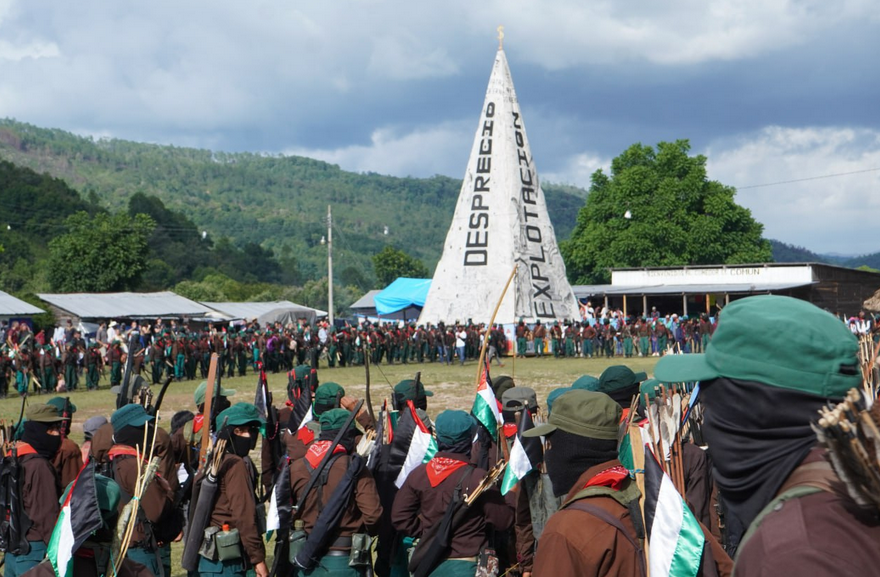
“Now I’m going to tell you what I’ve seen in the last 12-13 years. It was in 2013 that it became public knowledge that command and spokesperson roles were being transferred to Sub-commander Moisés. But it was on December 21st, 2012, the day the world was supposed to end, that it was finalized. What Sub-commander Marcos told Sub-commander Moisés was, among many other things: of all the things you have to do, the first is to find your replacement. In the pyramid of an army, from the top or the bottom, the custom is that the commander chooses the second in command, and that person is the one who takes over if the first in command is absent.
What Sub-commander Moisés did was not choose a second in command, but rather truncate the EZLN pyramid. That’s what I’ve seen. He didn’t look for one replacement, but many. Then he began to broaden the consultation, the discussion; he started by involving the Clandestine Revolutionary Indigenous Committee more, that is, the commanders. The discussions for each step that were taken were held in consultation with the communities, then he invited others, and then others. And now these meetings that are called inter-zone are a nightmare; there are more of them than there are people here.”
Captain Marcos
These were some of the words of Captain Marcos, spoken at the “Of Pyramids, Histories, Loves and, of course, Heartbreaks” encounter at CIDECI, between December 26th and 30th. Some of us were perplexed, especially considering the history of revolutionary movements around the world, for whom the pyramid was a matter of principle.
How is it possible that Zapatismo has dismantled nothing less than the military pyramid, something sacred in any theory and practice of war and revolution?
The first thing to note is that Zapatismo does not adhere to previous theories and practices. But how could it be otherwise, if one of its defining characteristics is rebellion? To be rebellious against capitalism and governments but not at home would be a tremendous contradiction. To be rebellious implies not submitting to traditions, even revolutionary ones.
Lenin was completely unorthodox compared to Marx, who asserted that the revolution would first occur in the most developed capitalist countries, such as Germany, because the “objective conditions” for socialism had matured there. On the contrary, Lenin had no doubt that Tsarist Russia was the weakest link in the system, and he placed his trust in the workers and (partially) in the peasants as forces capable of driving the revolution.
Mao was unorthodox compared to Lenin and the Bolsheviks, who relied on the insurrection of urban workers in the large factories, as had happened in Moscow and St. Petersburg. The Third International promoted the revolutionary struggle of the workers in China, although all attempts failed, which led Mao to place his trust in the peasantry (80% of the population) as the driving force of the revolution. For Marx and Lenin, the peasantry represented backwardness, while the workers were modernity and embodied the possibility of socialism.
Heterodoxy, the opposite of orthodoxy, is a necessary condition, since the realities of each part of the world reveal different characteristics and approaches. Therefore, what has happened elsewhere cannot be repeated, and it is always necessary to create new approaches. Creation is a precondition for changing the world, while repetition is almost a recipe for failure.
In Latin America, copying what has happened elsewhere has always yielded poor results. A century ago, communists argued that it was necessary to fight against Latin American “feudalism,” and thus promoted a democratic revolution in alliance with sectors of the bourgeoisie. But this continent never had feudalism, as it did in Europe, and this was one of the debates between the new revolutionary left and the communist current in the 1960s and 1970s. Similarly, the protracted people’s war formulated by Mao is not necessarily applicable to each and every one of our countries, as if it were some kind of religion. In countries with small rural populations, without traditions of peasant revolts or wars, people’s war makes no sense whatsoever. Attempting protracted people’s war where the conditions for it do not exist has led not only to failures but also to repressions that the people paid for.
Secondly, every military structure has a unified, permanent, and stable command, often reduced to a single person: the commander-in-chief. In this respect, revolutions have copied the logic of traditional armies, which always function like a pyramid. Whoever is at the top of the pyramid gives orders without consulting others, and mistakes are often made that lead to horrors. In many cases, this behavior is explained by security concerns, which are prioritized over the participation of many people in decision-making.
Zapatismo has long consulted with its support bases on the decisions it makes. But this is something else entirely, something much deeper.
Thirdly, and centrally, are the paths the EZLN is taking. Captain Marcos said, “More and more people are participating until the moment comes when it will be equal.” He was referring to the participation of many people in military decision-making.
My personal interpretation, and of course I could be wrong, is that we are facing something completely new in the world of anti-capitalist struggle. Flattening the military pyramid means that decisions are no longer in the hands of “experts,” but increasingly in the hands of the people. Isn’t this a profound revolution and a path never before trodden?
If, as Sub-commanderMoisés said in Oventik on December 31st, we Zapatistas “are light and a mirror,” then it is up to us to look at ourselves and decide what we are going to do, in addition to respecting and admiring them.
Original article by Raúl Zibechi, Desinformémonos, January 12th, 2026.
Translated by Schools for Chiapas.