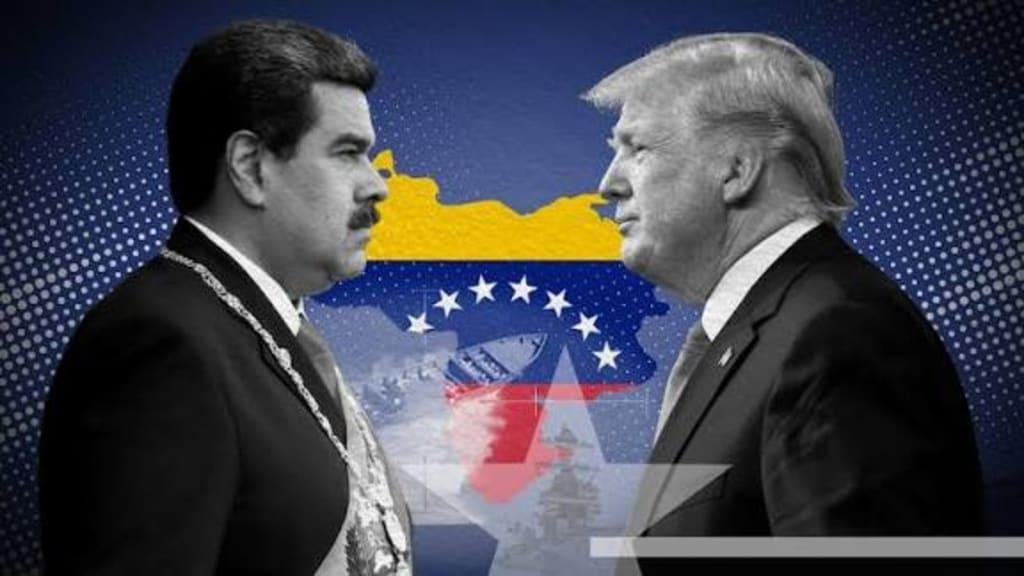
Recent events surrounding Venezuela cannot be explained simply in terms of “diplomatic pressure” or “internal political differences.” What is happening today is the escalation of a large-scale imperialist project that has gone beyond severe economic sanctions to include the confiscation of oil tankers, drone attacks, limited military operations and the open threat of direct intervention.
This represents a clear return by the United States to the logic of the Monroe Doctrine and the reestablishment of the “backyard” in the Western Hemisphere. In such circumstances, any theoretical ambiguity, suspension of positions or political “neutrality” is not simply an analytical error, but a political action with objective consequences; an action that can – consciously or unconsciously – serve the project of aggression.
Venezuela has once again become a scenario where unmasked imperialism exhibits its true logic: economic pressure to break society, a dependent opposition to legitimize itself politically, and military threats to impose the supreme will. What is happening today against this country is neither an “internal crisis” nor a purely political conflict, but rather an organized effort to break national sovereignty and restore a servile order in the Western Hemisphere.
In such circumstances, the issue is not just the conduct of the United States or the role of the dependent opposition; the main issue is the historical proof of the forces that consider themselves anti-imperialist and leftist. There are moments when ambiguity, suspense and abstract dualism end in favor of the aggressor. Venezuela today is one of those moments.
Sanctions, piracy and low-cost war
The seizure of oil tankers carrying millions of liters of crude oil, attacks on vessels in nearby waters and the death of dozens of people are components of a hybrid war: a war that is fought without an official declaration, but with real and bloody results. Economic sanctions, which have subjected the Venezuelan people to severe economic pressure for years, are precisely the complement to this strategy: weakening society from within to prepare the ground for political collapse or military intervention.
The condemnation of these actions by countries and global public opinion, from Latin America to Asia, demonstrates that this is not a “political disagreement”, but rather an attack on the principle of national sovereignty and international law. However, the United States has clearly demonstrated that global public opinion and government protests have the least weight in its calculations.
Dependent opposition and legitimation of aggression
One of the most dangerous components of the Venezuelan crisis is not only external pressure, but the active role of a sector of the national opposition in paving the way for imperialist aggression. At the head of this movement is a figure who can no longer simply be called a “government critic” or an “opposition activist”: María Corina Machado.
Machado has publicly and repeatedly asked the United States:
—Intensify sanctions against Venezuela;
—Confiscate the country’s assets;
—And even keep the option of direct military intervention on the table.
These positions, in a context of economic siege, military threat and direct attacks, no longer constitute “political dissidence” or “democratic struggle”; They are rather a formal request for collective punishment of a nation and an open invitation to foreign aggression. In contemporary political history, there are few examples of an opposition that has so openly positioned itself as a strategic partner of an imperialist power.
Granting international awards and official platforms to such a figure is part of the same project of legitimizing aggression: turning the agent of foreign pressure into a “hero of human rights” and the victim of sanctions and economic war into “responsible for the crisis.”
This mechanism was previously used in Libya and Syria, and its disastrous consequences for the population of these countries are evident. In this context, the affiliated opposition is not a marginal actor, but rather part of the architecture of the hybrid war against Venezuela; an architecture without which sanctions, confiscations and military threats would not have proceeded so recklessly.
Popular resistance and the question of the State
Faced with these threats, the Venezuelan Government – despite all the criticism of its policies and actions –, as the only official and legal structure available to the people, has been forced to organize defense: popular mobilization, local militias and public education to counter the aggression.
At this point, it must be clear: without preserving the framework of the State and national sovereignty, sustainable popular resistance is not possible. Contemporary history has clearly demonstrated that the collapse of the state leads neither to “freedom” nor “socialism”, but to chaos, civil war, foreign intervention and the destruction of progressive forces.
The clouded left: “No to imperialism, no to the State”
In such circumstances, it was expected that the left and the communist forces, understanding the historical moment, would adopt a clear and responsible stance alongside the people and against foreign aggression. Unfortunately, the Communist Party of Venezuela and sectors of the left have chosen a path that not only does not favor resistance, but weakens it.
The slogan “Neither imperialist tutelage nor authoritarian continuity” is an abstract and misleading dualism, in a situation where imperialism acts objectively, armed and aggressively. It distorts the main contradiction and equates the main agent of violence – imperialism – with the State, which, despite all criticism, is the only existing framework for collective defense.
By adopting this position, the Venezuelan Communist Party has practically refused to:
—organize the resistance together with the people;
—defend national sovereignty against aggression;
—and play its historic role in critical moments.
This passivity is neither “class independence” nor a “principled position,” but rather a way of evading political responsibility at a time when history demands a clear position.
What is the practical result of such an approach?
Weaken the internal front, create political confusion and open space for a dependent opposition that openly positions itself on the side of the foreign enemy. In practice, these positions—even if accompanied by the mention of “imperialism”—help justify and facilitate imperialist aggression.
Historical experience has shown that a left that shies away from defending national sovereignty in the face of an external threat will lose not only the State, but also itself and its social base. Imperialism, after victory, does not need a critical left.
Responsible anti-imperialist stance
The realistic and responsible position regarding the current situation in Venezuela does not consist of the sanctification of the State or of ignoring social and class contradictions. Rather, it has a clear historical order:
—Unconditional defense of national sovereignty against foreign aggression;
—Together with the people and the organized resistance against imperialism;
—Criticism of the Government from a position of independence and within the framework of strengthening national resistance against external threats, not a criticism that, together with aggression, leads to weakening the internal front and legitimizing imperialist pressure.
Any line that alters this order, consciously or unconsciously, contributes to weakening the resistance and strengthening the imperialist project.
Final words
Venezuela today is not only a battlefield against foreign aggression; It is proof of the honesty, political maturity and historical responsibility of the global left. Faced with a people that defends its independence under the most severe sanctions, economic war and military threats, we must stand up or be practically relegated to the margins of history, taking refuge behind abstract slogans. Decisive moments are not the time to “sit on two chairs.”
source: 45 RPM