In Latin America, the history of US interventions is a continuous thread that spans two centuries. It is not a catalog of isolated episodes, but rather a persistent policy of power that combines doctrine and the use of force. From the 19th century to the present day, the region has experienced direct incursions, prolonged occupations, remotely supported coups, and “preventive” deployments that have left an indelible mark on our nations and their collective memories.
The first milestone was the war against Mexico (1846–1848). Under the delirium of Manifest Destiny, Washington developed a campaign of occupation that culminated in the Treaty of Guadalupe Hidalgo and the cession of more than a third of Mexican territory. The military victory set a political precedent for the type of hemisphere the United States sought to build.
During the Panama crisis of 1885, the United States demonstrated the hypocrisy of its commitments to “neutrality” by landing marines to secure transit and protect interests. It withdrew quickly, but the message was clear: the canal and its surroundings were a “vital interest” for the United States.
This strategic priority led to support for Panama’s separation from Colombia in 1903. The United States immediately recognized the new government that signed to establish the Canal Zone. It was a supervised independence, essential for the canal project and inseparable from the military and commercial expansion of the early 20th century.
In Nicaragua, the occupations of 1912–1925 and 1926–1933 were part of the so-called Banana Wars. The presence of marines supported friendly governments, and during the second occupation, they fought Sandino’s guerrilla forces until his assassination in 1934. The occupation left behind a military dictatorship that would last for decades.
In 1932, the United States carried out a large naval deployment off the coast of El Salvador during the insurrection led by Farabundo Martí. The repression by the Salvadoran army left tens of thousands dead. The presence of foreign ships affirmed the geopolitical equation of the time: protect investments, contain social protest, and send signals of power.
With the Cold War, the repertoire changed form. In Guatemala, the CIA promoted the overthrow of Árbenz in 1954 and shut down a reformist experiment that was uncomfortable for the United Fruit Company and anti-communist orthodoxy. In 1961, there was the failed Bay of Pigs invasion in Cuba, and in 1965, the coup against President Bosch in the Dominican Republic, with the deployment of more than 20,000 soldiers to “prevent another Cuba” and ensure a favorable outcome for Washington.
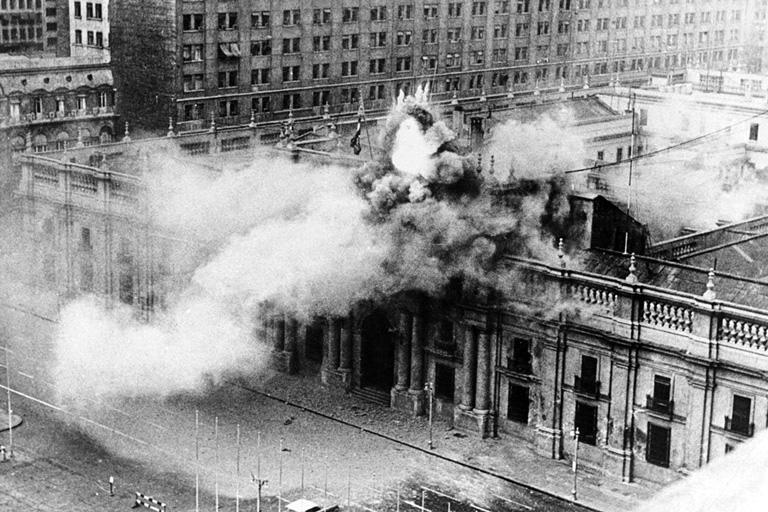
In the 1970s and 1980s, the logic of hemispheric security deepened. With Operation Condor, Washington promoted coups and military dictatorships in the Southern Cone. In Chile, it facilitated the overthrow of Allende in 1973 and the rise of Augusto Pinochet. The coups in Brazil (1964), Uruguay (1973), and Argentina (1976) had U.S. approval and assistance. In all these cases, coordination with the United States included the criminal persecution of opponents. The consolidation of authoritarian regimes, under the banner of the fight against communism, left a trail of human rights violations and forced disappearances throughout the region.
A new wave of interventions took place in response to the revolutionary struggles in Central America. In Nicaragua (1979-1990), the Reagan administration financed the Contras and opened the Iran-Contra chapter. In El Salvador (1980-1992), it provided advisors and weapons to sustain an anti-insurgency war with a very high human cost. The 1980s ended with the military occupation of Grenada (1983) and the invasion of Panama (1989) with 27,000 Marines and the capture of Noriega.
The inevitable question is what has changed. The rhetoric, yes; the use of force, less so. In addition to the classic justifications—security, stability, protection of nationals—today we have drug trafficking, “orderly transitions,” and the defense of democracy. Trump’s abusive, violent, and warmongering personal style is the focus of much of the analysis and explanations of the current intervention in Venezuela. But it must be understood that this is also part of the US tradition toward Latin America. Words matter, but actions matter more: landings, occupations, military advice, sanctions, and covert operations have defined the political territory where nation-building projects and development models are contested.
Recognizing this history is not an exercise in victimhood; it is a condition of sovereignty. Latin America has resisted, learned, and built alternatives. Memory is not for museums; it is a compass for thinking about foreign relations based on alliances, cooperation, and mutual respect. Peace and sovereignty require legitimate and determined governments, informed citizens, and a regional agenda that is not subordinate to Washington’s political cycles.
The shadow is long but not eternal. If a century and a half of interventions teaches us anything, it is that the hemisphere is not condemned to repeat its past, but to transform it.
Original text by Imanol Ordorika published by La Jornada on January 15, 2026.
Translated by Schools for Chiapas.