Puerto Rico’s remilitarization reveals the island’s colonial role in Washington’s war on Venezuela. A legacy that extends through a century of militarism, constitutional colonialism, and resistance.
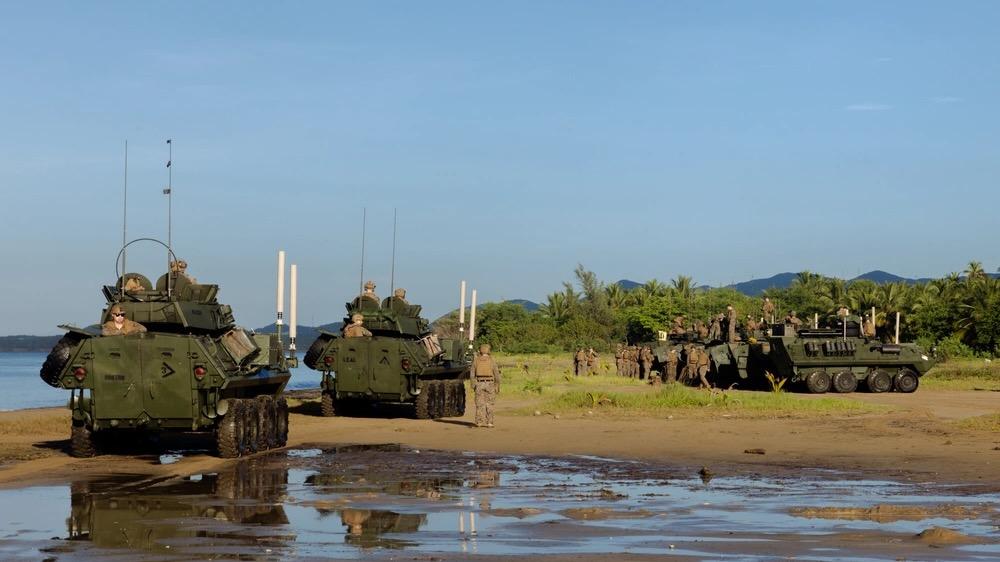
In late August 2025, residents of Arroyo and Guayanilla in Puerto Rico’s southern coast woke up to the sound of military helicopters overhead and the sight of warship silhouettes on the horizon. On August 31 (after the military buildup had already began) Puerto Rico’s Ports Authority and National Guard quietly signed an agreement with the US Navy enabling expanded use of the former Roosevelt Roads base in Ceiba, the former Ramey Air Force Base in Aguadilla, and the Muñiz Air National Guard Base in Carolina; Puerto Ricans did not learn about the agreement until after the ink was dry.
The US Navy announced the deployment as part of training exercises for Southern Command (SOUTHCOM) “regional readiness”. The reality was preparation for the siege against Venezuela and Washington’s renewed drive for hemispheric dominance under the so-called “Donroe Doctrine”. Since then, the buildup has only intensified. Across multiple points on the island (Ceiba, Aguadilla/Rafael Hernández Airport, and Ponce/Mercedita Airport) there has been a growing presence of war-fighting platforms and logistics: Marine F-35B stealth fighters, armed MQ-9 Reaper drones, MV-22B Ospreys, Navy EA-18G Growlers, and LCAC hovercraft.
Meanwhile, the broader Caribbean has been flooded with war machinery. By early November, more than a dozen warships, a nuclear submarine, F-35 stealth fighters, and 10,000 troops were already in the region; by late November, the USS Gerald R. Ford carrier strike group entered Caribbean waters. This is the largest US military buildup in the Caribbean since the October Crisis of 1962 (known in the West as the Cuban Missile Crisis).
The stated rationale has been “counter-narcotics” and “counter-narco-terrorism”. But the nakedly imperialist campaign has been marked by lethal force on a scale that has triggered legal alarm even inside Washington: since early September, US forces have carried out more than 30 strikes on alleged drug boats in the Caribbean and eastern Pacific, killing at least 110 people. The escalation has also included a widening interdiction campaign against Venezuelan oil exports: US forces have seized multiple tankers and detained crew members in undisclosed locations, while enforcing a de facto “blockade” of sanctioned vessels.
Then came the January 3, 2026 attack, when US forces struck military and civilian installations in and around Caracas and abducted President Nicolás Maduro Moros and his wife, First Combatant Cilia Flores. The bombing left at least 100 people dead, including 32 Cuban nationals who were part of Maduro’s security detail, as well as civilians. The raid relied on aircraft like the EA-18G Growlers (electronic-attack jets designed to jam enemy radar and communications) to suppress Venezuela’s air defenses. The illegal and brutal operation was met with widespread condemnation from heads-of-state around the world and has since sparked mass protests from Latin America to Asia and Africa, and even across hundreds of US cities.
Puerto Rico has been central to the offensive against Venezuela and the application of the Donroe Doctrine in the region since the buildup began, and Puerto Ricans have had no say in the matter. In just a few months, the island’s territory and infrastructure were folded into a regional war machine that moved from “readiness” drills to lethal strikes, tanker seizures, and a bombing raid on a sovereign capital. These events have laid bare Puerto Rico’s colonial status once more. Faced with the use of their home as a platform from which to attack a sister people, Puerto Ricans are reminded that no matter what our passports say, the US government regards us as it does so much of the Global South: our land is nothing but a theater of war and our bodies expendable material in wars against our brothers and sisters.
Puerto Rico’s long struggle against militarization
Today’s militarization of Puerto Rico is a return to a violent history that many Puerto Ricans fought to leave behind. Puerto Rico is an archipelago, and two of its inhabited eastern islands (Vieques and Culebra) sit out in the same waters Washington has long treated as a live-fire corridor. Vieques (population 8,249 in the 2020 census) lies about seven miles east of the main island; its name comes from the Taíno bieque, meaning “small island”. Culebra (population 1,792) lies about seventeen miles east of the main island and roughly nine miles from Vieques; its name (meaning “snake”) echoes the way the island chain curls across the sea. Together, these islands are home to immensely biodiverse ecosystems, including dry-forests, mangroves, bioluminescent lagoons, coral-fringed cays, and white sands where leatherback, hawksbill, and green sea turtles nest. Vieques is one of nine protected National Wildlife Refuges located in the Caribbean and is home to at least four endangered plant species and ten endangered animal species.
From the malecón in Esperanza in the south of Vieques, the fisherman José Silva told Puerto Rico’s Centro de Periodismo Investigativo (Center for Investigative Journalism, CPI) in November 2025 that the renewed roar of military aircraft felt like “returning to the monster of bombs” (a return to an era when the island lived under the permanent thunder of live munitions exercises). CPI reports that the revived military presence in the former Roosevelt Roads base in Ceiba (about 14 nautical miles from Vieques) has reopened old wounds that never had the chance to heal. Yamilette Meléndez, who works near the ferry dock in Esperanza, described how the sound pulled her straight back into childhood: hiding under the bed as jets passed overhead and bombs and artillery shook the walls. “All the trauma came back,” she said.
Vieques and Culebra under the gun
In 1901, the US Navy evicted residents from San Ildefonso, Culebra’s main town, to build the Culebra Naval Reservation training base. For decades, it used the island and its cays for aerial bombing, artillery fire, amphibious training, and submarine-warfare maneuvers. By 1950 it had seized 1,700 acres, while much of the civilian population had been driven out, going from 4,000 (1900) to 580. In the mid-1950s the Navy pushed for total eviction. That move was resisted by the Puerto Rican government, arguing that Commonwealth status required a popular vote to abolish the municipality. The Navy tried again in 1970 to forcibly remove the entire population; that same year, Culebra had endured directed missile fire for 228 days and live munitions fire for more than 100 days, leaving behind a cratered landscape, unexploded ordnance, and toxic waste.
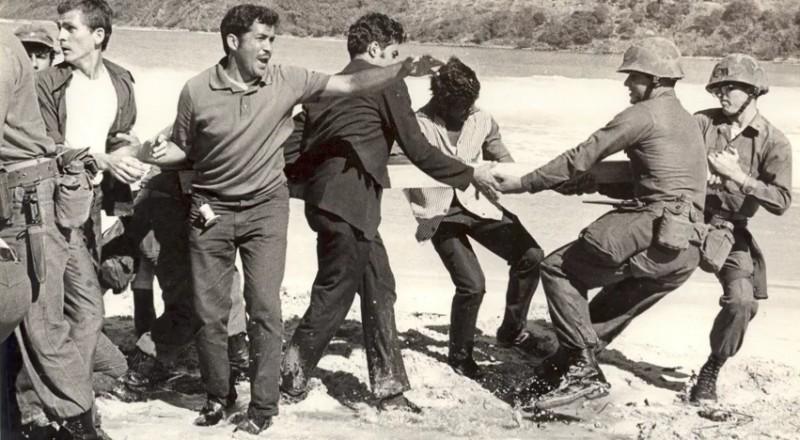
Resistance escalated into a broad, organized campaign. That year, residents demonstrated on the beaches; after a court reaffirmed the Navy’s right to use Culebra, they marched to a command post and issued an ultimatum promising direct action. The Puerto Rican Senate passed a resolution urging President Nixon to reconsider the Navy’s presence, drawing national attention and spurring congressional hearings and investigations. Protests spread to the naval base in San Juan: in June 1970, twenty Culebrans formed a human chain to block ship-to-shore missile fire, followed by a three-day encampment organized by the Puerto Rican Independence Party (Partido Independentista Puertorriqueño, PIP) that drew more than 600 people, with PIP leader Rubén Berríos Martínez pledging “pacific militancy”. In early 1971, the PIP (alongside the Rescue Culebra Committee (RCC), the Clergy Committee to Rescue Culebra, and a Quaker Action Group) built a chapel on Flamenco Beach inside the bombing range (after a church had been demolished by the military), forcing the Navy to halt exercises. The chapel was later torn down, and Berríos and thirteen others were sent to federal prison for trespassing, triggering a wider wave of solidarity: a student uprising at the University of Puerto Rico, daily vigils at the jail, demonstrations in Washington, DC, and replica chapels erected outside the Pentagon. Even after the Culebra Agreement (January 1971) promised an end to bombing after 1975, Defense officials signaled they would continue to use the base, prompting renewed protests that united actors across the political spectrum (the PIP, the Puerto Rican Socialist Party (Partido Socialista Puertorriqueño, PSP, and even Culebra Mayor Ramón Feliciano) until Nixon ordered the Navy out by 1975.
On Vieques, the Department of the Navy acquired the western and eastern ends of the island between 1941 and 1950, seizing roughly 22,000 acres (about two-thirds of the island). The western parcel (about 8,000 acres) served chiefly as a munitions depot; the eastern parcel (about 14,000 acres) became the core training complex, including an 11,000-acre area for ground exercises and a roughly 900-acre area used for live-ordnance strikes. For decades, Vieques was treated as a combined-arms laboratory: ship-to-shore gunfire, air-to-ground bombing, amphibious landings, small-arms and artillery fire, and sea-land-air exercises. Until April 1999, the range was used about 180 days a year, including roughly 120 days of live-fire exercises; federal health investigators later reported that between 1983 and 1998 exercises used an average of 1,862 tons of ordnance annually, containing about 353 tons of high explosives.
Resistance also built over decades before erupting into a mass movement. Organized protests in Vieques were already serious enough by the late 1970s to trigger congressional scrutiny, including a House panel review of Navy training on the island. But the decisive rupture came on April 19, 1999, when a Marine Corps jet dropped two 500-pound bombs that killed David Sanes Rodríguez, a civilian security guard, and injured others – a tragedy that galvanized Puerto Rican opposition and made the range politically untenable. Activists began arriving by boat and setting up sit-in camps inside the bombing zone, drawing national figures and members of Congress into the struggle. Washington’s response mixed concession and force: on January 31, 2000 Clinton announced a plan that promised a Vieques referendum and temporarily limited training to nonexplosive ordinance for no more than 90 days per year, while on May 4, 2000, a deployment of over 300 federal agents violently removed 216 demonstrators from the range so exercises could resume. The confrontation continued through lawsuits, civil disobedience, and political pressure from San Juan. Even as federal policy tried to manage the crisis, the movement kept its demand clear: immediate demilitarization. The Navy closed the Vieques range on April 30, 2003 and transferred the land to the Department of the Interior.
The costs of militarization
By the time the Navy was kicked out, both Vieques and Culebra had absorbed a volume of fire power that left a trail of devastation Washington is still cleaning up. That devastation is etched into the soil, lingers in the water, and continues to wreak havoc in the bodies of the islands’ residents.
In a 2021 report, the US Government Accountability Office (GAO) noted that the Department of Defense expects cleanup efforts on Vieques and Culebra to continue through fiscal year 2032, with combined past and planned costs totaling nearly 800 million USD. On Vieques, the GAO stresses that “substantial work remains” at sites known or suspected to contain unexploded ordnance and other munitions-related hazards.
The scale is staggering: the GAO reports that as of March 2020 removal actions at Vieques land sites had already produced over 8 million items of material potentially presenting an explosive hazard, including about 109,000 munitions items – tens of thousands of bombs and projectiles among them. Offshore, the cleanup will take even longer. The GAO describes a single underwater site of roughly 11,500 acres, covering areas known or suspected to have been impacted by munitions, including nearshore zones adjacent to public beaches.
The scale of environmental devastation is only matched by that borne by the people. According to Puerto Rico Central Cancer Registry data (2000–2021), a review of municipal cancer mortality found that Vieques and Culebra had the highest age-adjusted cancer death rates in Puerto Rico: 127 deaths per 100,000 in Vieques (an average of 17 cancer deaths per year) and 132 per 100,000 in Culebra (an average of 3 per year). For context, Puerto Rico’s overall age-adjusted cancer death rate in more recent years has been roughly ~101 per 100,000. That comparison isn’t perfectly one-to-one (the time windows differ, and small island populations can make year-to-year rates volatile), but the evidence is still hard to ignore: Vieques and Culebra sit roughly a quarter to a third above the main islandwide rate. This is how the empire treats its colonial subjects: land reduced to a laboratory for war technology, decades of dangerous, incomplete remediation, and generations poisoned and butchered.
Yet despite the human and environmental costs of US militarism, the framework that enables this exploitation and devastation of land and people is institutional, built into the colonial relationship itself. Below we trace the evolution of how the colonization of Puerto Rico came to be legitimized under constitutional seal.
Constitutional colonialism
Puerto Rico’s role as a military garrison is the outcome of a legal regime built to treat the island as a colony for extraction and war. That structure was assembled in layers. First by conquest and military occupation, then by congressional statute, and finally by Supreme Court doctrine. Together, they created a system in which Puerto Rico could be strategically indispensable to the United States while remaining politically subordinate to it. Washington could thus requisition Puerto Rican land, airspace, and ports for military purposes without the binding consent of its people.
The Treaty of Paris
When Spain lost the Spanish-American War, the 1898 Treaty of Paris ceded Puerto Rico, Guam, Cuba, and the Philippines to the US. Puerto Ricans were not consulted; they were handed over from one imperial master to another. That “cession” ratified Puerto Rico’s colonial status and opened the period of US military government on the island.
The Foraker Act
The 1900 Foraker Act ended the initial period of direct US military rule (1898–1900), but it did not end colonial domination. It created a civilian government structured around federal authority: the governor and key officials were appointed by the US president, and the island’s political life was placed under an “insular” regime – meaning a system of territorial administration in which Puerto Rico was governed as US property under Congress’s plenary power, rather than as a polity with sovereign authority. In practice, “civil government” meant the colony was bureaucratized: the island acquired local institutions, but the decisive levers of power remained in Washington. Military rule gave way to administrative rule (leaving the colonial status unchanged).
The Insular Cases
The Insular Cases, beginning with Downes v. Bidwell (1901), are where the Supreme Court manufactured the constitutional justification for colonialism under the bland sounding category of ‘unincorporated territory’. They did it in openly racist language. In Downes, the Court warned that newly seized possessions might be “inhabited by alien races”, supposedly incapable of self-government “according to Anglo-Saxon principles”. In De Lima v. Bidwell (1901), dissenting justices even floated the specter of the “nationalization of savage tribes” to argue for a flexible imperial Constitution. The core logic is brutal in its simplicity: Puerto Rico could belong to the US, while the full Constitution did not necessarily “follow the flag”. Put plainly, the Court held that when the United States takes a territory, constitutional protections do not automatically apply in full to the colonies’ inhabitants. This doctrine created a juridical loophole that lets Washington rule through a separate constitutional track. Congress can legislate for Puerto Rico in ways it could not for a state, and residents can be governed without the same democratic levers (full voting representation) or the same automatic application of constitutional rules. This is constitutional colonialism: an entire population under a managed state of exception that is written into US law.
The Jones-Shafroth Act
The 1917 Jones–Shafroth Act imposed US citizenship by statute (not by constitutional right), while keeping Puerto Rico’s political subordination intact. Statutory citizenship meant Puerto Ricans were made US citizens but not incorporated into the Union as full constitutional equals. Under the act, Puerto Rico had no voting representation in Congress and its citizens could not vote for the president (a fact that remains true more than a hundred years later). The timing is crucial. In 1917 the US entered World War I, and the law’s passage is closely tied to the draft context. Through forced citizenship, a colonial population could be coerced into becoming cannon fodder in a war they did not choose, without being granted full democratic power over the state that conscripts it.
Put together, these measures formed the legal infrastructure of a security colony whereby Puerto Rico is inside the US strategic perimeter but outside full democratic inclusion. That is what makes today’s remilitarization not only institutionally possible but domestically lawful inside an imperial constitutional order. Bases can be reopened through agreements signed without the people’s consent; airspace can be restricted for military operations; ports and runways can be folded into the infrastructure of a regional war against a sister republic – and Puerto Ricans need not be consulted. What’s more, they have no binding democratic mechanism to stop it.
From constitutional to technocratic colonialism
Created under the Puerto Rico Oversight, Management, and Economic Stability Act (PROMESA), signed into law by Barack Obama in June 2016, the Fiscal Control Board (“la Junta”) was imposed on Puerto Ricans but presented as a neutral fix: a panel of “experts” tasked with restoring “fiscal responsibility” and reopening access to capital markets. In reality, PROMESA (which, to add technocratic insult to colonial injury, translates to “promise”) – installed a federal receivership with sweeping powers over a colonized territory. The Board can certify fiscal plans and budgets, police local legislation, and drive a court-supervised bankruptcy process – authority the US Supreme Court itself has described in plain terms as the power to “supervise and modify” Puerto Rico’s laws and budget. The result is technocratic colonial rule. Elected officials can posture, plead, and negotiate, but the binding decisions are made by an unelected body whose mandate is defined in Washington, not San Juan.
CPI’s reporting shows what the rest of the Global South knows intimately well about what “experts” prescribe: an austerity program that targets social reproduction (health, education, wages) while insulating the colonial debt regime and expanding the space for privatization. Early fiscal plans approved by the Board included cuts in health, wage freezes, “non-essential” service reductions, and mass public school closures, alongside deep reductions to the University of Puerto Rico’s public subsidy. This logic has continued unabated. CPI has documented continuing waves of school closures pushed through without meaningful community participation, and the steady degradation of public capacity that makes “public-private” takeover look inevitable. And the Board’s ecosystem of advisors makes the plunder explicit. Consulting firm McKinsey (one of the Board’s key consultants) billed tens of millions while also holding Puerto Rico bonds through a subsidiary, collapsing the distance between “reform” and creditor interest. When journalists and communities demand transparency, the colonial character hardens further: CPI’s legal fight over access to Board records reached the Supreme Court, where the Court held that the unelected Board has “sovereign” immunity (colonial domination dressed up in the grammar of independence). Even now, CPI reports that the Board has failed to publish financial disclosure records required under PROMESA. And the link between PROMESA, the Board, and militarism is clear to many Puerto Ricans. As Jocelyn Rogelio of the pro-independence organization Jornada se Acabaron las Promesas (No More Promises Collective) put it, “The reality is that the Fiscal Control Board has become a facilitating instrument for the neoliberal and imperial policies of the US government. … [it] helps make Puerto Rico’s remilitarization look acceptable and backed by the state”. In other words, the same regime that enforces austerity also normalizes the war footprint.
The historical imperative of national liberation
Twice colonialized, Puerto Rico has not been free for over five hundred years. It has been an imperial outpost and a site of foreign extraction. This is precisely what Hugo Chávez and the Bolivarian Revolution refused in Venezuela. Chávez rejected the premise that Latin America is a US domain to be administered under the Monroe Doctrine and opened up to the whims of the market, but a region with the right to chart its own political destiny as one people – as Nuestra América (Our America). He insisted on the need to break with dependency and subordination toward sovereignty, dignity, and development.
What is being done to Puerto Rico is not an anomaly, it is a model. Trump’s Donroe Doctrine is a blunt signal that Washington sees hemispheric dominance not as a relic of the past, but as a project it never abandoned. Venezuela has been targeted for the same reason Cuba has endured a brutal sixty-year blockade: because it refuses domination. Any country in Nuestra América that wavers, any government that treats sovereignty as negotiable, will meet the same machinery: blockade, sanctions, invasion, militarization, legal exceptionalism, and technocratic control that clears the ground for plunder. Puerto Rico’s independence is therefore not a romantic slogan – it is a historical imperative. Until Puerto Ricans control their territory and institutions as a sovereign people, in Washington’s eyes the island will remain nothing more than an aircraft carrier. Independence is the only way to end the colonial veto, to stop the island from being used against sister nations, and to finally secure Puerto Ricans’ right to decide their future. But independence will not be handed down by the colonizer, nor by a local bourgeoisie content to lick the crumbs off the Yankee looters’ table while handing over what remains of our country. It will only be won through struggle. From Port-au-Prince to Havana to Caracas, the fight for freedom is etched into the Caribbean’s history. Empire is not destiny. Now, as Washington lashes out in hyper-imperialist throes of decline, the time is ripe for a free Puerto Rico.
Eduardo Rodríguez is a Puerto Rican writer, editor, and translator. He is an editor at Tricontinental: Institute for Social Research.
Source: https://peoplesdispatch.org/2026/01/30/puerto-rico-venezuela-and-weaponized-colonialism/