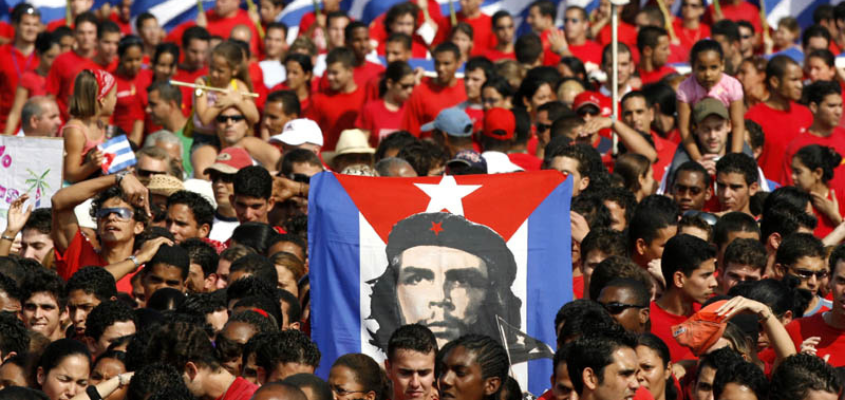
The struggle to defend the Cuban Revolution—to preserve Cuba’s independence, sovereignty, and right to self-determination—is not simply the struggle of a small Caribbean nation resisting a powerful neighbour. Nor is it confined to the geographical contours of an island of eleven million people. It is, rather, a struggle with profound and incalculable consequences for Latin America, the Caribbean, and the global fight for justice, human dignity, and the right of peoples to live free from imperialist diktat. What is at stake in Cuba has never been merely Cuba itself. The fate of the Cuban Revolution is inseparable from the broader historical contest between domination and emancipation, between empire and sovereignty, between a world ordered by profit and power and one grounded in human need and collective dignity.
From its very inception, the Cuban Revolution represented a rupture in the global order of imperialism. In the Western Hemisphere—long treated by Washington as its private preserve—Cuba asserted the radical proposition that a small, formerly colonized country could chart its own path, control its own resources, and prioritize social justice over foreign capital. That defiance, more than any specific policy or alliance, has been the enduring “crime” of the Cuban Revolution. The relentless hostility directed at Cuba for over six decades—economic warfare, political isolation, sabotage, terrorism, and ideological assault—cannot be understood as a response to Cuban actions alone. It is a warning, aimed at the rest of the Global South, of the price of disobedience.
In 1991, amid the collapse of the Eastern bloc and the triumphalist declarations of the “end of history,” Fidel Castro offered a stark and prescient assessment of the moment. “Now internationalism means defending and preserving the Cuban Revolution,” he stated. “To defend this trench, this bastion of socialism, is the greatest service we can offer to humanity.” This was not rhetorical flourish. It was a strategic and moral diagnosis of a new global conjuncture. With the socialist camp dismantled and neoliberalism ascendant, the survival of the Cuban Revolution itself became an act of internationalism—an objective barrier against the unchallenged expansion of imperial power and market fundamentalism.
Three years later, on November 25, 1994, Fidel sharpened this argument in his closing speech to the World Conference in Solidarity with Cuba. “We understand what it would mean for all the progressive forces, for all the revolutionary forces, for all the lovers of peace and justice in the world, if the United States succeeded in crushing the Cuban Revolution,” he declared. “And because of this we consider defending the revolution along with you to be our most sacred duty, even at the cost of death.” These words captured a truth often obscured in mainstream discourse: the destruction of the Cuban Revolution would not be a neutral event. It would be a historic defeat for all those struggling against exploitation, racism, militarism, and imperial domination.
History offers powerful confirmation of this insight. Just as the existence of the Russian Revolution in 1917 ignited revolutionary movements and anti-colonial struggles across Europe, Asia, Africa, and Latin America, the Cuban Revolution has functioned as an objective force against imperialism since 1959. Its very survival has demonstrated that alternatives are possible—that the rule of capital and empire is not immutable. Even when materially constrained, besieged, and isolated, Cuba’s continued existence as a sovereign, socialist project has exerted an influence far beyond its borders, shaping political imagination and sustaining hope in moments of global retreat.
But the Cuban Revolution has been more than a symbol. It has been an active, conscious agent in the ideological and political struggle against imperialism. Cuba has convened and hosted a remarkable array of conferences, symposia, and international gatherings that challenge the prevailing world economic and political order of neoliberalism. From solidarity meetings with national liberation movements, to forums of intellectuals and social movements, to initiatives linking struggles in the Global South, Cuba has consistently worked to build what might be called unity of awareness and unity of consciousness—with the ultimate aim of unity in action. This work has been grounded in a vision of internationalism not as charity or paternalism, but as shared struggle.
In Latin America and the Caribbean, the impact of this orientation has been especially profound. Cuba’s steadfast resistance helped create the political and moral conditions for the resurgence of progressive governments in the early twenty-first century and the emergence of regional projects aimed at sovereignty and integration. Even when such efforts have faced setbacks, the Cuban example has remained a reference point—a reminder that dignity, social justice, and independence are not abstractions but lived possibilities, even under conditions of extreme pressure.
Globally, Cuba’s role has extended to concrete practices of solidarity that defy the logic of empire. Its commitment to international medical cooperation, education, and disaster relief has offered a radically different model of global engagement—one rooted in human need rather than profit or geopolitical domination.
Besieged by the empire, the heroic island nation has made invaluable contributions to the well-being of the world’s nations and peoples, having established an unparalleled legacy of internationalism and humanitarianism. Over 400,000 Cuban medical personnel have served in 164 countries fighting disease. It is internationalist Cuba which selflessly dispatched tens of thousands of medical personnel to dozens of countries across the world to fight disease, be it Ebola or COVID-19.
More than 2,000 Cubans gave their lives in the struggles to liberate Africa from the scourge of colonialism and the racist apartheid South African state. As Nelson Mandela emphasized: “The Cuban people hold a special place in the hearts of the people of Africa. The Cuban internationalists have made a contribution to African independence, freedom, and justice, unparalleled for its principled and selfless character.”
These practices underscore why the Cuban Revolution has been both a symbolic and a concrete anchor in the struggle for a more just world. They reveal a politics in which ethics and power are not divorced, and in which the value of a society is measured by its contribution to humanity, not by its accumulation of wealth.
This is precisely why Cuba must not fall. The crushing of the Cuban Revolution would embolden imperial aggression everywhere. It would reinforce the doctrine that no country, however principled its aspirations, can defy the dictates of global capital and survive. It would deepen cynicism and despair among oppressed peoples and movements struggling for emancipation, sending a chilling message that resistance is futile and alternatives are illusions.
Conversely, the defence of Cuba affirms a different historical logic. It insists that sovereignty matters, that small nations have rights, and that social justice is not a utopian dream but a concrete political project worth defending. To stand with Cuba is not to romanticize its challenges or deny its contradictions; it is to recognize that the broader struggle for justice, peace, and human dignity is inseparable from the survival of one of its most enduring and defiant embodiments.
In this sense, defending the Cuban Revolution remains, as Fidel insisted, an act of internationalism in its most profound form. It is a defence not only of a country, but of a principle: that humanity has the right—and the capacity—to imagine and build a world beyond imperial domination. Cuba must not fall because if it does, the loss will not be Cuba’s alone. It will belong to all those who dare to believe that another world is possible.
Isaac Saney is a Black Studies and Cuba specialist and coordinator of the Black and African Diaspora Studies (BAFD) program at Dalhousie University in Halifax, Nova Scotia.
source: Black Agenda Report