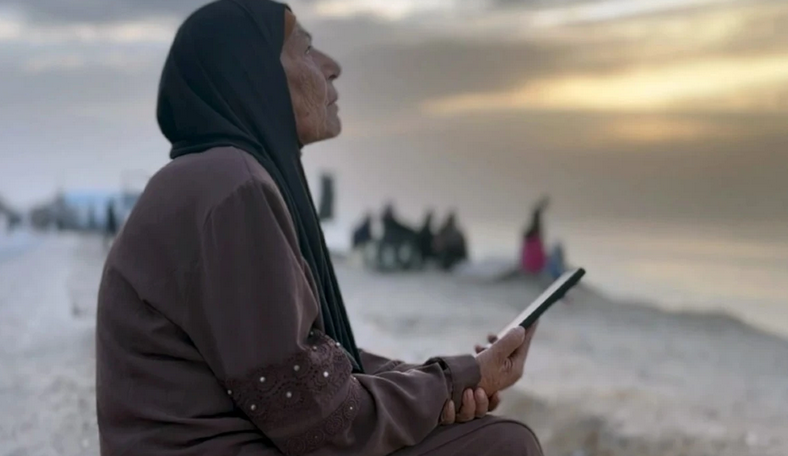
Nariman Alloush stood over her son’s body in Deir Al-Balah cemetery and whispered a final farewell. The scene painted decades of war, exile and loss across a journey that began in south Lebanon and ended in Gaza.
Alloush, in her seventies, is the mother of Ali Al-Razayneh, a senior commander in the Palestinian Islamic Jihad. Israel assassinated him earlier this month.
“I have no brother or father here,” she said in her southern Lebanese dialect, as she looked at her son one last time. “Goodbye, Ali. Greet your father and your children who went before you.”
Alloush was born in the Lebanese border town of Hounine, near Northern Galilee. Her life followed the familiar story of the Palestinian struggle. She married a fugitive fighter in the 1970s and later raised sons who chose the same path.
She met her husband Fathi in 1976. He was fighting with the Palestinian revolution in south Lebanon. “We loved each other and shared the same cause,” she said. They married in 1977.
Normal life never came. Assassinations, farewells and displacement became routine. The family moved between Beirut’s Tal Al-Zaatar and Burj Al-Barajneh camps. She gave birth to her daughter Nisreen, then to twins, Mustafa and Ali.
In Lebanon, Alloush witnessed the War of the Camps and lost relatives in the violence. She remembers the massacres of Sabra and Shatila and the devastation of southern villages. The memories remain vivid decades later.
In 1994, she returned to Gaza with her husband and seven children. Ali and Mustafa were 13 at the time. Before that, she had raised them alone in Lebanon while her husband left Beirut with Palestinian fighters to Yemen. They reunited in Gaza after the Palestinian Authority returned to the territory.
From Burj Al-Barajneh and Nabatieh in Lebanon to Jabalia camp and Beit Lahia in northern Gaza, the children grew up quickly.
With the outbreak of the second Intifada, her sons Ali and Hussein joined the resistance. Their names surfaced during Israeli incursions in northern Gaza.
“My sons chose their path,” she said. “No one could stop them despite the hardships.”
Alloush endured five wars in Gaza. Ali became a prime target for assassination. He survived attempts in 2014 and 2021. Israel also tried to kill him during escalations in 2022 targeting Islamic Jihad’s military leadership.
The 2014 war was the hardest. An Israeli strike destroyed her home in Beit Lahia. “They told me the house was bombed. I said it was just dust on Ali and Hussein’s boots,” she recalled. Later, more strikes followed. “They bombed homes over our heads to reach Ali. We were all injured.”
Her daughters Amal and Ghada lost their legs. She took them to Lebanon for treatment. After ensuring their recovery, she returned to Gaza in 2018, even though her husband had died in 2011. “I couldn’t leave. Gaza is my second home. It’s the home of my children and my family.”
Since October 7, she said, the suffering has been relentless. For months she could not see Ali or Hussein. “I sat all day in Jabalia camp hoping to see them by chance,” she said. She couldn’t see them for eight months.
During Israel’s third incursion into Jabalia, Hussein was wounded on the battlefield. His leg was amputated before Israeli forces arrested him from Kamal Adwan Hospital. Earlier, Ali’s young son Baraa was killed in a strike on Al-Shifa Hospital.
“After the truce, I thanked God that Ali was still alive,” she said. “And I prayed for Hussein’s release.”
One of his fellow fighters told Al-Akhbar that Ali was relentless. “He never left the battlefield and knew no fear. Each time warplanes struck the house or shelter where he was staying, he would shake off the dust, endure his wounds, and press on. He was wounded twice. His heart broke again and again at the deaths of his comrades, one after another, then at the death of his son Baraa, and later at the injury and arrest of his brother, commander Hussein. Despite it all, he remained steadfast.”
Earlier this month, Israel succeeded in killing him.
Alloush speaks often of her Lebanese roots. She says she is proud of her country’s support for Gaza. “No one stood with Gaza like our people in Lebanon and Yemen,” she said. She also expressed admiration for the late Hezbollah leader Hassan Nasrallah. “When he was killed, I felt every sacrifice we made for Palestine was small.”
As the sun set over the Mediterranean, she prepared to return to her tent in Deir Al-Balah, where she’s now displaced.
“Israel thinks this is over. It’s not,” she said. “There are thousands of orphans in Gaza and Lebanon. They will grow up and ask where their parents went. They will learn who killed them. If Israel believes that after all this blood a generation will rise to greet it with flowers, it is deeply mistaken. Palestine does not die. Injustice has an end.”
Source: Al Akhbar