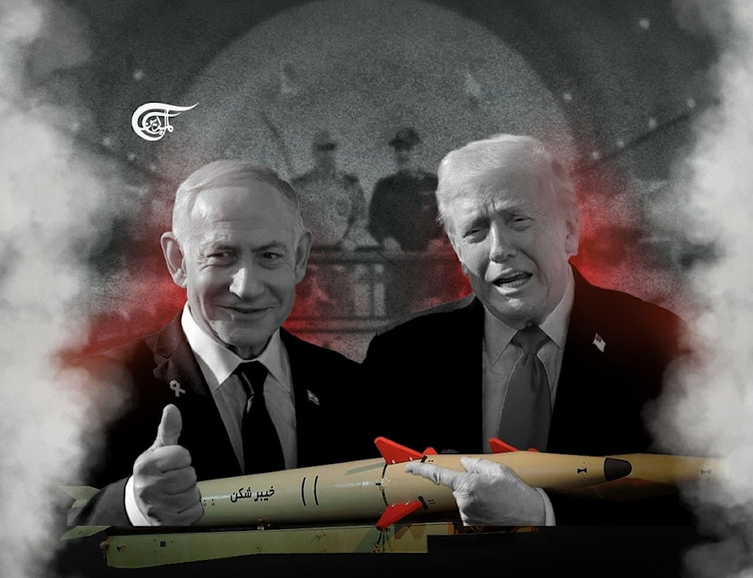
While it is impossible to predict precisely what the war on the Islamic Republic of Iran and its regional allies will result in, the winnability of the regional conflict is clear. The only thing driving this attack is sheer Israeli arrogance, as there is no conceivable situation where all out regional war delivers anything short of uncontrollable chaos.
Why is an all out regional war unwinnable? Although there are various reasons as to why this is the case, it suffices to say that the US and Israelis have no way of controlling its outcomes, in addition to this, they simply do not possess the military industrial capacity to wage such a war for a long period of time.
Now, when this argument is made, it is not done from an idealistic point of view. Therefore, it is important to preface this piece on the fact that there is a clear Israeli-US superiority in terms of technology and the kinds of weapons they possess. Nobody disputes this. There is also clear superiority in the field of their intelligence agencies.
So, let us first assume that the United States and the Zionist entity manage to score all of their desired tactical victories. Working on this assumption will then definitively prove the injudicious nature of the endeavour.
Therefore, under the best case scenario for the Zionist coalition, perhaps they succeed in conducting another decapitation strike on the Iranian military leadership, manage to penetrate and destroy some missile bases, nuclear facilities, while gutting the Islamic Republic’s air defences. These are very likely goals that they will seek to achieve.
Let’s also work under the assumption that they manage to put Tehran on the backfoot for at least a week, due to the intensity of their air campaign, making it difficult for the Islamic Revolution Guards Corps (IRGC) to fire large bursts of ballistic missiles at a single time. Then, after achieving air dominance, strikes on essential infrastructure begin, including cultural sites, government buildings, the media, but also the likes of oil facilities, agricultural areas and water systems.
On top of all of this, assume hybrid warfare tactics will be ongoing. Militant groups, especially those focused along the Iranian periphery, will start major offensive operations, working in conjunction with foreign intelligence agents and operatives on the ground, similar to what we witnessed during the 12-day War in June of 2025.
Note that the much debated potential goal of assassinating Ayatollah Seyyed Ali Khamenei is not included above. Although many have speculated that the strategy could very well hedge upon this, it guarantees a war with no predictable end, no escalation ladder and will likely trigger calls for global Jihad.
An inevitable US-Israeli defeat
Giving the Zionist coalition the best possible conditions and achievements as a result of their opening offensive, this strategy will quickly begin to run into major issues.
As we saw last June, decapitation strikes against the Iranian leadership do not work at crippling the government and its military, they are simply replaced by another line of leadership, who implement a whole series of pre-planned counter attack strategies.
The Israelis wrongfully believed that their success during the initial attack on Iran last year was going to wield major results, even attempting to utilise their asset in the United States, the son of the deposed Iranian dictator, to call for a revolt. Not only did no such action take place, as Iranians outside of the diaspora do not support this clear Zionist puppet, but the very opposite occurred as the population rallied behind the flag.
Within 15 hours, the Iranians not only managed to get their air defences back online, but captured the initiative and began launching huge volleys of ballistic missiles into the heart of Tel Aviv. As the conflict evolved, a few important developments occurred: the Israeli air defences began to buckle – with the draining of anti-air munitions – while their agents on the ground carried out most of the attacks, something that is key to note.
While it is clear that the US will bring in greater firepower than the Israelis can muster, an air force is still run by human operators who get tired and operate equipment that needs to be serviced. Iran will very easily be able to launch drones waves constantly at US and Zionist positions, and even if their ability to launch large salvos of missiles is constrained during the first week of the conflict, eventually the opportunity will present itself.