Iran’s armed forces carried out a series of coordinated operations on Tuesday across multiple theaters in West Asia, targeting United States and zionist military assets as part of the ongoing retaliatory strikes.
The operations were conducted by different branches of the Iranian armed forces, including the Aerospace and Ground Forces of the Islamic Revolution Guard Corps (IRGC), the IRGC Navy, the IRGC Ground Forces, and units of the Islamic Republic of Iran Army (Artesh).
Camp Arifjan targeted, heavy US casualties reported
Iranian forces launched 10 drones toward the US Marine Corps base at Camp Arifjan in Kuwait in what was described as a combined drone–missile operation. According to Iranian estimates, more than 160 US Marines were present at the time of the strike, with preliminary assessments indicating over 100 casualties.
No official US confirmation has yet been issued regarding the reported losses.
At dawn, Iranian forces conducted a large-scale drone and missile operation against Sheikh Isa Air Base in Bahrain. Ten strategic sites were struck, including the air command-and-control center, aircraft fuel depots, and residences used by senior US commanders.
THAAD radar reportedly disabled, drones downed
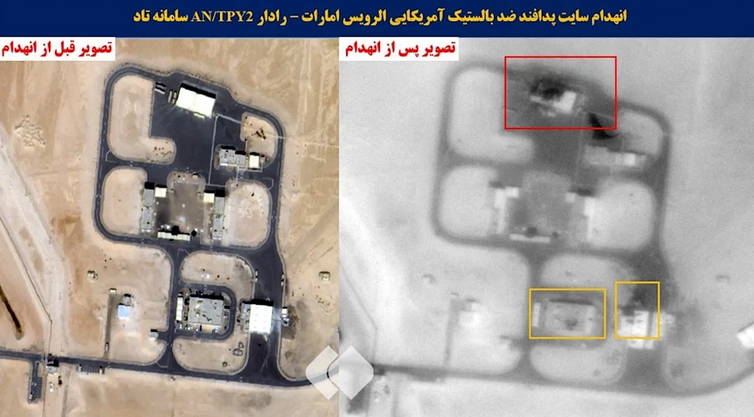
Iran also announced that a second THAAD anti-missile system radar, AN/TPY2 radar, in West Asia was struck with precision missiles, rendering it out of operation. Iranian sources added that a THAAD radar at Al-Ruwais in the United Arab Emirates had been destroyed the previous day.
Meanwhile, over Iran, IRGC air defenses shot down a zionist Hermes drone over Khorramabad, while a Hermes-900 drone equipped with electronic warfare systems was also intercepted and captured intact.
Separately, air-defense units of the Artesh downed seven additional zionist drones, bringing the total number of zionist and US drones shot down during the current confrontation to at least 35.
Operations in Iraq and the Indian Ocean
IRGC Ground Force units launched 30 drones against positions of collaborationist armed groups in Iraqi Kurdistan, stating that the groups had been planning infiltration operations.
In parallel, the IRGC Navy said it targeted a US Navy destroyer with Qadr-360 and Talaeiyeh cruise missiles. The IRGC-N explained that the destroyer was conducting a refueling operation in the Indian Ocean, nearly 650 km off the Iranian coast, at the time of the attack.
The IRGC Navy said that the missiles struck the destroyer and the refueling vessel of the US Navy, reporting that fires broke out from both ships.
IRGC Aerospace Force strikes Israeli targets
Meanwhile, the Aerospace Force of the IRGC carried out “an effective missile and drone assault” late on Tuesday targeting central and northern areas of the occupied Palestinian territories, marking the 17th wave of Operation True Promise 4.
In a statement, the IRGC said the strikes targeted the headquarters of the Israeli occupation forces’ General Staff and the Ministry of Security complex, the HaKirya, as well as infrastructure in Bnei Brak. Additional military objectives were struck in Petah Tikva, northeast of Tel Aviv, along with a military center in the Western al-Jalil.
According to intelligence assessments and field monitoring cited by the IRGC, more than 680 zionist troops have been killed or wounded since the beginning of the confrontation.
The statement stressed that technical gaps and the declining efficiency of the occupations multi-layered air defense systems enabled Iranian missiles and drones to penetrate deep into the occupied territories and strike their targets with high precision.
The IRGC underscored that Iran’s Armed Forces will continue conducting calculated operations aimed at undermining the occupation’s military infrastructure, pledging to fulfill their commitment until this “cancerous tumor” is fully uprooted from the region.
Gulf states strained by interceptor losses
The outcome and duration of the widening war on Iran may hinge less on battlefield maneuvers and more on a stark calculation of the size of Iran’s missile and drone stockpiles versus the interceptor reserves held by the United States, the zionist entity, and Gulf states, according to analyses published by The Economist and The Guardian.
In the first three days of the current war, Iran reportedly fired hundreds of ballistic missiles and a couple of thousand one-way attack drones at zionist targets in occupied Palestine and US military and intelligence assets in the United Arab Emirates, Bahrain, Kuwait, Qatar, Saudi Arabia, Jordan, and Iraqi Kurdistan.
By comparison, during the 1991 Gulf War, Iraq launched fewer than 100 missiles at zionist targets and Saudi Arabia combined, The Economist noted, pointing to the scale of Iran’s early retaliatory strikes.
While Gulf governments insist that most incoming projectiles have been intercepted, the pace of fire has placed extraordinary strain on air defense systems. Cities such as Dubai now reportedly experience near-daily interceptions overhead.
According to The Economist, Gulf states may have expended around 800 interceptor missiles, such as the Patriot PAC-3 and THAAD, within just two days. Production capacity appears limited in comparison.
Lockheed Martin manufactures roughly 600 PAC-3 interceptors annually, while the output of THAAD systems is significantly lower. These interceptors are then distributed to multiple arenas, including the Indo-Pacific, Europe, and the US homeland.
The magazine suggests that if the pace continues, Gulf states may be forced to ration their interceptors and make difficult choices about which locations to defend.
A widening regional battlefield
The geographical spread of Iranian strikes, hitting US bases and assets in Qatar, Abu Dhabi, Kuwait, Iraq, Bahrain, and Oman, has made this the most expansive West Asia conflict since the Second World War, The Guardian reported.
Stacie Pettyjohn, director of the defense program at the Center for a New American Security in Washington, described the confrontation as “a bit of a salvo competition”, referring to the exchange of large volleys of precision-guided munitions between the US and the zionist occupation on one side and Iran on the other.
“The question is who has the deeper magazines of key weapons, and the big unknown is how deep Iran inventories are,” she said.
AN/TYP-2 radars destroyed
The United Arab Emirates has rejected reports suggesting it is running low on interceptors, stating that it maintains a “robust strategic stockpile of munitions” capable of sustaining extended operations. Emirati authorities reported intercepting 161 of 174 ballistic missiles launched toward the country, with the remainder falling into the sea. Of 689 Iranian drones, 645 were intercepted, alongside eight cruise missiles.
However, satellite imagery and footage shared on social media tell a starkly different story. Iran’s Islamic Revolution Guard Corps (IRGC) revealed that its forces hit and destroyed a highly prized radar system, an integral part of the THAAD anti-missile system. Satellite images published by Iranian media showed the AN/TYP-2 radar destroyed at the Al-Ruwais site. Iranian military reports also revealed that a second AN/TYP-2 radar was destroyed in the Muwaffaq Salti Air Base in Jordan. These radars are central to the early detection of ballistic missile threats and to coordinating the interception sequence.
Strategic AN/FPS-132 no more
Qatar likewise reported detecting and intercepting the majority of incoming aerial threats, including the claimed downing of two Iranian fighter jets, three cruise missiles, and most ballistic missiles and drones directed at its territory. Nevertheless, Iranian forces were reportedly able to strike another strategic US military asset. At Al Udeid Air Base, an AN/FPS-132, a central pillar of the US and NATO missile defense architecture, was destroyed, as confirmed by satellite imagery from Planet and Middlebury.
The radar, estimated to cost approximately $1.1 billion, plays a critical role in long-range missile detection and early warning. Its destruction carries implications extending beyond the region, affecting the United States’ broader missile defense posture against major global powers such as China and Russia.
Gulf burns through stockpiles to defend US aggression
Kelly Grieco, a strategic and military analyst at the Stimson Center, cautioned that while precise inventory levels are unclear, Gulf states are “burning through a lot” of their defensive munitions. She warned that difficult decisions may soon be required about what assets to shield.
“The Iranians know this,” Grieco said, describing Tehran’s strategy as sustaining smaller but continuous waves of attacks to exhaust defenses over time as “death by a thousand cuts”.
Beyond the military balance, cost and production timelines will shape the conflict’s trajectory. Grieco estimates that intercepting a drone can cost up to five times more than producing one. Advanced US-made interceptors are not only expensive but also slow to replenish and in high demand globally, including in Ukraine and Taiwan.
Pettyjohn suggested that if US, zionist, or Gulf interceptor stockpiles were significantly depleted, pressure could mount to halt offensive operations and pursue negotiations. While the United States could theoretically withdraw forces, she noted, the zionist regime cannot.
Gulf states, meanwhile, are increasingly bearing the brunt of retaliatory strikes.
Hezbollah launches attacks on occupation
Fighters of the Islamic Resistance launched decisive retaliatory strikes on Tuesday in response to the brutal zionist aggression on Lebanon that struck dozens of Lebanese cities and towns, including the Southern Suburb of Beirut.
We publish their communqiue below in full:
The Islamic Resistance is committed to defending its land and people, especially as the “israeli” enemy crosses boundaries with its crimes. Its response targeted military sites, unlike the enemy which targets civilians. This is the minimum duty to restrain it and prevent it from persisting in its dangerous objectives against Lebanon, its state, its people, and its resistance.
Kurdish forces take public collaborationist stance with imperialism
The CIA is working to arm Kurdish forces in Iran as part of a broader effort to pressure Tehran and potentially spark internal unrest, multiple sources familiar with the plan told CNN.
According to the report, the administration of President Donald Trump has been engaged in active discussions with Iranian opposition groups and Kurdish leaders in Iraq regarding the provision of military support.
Iranian Kurdish armed groups currently maintain thousands of fighters operating along the Iraq-Iran border, primarily within Iraq’s Kurdistan region. Several of these groups have issued public statements since the beginning of the war, signaling potential imminent action and urging Iranian military forces to defect.
Meanwhile, Iran’s Islamic Revolutionary Guard Corps (IRGC) has intensified operations against Kurdish positions. The IRGC stated on Tuesday that it targeted Kurdish forces using dozens of drones.
US contacts with Kurdish opposition groups
On Tuesday, Trump reportedly spoke with the president of the Democratic Party of Iranian Kurdistan (KDPI), Mustafa Hijri, according to a senior Iranian Kurdish official cited by CNN. The KDPI was among the groups targeted by the IRGC.
Iranian Kurdish opposition forces are expected to participate in a ground operation in western Iran in the coming days, the official said. “We believe we have a big chance now,” the source stated, referring to the timing of the operation. The source added that the militias expect US and zionist support.
Trump also contacted Iraqi Kurdish leaders on Sunday to discuss the US military operation in Iran and potential coordination as the mission progresses, according to two US officials and another source familiar with the discussions. Any attempt to arm Iranian Kurdish groups would require cooperation from Iraqi Kurdish authorities to allow weapons transit and use Iraqi Kurdistan as a staging ground.
One person familiar with the discussions said the objective would be for Kurdish armed forces to engage Iranian security forces and pin them down, enabling unarmed Iranians in major cities to mobilize without facing the kind of crackdown seen during unrest in January.
Another US official said Kurdish involvement could help stretch Iranian military resources. Additional proposals reportedly include whether Kurdish forces could seize and hold territory in northern Iran to establish a buffer zone benefiting “Israel”.
The CIA declined to comment.
‘Clearly trying to jump-start’ an uprising
Alex Plitsas, a CNN national security analyst and former senior Pentagon official under former President Barack Obama, said the US “is clearly trying to jump-start” the process of overthrowing the Iranian government by arming the Kurds.
“The Iranian people are generally unarmed as a whole, and unless the security services collapse, it’ll be difficult for them to take over unless someone arms them,” Plitsas told CNN. “I believe the US is hopeful that this will inspire others on the ground in Iran to do the same.”
Jen Gavito, a former senior State Department official under former President Joe Biden, raised concerns regarding the broader consequences of such a policy. “We are already facing a volatile security situation on both sides of the border,” Gavito said, adding: “This has the potential to undermine Iraqi sovereignty and essentially empower armed militias with no accountability and with little understanding of what it may set in motion.”
Zionist strikes and border escalation
In recent days, the zionist military has reportedly conducted strikes against the Iranian military and police outposts along the Iraq border, in part to lay groundwork for the potential movement of Kurdish armed forces into northwest Iran, according to one source cited by CNN. An Israeli source indicated that those strikes may intensify.
However, US intelligence assessments have consistently indicated that Iranian Kurdish groups currently lack sufficient influence or resources to mount a successful uprising independently, according to individuals familiar with the matter.
Iranian Kurdish parties are also seeking political assurances from the Trump administration before committing to any military effort. Remarkably, Kurdish forces were recently betrayed by the US in Syria, yet they continue to walk the path of collaboration.
Some Trump officials involved in discussions about supporting Kurdish groups have reportedly expressed concerns regarding their motivations and the level of trust required for such coordination.
“It may not be as simple as Americans convincing a proxy force to fight on its behalf,” a Trump administration official said. “You have a group of people who are thinking about their own interests, and the question is whether getting them involved aligns with their interests.”
PKK signals readiness to act in tandem with imperialism
PJAK, the PKK’s Iranian forces, announced their participation in the newly formed Alliance of Political Forces of Iranian Kurdistan.
Their recent statement states “the course of events in Iran has been moving toward a profound and fundamental change” that is on the verge of “impending collapse.”
We, as the Alliance of Political Forces of Iranian Kurdistan, state that this is not a war between Iranian society and people on the one hand and the United States, Israel, and the international community on the other. In fact, this is the war of the dictatorial and repressive regime of the Islamic Republic, which has enslaved all the peoples of the country. It has deprived the Iranian people of all their rights and freedoms and, in February of this year, massacred thousands of Iranian protesters and human rights activists.
In this period, when Iran and Rojhilatê (Eastern) Kurdistan are experiencing their most decisive days, we appeal to the Kurdish people:
They continue by claiming they are on the verge of participating in military operations in collusion with US and zionist imperialism.
The collapse of the PKK into formal puppet status of the US is stunningly clear.