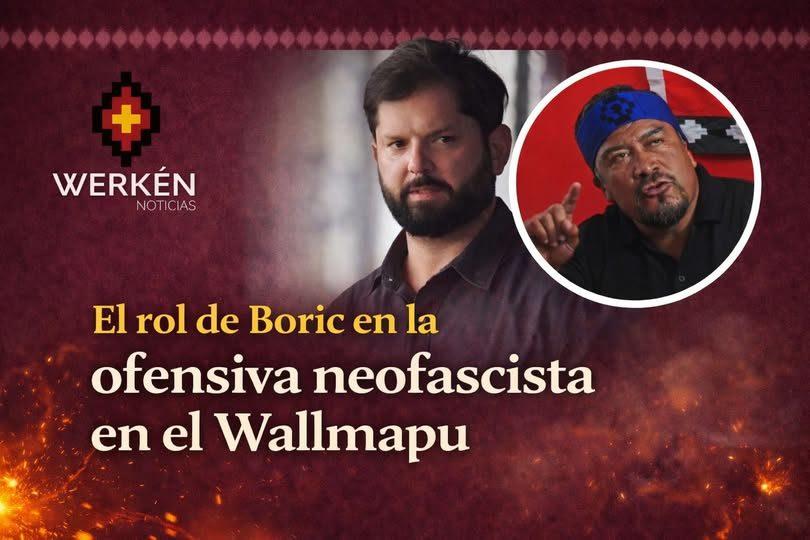
The Boric administration will be remembered as the worst of the post-dictatorship governments for the struggle of the Mapuche Nation. An assessment of the actions carried out by his administration highlights:
– Militarization of Wallmapu through the bellicose States of Emergency, which were maintained permanently throughout his four years in office.
– The failed Peace and Understanding Agreement, which turned out to be a farce and a mockery of the communities, which is why it received widespread rejection from the entire Mapuche movement. Its most concrete result was the complete lack of land restitution.
– Modernization of the State’s repressive apparatus, which involved, among other things, the acquisition of Israeli technology for police use and abuse in Wallmapu.
– Reestablishment of the National Security Doctrine, which provided the ideological framework for persecution and repression, as during the Pinochet dictatorship, and which currently defines the Mapuche people as the internal enemy of the Chilean State.
– Continued criminalization of the Mapuche cause through much harsher legislation, which includes even more cruel and repressive laws and regulations, such as the anti-land occupation law, designed to return land to forestry companies. The Naím Retamal law, or “trigger-happy” law, grants impunity to police and military personnel who commit acts of repression. The refinement of the Anti-Terrorist Law extends to the persecution of even the support networks of those who struggle.
– Persecution and imprisonment of the largest number of Mapuche community members ever seen under previous governments, now exceeding 150 Mapuche Political Prisoners (MPPs). These prisoners are subjected to degrading treatment and violations of their political and cultural rights, including cases of torture.
– Repression of all demonstrations and movements for the essential rights of the Mapuche Nation, primarily those concerning land reclamation, where progress in territorial restitution for many communities was also halted. This was achieved through repressive policies carried out by judges, police, and prosecutors, many of whom are known to be anti-Mapuche and operated within a militarized context where prerogatives and actions are at the disposal of the Armed Forces.
In short, the Boric government used repression, militarization, imprisonment, torture, and various abuses against our people to strengthen the system of domination.
Furthermore, he intensified extreme neoliberal policies. This was evident not only in his economic measures favoring businesses in ancestral territory, but also at the national level, such as the ratification of the TPP 11; the signing of free trade agreements with the European Union, China, and US imperialism; the privatization of copper to Canadian capital; and the privatization of lithium and its transfer to transnational corporations, where the figure of Ponce Lerou, Pinochet’s former son-in-law, was given preferential treatment, despite his active participation in the privatization of ancestral Mapuche territory.
So, what did Boric, the Broad Front, the Communist Party, and the former Concertación coalition do as a government? The answer is clear and unequivocal: they betrayed the Mapuche people and handed us over to oppressive institutions, thus perpetuating the system of domination. Without a doubt, they attempted, with the full force of the State, to halt the struggle for the reconstruction of the Nation, the defense and recovery of our ancestral lands. They disregarded our historical demands. Our fundamental struggle is against the capitalist regime that devastates and plunders our historical territory. Our struggle is against the unscrupulous businesspeople who, through their investments, destroy our ancestral lands.
We are a Nation with a centuries-long history of struggle against domination and invasion, and we know very well how the elites, the Chilean bourgeoisie, have built their power on the foundation of dispossession, oppression, exploitation, and injustices against our people.
Today, Boric leaves with his arrogant rhetoric, but he will be remembered as a despot who sought to use us as a symbol of struggle and then betrayed us, siding with the same powerful elites as always.
Boric will go down in history as a sinister individual who facilitated all the conditions for the far right to bring Kast to power, and to launch a neo-fascist offensive that will amount to a new war of extermination for the Mapuche people. In fact, Boric has ensured impunity for the repressors of the Mapuche movement, giving free rein to forestry capital and revealing his true reactionary and treacherous nature toward the Mapuche cause.
Beyond the measures denounced, Boric will be remembered for having paved the way for the fascists, favoring the powerful and the main economic groups, since his administration reproduced the neoliberal model, allowing the realignment of big capital in Wallmapu and in present-day Chile.
These policies, in structural and ideological terms, have created the conditions for the accumulation and reproduction of large capital in the usurped territories, placing themselves against the processes of autonomous territorial restitution that we, the communities and organizations in resistance, are carrying out with dignity. This will exacerbate the contradictions and intensify the territorial struggle.
The Mapuche struggle will not stop in the face of a new offensive by fascism. Our ancestors already taught us the path of resistance; from our lonko (chiefs) we learned the marrichiweu ka weuwaiñ pu peñi pu lamngen (the spirit of resistance for our brothers and sisters).
Freedom for the imprisoned Mapuche political prisoners and all the imprisoned weichafe (warriors)!
By Héctor Llaitul Carrillanca /Werken Noticias /Resumen Latinoamericano, March 14, 2026.