Iran’s Islamic Revolution Guard Corps (IRGC) announced wave 73 of missile strikes targeting multiple areas in the occupied Palestinian territories, as part of its ongoing True Promise 4 operations.
The IRGC said that military installations and security centers in Arad, Dimona, Eilat, Beer al-Saba’, and Kiryat Gat were hit in the latest wave.
The statement added that the strikes followed what it described as the “collapse” of zionist air defenses, alongside targeting of military bases, including sites linked to US forces in the region.
The IRGC reported more than 200 dead and wounded during the early hours of the operation, according to field assessments.
It also claimed that zionist authorities are restricting journalists and eyewitnesses in an effort to limit reporting on the scale of destruction and casualties.
According to zionist media, an Iranian missile struck the city of Arad in the southern occupied Palestinian territories on Saturday evening, killing at least 8 settlers and injuring around 100 others in what Israeli media has described as the deadliest single strike since the beginning of the war.
The missile, identified by some zionist media platforms as a Khorramshahr-4 ballistic missile carrying a half-ton warhead, scored a direct hit on a residential area of Arad, with Israeli news outlets saying the strike was “a failure of the air defense system.”
The latest strikes come as part of the broader True Promise 4 campaign, with the IRGC signaling continued operations across multiple fronts and expanding targeting within the occupied territories.
Dimona strike signals Iran’s effective control
An Iranian missile strike on the southern occupied city of Dimona highlights Tehran’s continued “effective command and control,” according to a leading Israeli Iran expert.
Zionist media reported on Saturday evening that several sites near the Dimona nuclear facility, in southern occupied Palestine, were struck by Iranian missiles, noting that settlers remain trapped under the rubble.
According to the reports, the latest missile barrage caused damage across parts of Dimona, with impacts reported in multiple locations.
‘Structured deterrence’ and escalation management
Danny Citrinowicz, a senior fellow at the Institute for National Security Studies, said the Dimona attack, alongside earlier strikes, fits into a broader pattern of “deliberate signaling” and controlled escalation.
He argued that Iran’s ability to strike Dimona demonstrates strategic guidance translating into precise operational execution at the tactical level,” describing the response as part of a calculated approach rather than random retaliation.
Citrinowicz said the pattern reflects “structured deterrence”, aimed at shaping Israeli behavior and imposing high costs, rather than uncontrolled escalation.
Iranian state media said the Dimona strike was carried out in response to a US-Israeli attack on the Natanz nuclear facility. The zionist military said it was not aware of any such strike.
Zionist outlets also confirmed that, in addition to structural collapses, a gas storage tank in the area was hit, raising concerns over a potential leak.
Channel 12 reported that the number of injured has risen to more than 51, while air raid sirens sounded repeatedly throughout the day. Zionist media further stated that military helicopters landed at a helipad in Dimona to evacuate the wounded.
Hezbollah unleashes wave of strikes
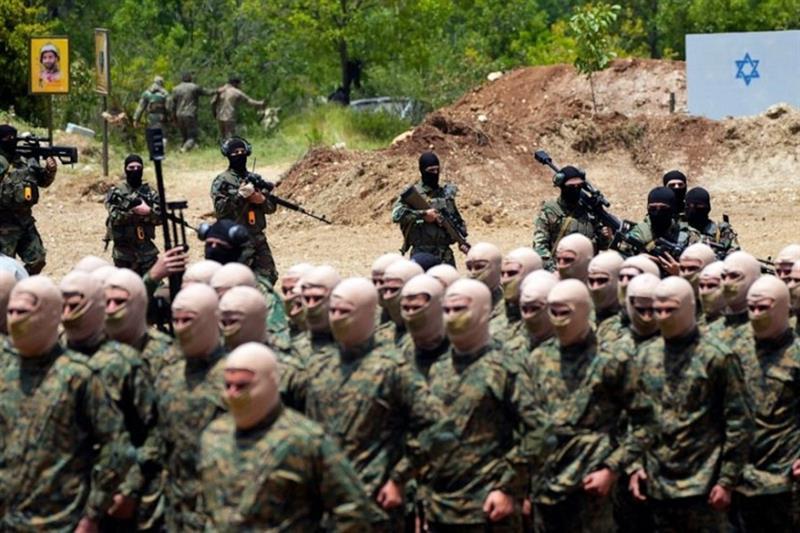
The Islamic Resistance in Lebanon carried out a series of coordinated operations targeting gatherings of occupation soldiers and military vehicles that had advanced into Lebanese territory along the southern border.
Sustained strikes across multiple border areas
The operations focused on several key locations, including al-Odeisaa, Markaba, al-Taybeh, al-Khiam, and nearby border sites, where zionist troop concentrations and military vehicles were targeted with rockets and artillery fire.
- At 7:00 PM on Saturday, Resistance fighters struck a gathering of zionist soldiers and vehicles at al-Khazzan Hill in al-Odeisaa with a rocket barrage.
- At 10:20 PM, another gathering of zionist forces in Jabal Wardeh in Markaba was targeted with rockets.
- At 12:10 AM, Resistance fighters struck a gathering of zionist forces at al-Muhaysibat Hill, south of the Taybeh project, with a rocket salvo.
- At 12:15 AM, the same area was targeted again with artillery shells.
- At 12:30 AM, a third rocket barrage hit zionist forces at al-Muhaysibat Hill, south of al-Taybeh, marking a continued escalation in strikes.
- At 12:40 AM, Zionist troop gatherings in the Taybeh project area were targeted with rocket fire.
- At 3:10 AM, Resistance fighters targeted a gathering of zionist forces in the vicinity of the al-Khiam Detention Center with a heavy rocket.
- At 5:00 AM, Resistance fighters targeted a gathering of zionist forces and vehicles in the town of al-Taybeh with a precision rocket.
Resistance fighters also struck separate gatherings in Khirbet al-Kassif, southwest of Taybeh, using artillery shells.
In al-Khiam, occupation forces were targeted at multiple locations, including the newly established Hamams site and Khallat al-Asafir, where rocket volleys were launched.
The Islamic Resistance confirmed that its operations are ongoing in response to zionist incursions, targeting troop gatherings and military positions along the border and engaging forces at close range in several areas.
Hezbollah complicating IOF’s ability to locate missile launch sites
Hezbollah is making it more difficult for the zionist army to locate its rocket launch sites by changing launch patterns and spreading launch platforms across a broader area, including distant areas and within Shiite villages in southern Lebanon, Channel 12 reported.
The channel’s military affairs correspondent, Nitzan Shapira, noted that Hezbollah is deploying launch platforms in a way that makes it more difficult to locate and thus target them. This comes as hundreds of rockets continue to be fired daily toward the entity with about 40% targeting Israeli army positions along the border, despite an almost 24/7 zionist intelligence surveillance and lock.
Shapira added that the average number of rockets fired is around 100, increasing to about 150 on days of intensified operations, noting that the zionist army continues its operations inside Lebanon to pursue cells and launch platforms, only to be met with fierce resistance, preventing its advancement.
According to military estimates, Hezbollah still possesses thousands of short-range missiles, in addition to long-range missiles capable of reaching areas such as Gush Dan and other distant areas inside “he entity, reflecting the difficulty the zionist army faces in controlling rockets and their systems.