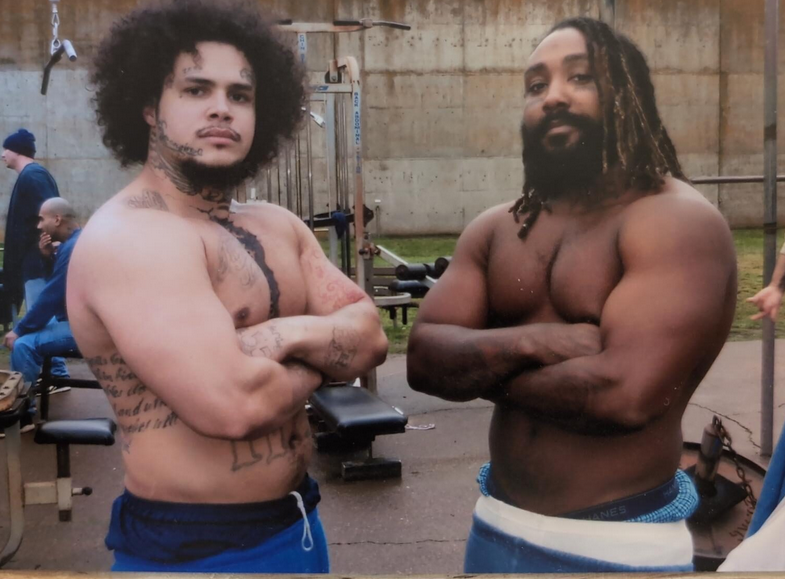
The Oregon Department of Corrections appears to have effectively disappeared Malik Muhammad, a Black Palestinian anarchist and antifascist prisoner serving one of the longest sentences handed to a protester after the 2020 George Floyd uprising.
According to court documents, Muhammad threw a Molotov cocktail at police in Oregon in 2020. In 2022, they pleaded guilty to 14 felonies and received a concurrent 10-year federal and state sentence in Oregon State Prison.
On Monday, March 30, 2026, members of Muhammad’s support team noticed something alarming: their profile had vanished from the prison messaging system GettingOut. Around the same time, their name no longer appeared in Oregon’s inmate search database. This disappearance happened in the wake of a call-in campaign to once again get Muhammad out of solitary confinement.
Since then, family and supporters have been scrambling for answers, calling Eastern Oregon Correctional Institution (EOCI) and multiple Oregon Department of Corrections (DOC) offices. They’ve gotten almost nothing in return.
WWFU has also made dozens of calls across the Oregon prison system in an attempt to locate them and have been unsuccessful in getting any of our questions answered.
Calls to Oregon State Penitentiary (OSP), including the Special Management Housing (SMH) unit where Muhammad had previously been held in solitary confinement, suggested they may have been at court, but provided no confirmation.
One official in the Office of Population Management confirmed only that Muhammad had been moved to a “confidential location,” a designation repeatedly invoked while officials declined to provide any verifiable information about their whereabouts.
Staff at Eastern Oregon Correctional Institution (EOCI) confirmed that Muhammad is no longer housed there. The Oregon Department of Corrections’ Public Information Officer did not provide answers, instead directing further inquiries elsewhere.
What followed was a bureaucratic loop: multiple phone numbers, referrals, and repeated contact attempts, none of which produced verifiable information about Muhammad’s location or condition.
Muhammad’s mother was given the same explanation. When she pressed for clarification, she was told that placement in a “confidential location” is determined on a case-by-case basis and could be due to medical, mental health, safety, operational, or court-related reasons, according to the Office of Population Management. No further details were provided.
These explanations, or lack-thereof, raised more questions than they answer.
People in state custody do not simply disappear from public records. Prison transfers generate paper trails. Locations are logged. Systems update. None of that appears to have happened here, or, at the very least, none of it is being disclosed.
As of publication, supporters say they have no idea where Muhammad is. They have not spoken to them since they were placed in solitary confinement prior to their disappearance. No federal agency, including the Federal Bureau of Prisons, has acknowledged taking custody.
Muhammad is, for all practical purposes, gone.
A Record of Isolation and Torture
Muhammad’s disappearance comes after years of extreme isolation.
Their support committee documented on Muhammad’s blog that they had spent more than 250 days in solitary confinement in 2024 alone, cut off from any meaningful human contact and communication.
Solitary confinement on that scale is not just punitive, it is widely recognized as torture.
The United Nations’s “Mandela Rules” state that more than 15 days in isolation constitutes cruel, inhuman, or degrading treatment, and can amount to torture. Decades of research have shown that prolonged isolation can cause severe psychological damage, including hallucinations, paranoia, cognitive decline, and suicidal ideation.
Muhammad has already endured conditions that meet that threshold many times over.
Now, supporters say, even the minimal visibility that remained has been stripped away.
“This is entirely different,” members of Muhammad’s support network say. “We are scared. We know nothing about Malik’s condition, location, or why ODOC has taken the extraordinary step of blocking all access and information.”
From Prosecution to Disappearance
Following Muhammad’s sentencing, prosecuted by Nathan Vasquez, their supporters exclaimed the severity of the charges and sentence already reflected a broader political crackdown on antifascist and anti-police protesters, believing that sentence was never just about the alleged conduct, but was about making an example.
An antifascist and anarchist protester. A moment of mass uprising. A state eager to reassert control.
Now, they argue, that same logic has escalated beyond prosecution and punishment into something even more extreme: disappearance.
Political Repression by Design
The use of secrecy inside prison systems is not new. “Confidential” placements and communication blackouts are often justified under the language of security.
But advocates say that when the state refuses to disclose even the most basic information, such as where a prisoner is being held, whether they are safe, whether they are alive, it crosses a line from control into outright repression.
Without transparency, there is no accountability. Without contact, there is no oversight.
And without public pressure, there is nothing to stop it from happening again.
Supporters are now calling for urgent action. They are urging people to contact the Oregon Department of Corrections, elected officials and to amplify prior reporting on Muhammad’s treatment.
Because what is happening is no longer ambiguous.
A prisoner has been removed from public record.
Their location is being withheld.
Contact has been cut off.
And the state is refusing to explain why.
Under international human rights standards, this pattern has a name: enforced disappearance. The detention of a person followed by a refusal to disclose their fate or whereabouts. It is a practice historically associated with authoritarian regimes and political repression.
The Oregon Department of Corrections may use bureaucratic language such as “confidential placement,” “operational reasons,” but the effect is the same: a human being has been made to vanish behind the walls of the state.
This is not a clerical error. It is not a routine transfer. It is an escalation.
And if it is allowed to stand, it sets a precedent: that the state can make political prisoners disappear, and face no consequences for it.
This is bigger than one case. When the state can make a prisoner vanish and refuse to account for it, it exposes a system built not on justice, but on control and impunity. Naming it matters. Resisting it matters more. Because what is happening here is not an anomaly, it is an escalation.
Who to call:
ODOC– (503)945-9090
OSP General Line– (503)378-2453
OSP SMH– (503)378-2597
Brynne Xin at the Office of Population Management–
(503)871-5496
EOCI– (541)276-0700
From We Will Free Us, by Alissa Azar
Read the original article here: https://www.wewillfreeus.org/oregon-doc-appears-to-have-disappeared-portland-protester-malik-muhammad/