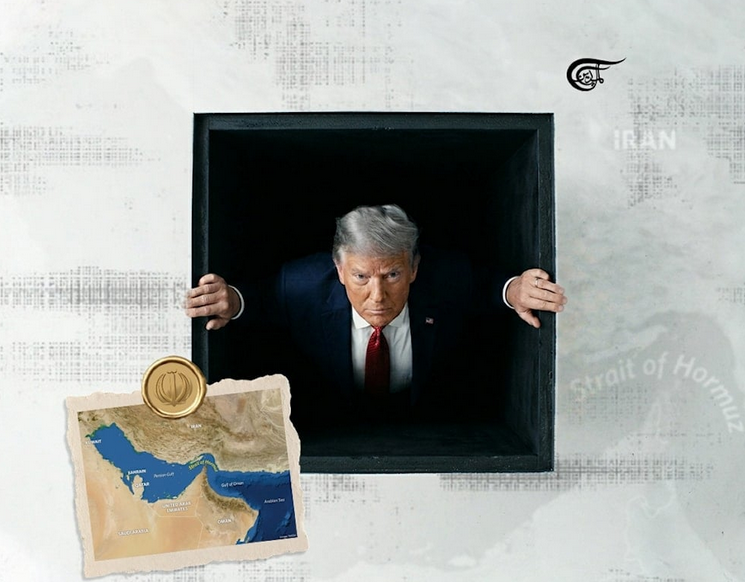
US President Trump has long viewed all forms of coercion, including war itself, as a “negotiating” tactic. In the months running up to his greenlighting the Israeli assassination of Ayatollah Sayyed Ali Khamenei, this catastrophic act was framed as a way to pressure the Islamic Republic into softening its diplomatic position on the nuclear file.
What any reasonable lay person could have told him is that publicly assassinating both a head-of-state who is also head of the state religion in the middle of ongoing negotiations could never be considered anything but a declaration of total war.
When the Iranian system failed to implode within days, as the Israelis, Iranian diaspora community, and his court of lickspittles told him it would, Trump found himself out of leverage. He burned through whatever credible threats of escalation he had in the act of going to war. Tehran, on the other hand, has been demonstrating that it started from the bottom of its escalation ladder, with a long way yet to climb.
The first signs of Washington recognizing it no longer has control of escalation in the war was the president’s flailing attempts to plead ignorance of Israeli airstrikes, first on fuel depots in Tehran and then on the South Pars gas-field infrastructure. By giving worthless assurances that “Israel” would not repeat such actions, he signaled he is at least aware of Tehran’s capacity to fully obliterate the energy infrastructure of the GCC states in reply, a threat it has made clear it will act upon if such redlines are crossed again.
For reasons likely not even known to Trump himself, Iranian restraint, even in the face of such extreme provocations, still seems to register in Washington as weakness to be exploited. Rather than seek an immediate offramp, he again escalated his threats against Iran’s entire energy grid if it failed to reopen the Strait of Hormuz within 48 hours. Tehran merely had to repeat what it would do if its power plants were attacked. Trump, no doubt having only just learned what the Strait of Hormuz is, backed down within hours of his self-imposed deadline. He extended it by five days under the pretext of secret negotiations with Iran that were going “very well.” The earnestness with which he insists upon the reality of these talks, and that it was Tehran who reached out, not him, is all the confirmation we need to conclude that these negotiations are a fabrication invented to justify the fact that he blinked first.
The deadline has moved again to April 6, and we can expect these extensions will continue to be granted in the hope that the media cycle will simply forget that it was the US who initiated the escalation cycle and needed a ruse in order to back down.
That most of the internet has already noted the president times his ultimatums according to the opening and closing of business on the stock market shows how little room for maneuver the White House has in shaping this narrative. It simply piles on additional pressure to either act on its threats or retreat.
Much has been made of Trump shifting his escalation timeline to fit with the arrival of the Marine Expeditionary Units for their as-yet unclear purpose. That may be, but once they arrive and are in position, the Americans will remain in the same predicament. They will either have to commit to further massive escalation, a ground invasion, for which they are unprepared, and which the Iranians already anticipate, or find another reason to hesitate rather than incur the consequences.
The opening of a ground incursion will itself be far costlier to Washington than it will to the Iranians. It will also precipitate exactly the kind of economic calamity the White House is desperate to avoid – the total closure of the Strait of Hormuz, which would become an active combat theatre.
Trump remains snared in a trap he laid for himself: he initiated the war, such that his threats of further escalation no longer faze his opponents, while following through magnifies the cost and risk to himself.
Secretary of State Rubio, in what admittedly could have been a ruse, telegraphed at the meeting of the G7 in France that no ground forces in Iran will be necessary and that the war ending with Iranian control of the Strait of Hormuz is simply a reality that will have to be dealt with by other countries. This would suggest that at least someone in the president’s circle is aware that the ceiling of American “success” in this war has already been reached.
The accumulating economic crisis and the imminent political costs to him in the November midterms make Trump increasingly likely in the coming weeks to declare victory after some performative operation and cease fire.
To the degree he will be able to negotiate on anything, the only point of discussion will be the end of the war itself. Iran’s nuclear program, military industries, and foreign policy are now irrevocably off the table, while Hormuz will continue to be a pressure point that will be exploited far into the future. Perhaps this will cause a rethink of his ‘negotiating’ strategy, but it no longer matters. Negotiations are dead, likely forever. No threats of further escalation will revive what Trump himself killed.
Samuel Geddes
Source: Al Mayadeen