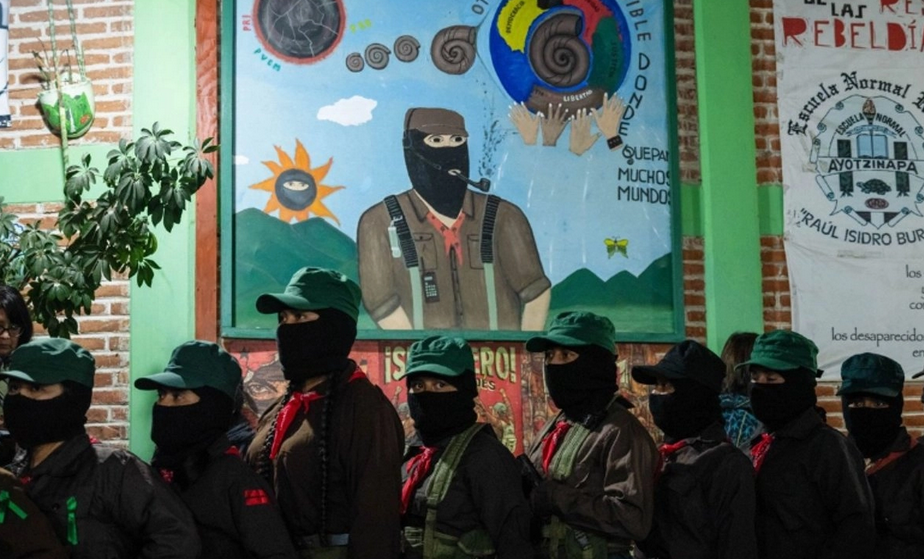
On April 2nd, 3rd, and 4th, a unique workshop was held at CIDECI in San Cristóbal de las Casas, Chiapas, centered on presentations by both Sub-commander Moisés and Captain Marcos. It was attended by approximately 500 people from some 30 countries, including Germany, Argentina, Brazil, Chile, the United States, France, England, Iran, Italy, and the Czech Republic, as well as members of national organizations and collectives and EZLN grassroots members. This audience did not participate; this was likely by design, as the aim was to present the Zapatista voice and thereby promote a shared process of reflection within the participants’ own communities. The workshop’s central theme was “The Storm Inside and Outside,” which had been announced a short time ago by the EZLN.
A brief historical overview was offered: from the Clandestine Revolutionary Indigenous Committee (CCRI) of 1994 to the EZLN of 2026. Captain Marcos highlighted that in ’94 the press debate revolved around why they rose up and then why they took so long. Later, the so-called civil society emerged, those without party affiliation. And the peak of the EZLN’s fame, from 1996 to 2001, with the San Andrés Accords, marked a turning point where it became clear that “after the fame and infamy, we saw that we were no longer just fighting for rights.”
The changes in the EZLN’s structure were addressed, aiming to abolish the pyramid that had been established. In 2014, Galeano was assassinated, Marcos died, and Galeano was reborn; Moisés assumed leadership. In 2015, the seminar “The Capitalist Hydra” was held, and they said we were exaggerating, even though we had been writing about what is happening now. Afterward, the first declaration for life was released, signed by them and others. The first stage was the tour of Europe led by Sub-commander Moisés. Upon his return, he said, “They’re really screwed. As things stand, we’re not going to make it; with the structure we have, we’re not going to make it.”
Following his anti-capitalist stance, Sub-commander Moisés pointed out, “We fight for the liberation of all living beings. They are destroying not only human life, but everything around us. You talk about climate change, we talk about Mother Earth. We won’t have homes or life if planet Earth is completely destroyed. Our grandparents and great-grandparents have told us how things were before; where it used to rain, now it doesn’t; where it was hot, now it’s cold. They knew when things bloomed. The question is, what to do? We are part of life. Now capital comes along and seeks to multiply its profits, and who buys it? Are we the consumers? Our grandparents from 80 years ago said they never saw water being sold.”
Sub-commander Moisés criticized the operation of government programs, citing impositions and mismanagement. The programs “Sowing Life,” “Youth Building the Future,” and “Our School” are mentioned. Another one they mention is “Servants of the Nation.” These are the ones promoting the vote that this government must continue to receive because otherwise, these programs will be discontinued. Vote-buying is already underway. And the sub-commander emphasized: “We are still facing the storm caused by the pyramid scheme. We have already destroyed it, and now we are building the Commons. It’s not just about the land; it’s about a new world, a new society, but without the pyramid. The problem we see is the capitalist legacy; we cannot abandon it.”
“We said that everyone should get together while we figure out how we are going to deal with the other communities that are not Zapatistas; they face a different situation, other sectors. The Commons is the opposite of ownership. No one should own the wind, the land, life, or human beings, not under a single ideology. In two years, our brothers arrived; now we don’t call them party members.” The assembly will no longer be exclusively for Zapatistas; those who are not will participate equally, as a group.”
Captain Marcos addressed the invisible wars. Deserters, informers, torturers, police, soldiers, they beat a journalist, and the media doesn’t report it. There is no difference between oppressor and oppressed. The women just want to be left alone to live in peace.
Increasingly, the concept of nation is being displaced onto soccer. States have lost their monopoly on violence because of organized crime; its infiltration is real. The market is no longer national, but transnational. There is also the monopoly on fake news, which is no longer controlled by the government; social media controls it. The captain reiterated that “the nation-state has no decision-making power. They can’t say that Mexico is sovereign if it can’t even decide whether to send oil to Cuba.”
He emphasized that the groups fighting for the disappeared are the ones who don’t give up, don’t sell out, don’t surrender. Don Mario and Doña Hilda from Ayotzinapa are here because truth and justice are part of the story of the disappeared. The seedbed and the shared proposals are an effort to promote a shift away from the paradigm imposed by those in power: conform, resign yourself, don’t organize.
Original article by Magdalena Gómez, La Jornada, April 7th, 2026.
Translated by Schools for Chiapas.