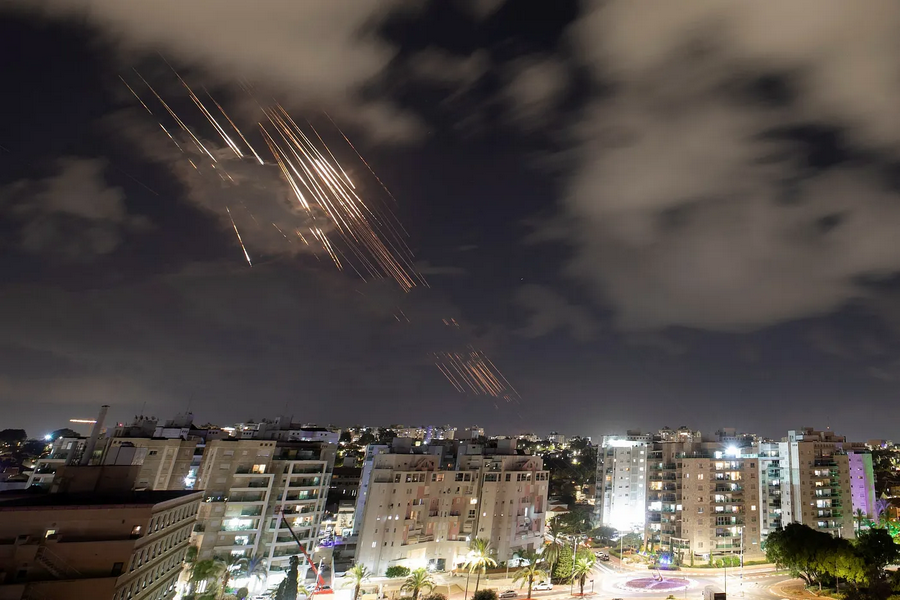
Since the most recent escalation of zionist aggression on Iran began — with the bombing of 180+ schoolgirls on February 28th — Iran has swiftly and powerfully responded with Operation True Promise 4:
- Targeting u.s. military bases in West Asia from Saudi Arabia, Qatar, United Arab Emirates (UAE), Jordan, and Iraq.
- Targeted assassinations of zionist government and military officials responsible for the genocide in Gaza and the war on Iran.
- Striking at the heart of the zionist entity’s technological, financial, military, and energy hubs.
- Striking multiple F-15s, KC-135s, MQ-9 Reaper Drones, and the “invincible” F-35 stealth fighter jet.
- Unleashing over 75 waves of missiles and suicide drones.
- Millions of settlers forced to live in bunkers, parking garages, and shelters.
In their arrogance, the zionist entity and the united states underestimated the power and internal stability the Islamic Republic of Iran had developed when they surprise-attacked the nation in the midst of negotiations on February 28th. They assumed that with the assassination of Ayatollah Khamenei, the nation would subsequently collapse from within. Not only did Iran withstand the martyrdom of key leaders, but they have been able to respond at a proportion that instills fear in the zionist entity. Iran has opened a door for nations occupied by the u.s. to take action against embassies and military bases. They have brought Ansarallah and Hezbollah into the fight, and by occupying zionist forces on multiple fronts, Iran has paved a wide path for Palestinian resistance factions to act inside occupation borders. The immediacy of the response, the precision, and the sheer volume of arsenal ready is not an accident. This is the result of intentional preparation, years of building, and a state that understood the necessity of material power.
Community Liberation Programs condemns the liberal instinct to downplay Iran’s military prowess and powerful stature in this war so as to appear sympathetic and play into the politics of “perfect victimhood.” Pushing a narrative of weakness violates Basil Al-Araj’s Rules of War (to never spread the occupation’s propaganda and to never undermine the resistance’s strength); to do so is to do the enemy’s work for them. This liberal cynicism and self-defeating rhetoric normalizes a global order where solidarity is only granted after massacre, where technological superiority and defensive infrastructure are reserved for the West, and where the Third World is expected to remain permanently docile and dependent, never to bite the hand that forces poison down their throats.
Liberation requires the building of material power. When the most impressive display of that principle unfolds before us, when Iran, a nation that has spent decades building indigenous capabilities under brutal sanctions, responds to zionist aggression at a scale that has sent settlers fleeing and left every surrounding u.s. military base in West Asia struck by its arsenal, what do we witness from the Western Left? Silence or equivocation. Platitudes that flatten Iran as a humanitarian cause, and not as the force that broke through the myth of the zionist occupation’s impenetrability. When the Axis of Resistance demonstrates what actual power looks like, the Western Left scrambles to “rehabilitate” and manage their image to be palatable to their own liberal sensibilities. This is the same aversion to power that has impeded the usefulness of the Western Left. It is the same aversion that admires “resistance” only when it wields no agency in the shaping of the world-system, only when it poses no real threat to the imperial order. It is the same aversion as the inability to commit to the arduous work of building the material foundations of sovereignty.
We are living in an era of movementist protest marches, with the majority of political action neither challenging the hegemony nor confronting structures of power, and reduced to little more than begging politicians for concessions. Many self-proclaimed leftist and anti-imperialist organizations and individuals have miscalculated both the terrain and the actors with whom they are contending. As Strategy for the Liberation of Palestine makes clear, revolutionary seriousness begins with a dialectical analysis of the enemy and the landscape — without which strategy becomes mere posture.
Get Community Liberation Programs’s stories in your inbox
Leftist organizing has become disconnected from materialism. The planning and building of decolonization programs, alternative institutions for the people, and independent supply chains has taken a backseat to performative actions. Today, for the majority of organizations, the measure of “successful” organizing is often a one-off rally, a large conference, a viral petition, or a high-turnout mobilization. These should be treated as tactical steps within a broader strategy — one aligned with the long-term development of independence and power. Instead, they are lauded as ends in themselves. There is a disparity between those who chant for the end of empire and those who are doing the work that decolonization requires. The Western Left does not grow its own food. It does not study the nodes of power that shape the world. It does not become militant enough to confront them. The Western Left would rather believe that the next viral post or nationwide conference will bring us one step closer to the revolutionary horizon. This is reflective of a typical liberalism: the need for immediate results and an unwillingness to commit to the labor of sustained organizing.
The Western Left confuses its rhetorical “opposition to imperialism” for a material opposition to the imperialist world-system itself. It has internalized the liberal logic that the only feasible and creditable resistance is the kind that never wins wars, never shakes the world order, never builds towards the “better world” so often touted in left-liberal sloganeering. The Western Left has become comfortable in its own marginality, mistaking its incapacity for moral purity. For the Western Left to acknowledge the scale of militancy and discipline constructed by the resistance movements in West Asia would mean having to confront its failure to build any of its own.
This failure is not merely a matter of political miscalculation or strategic error. Members of the Western Left do not act with seriousness or urgency because, ultimately, they have less at stake. They are not living through the slow genocide of sanctions that starves, disables, and deteriorates a nation. The Western Left are not waking up to the sound of drones circling overhead. The Western Left are the recipients of the flow of value from the peripheries. Their comfort is built on the extraction of wealth from the places where real resistance is forged. The Western Left can afford to equivocate. It can afford to condemn violence “on all sides” and to debate the precise language with which to frame the Islamic Republic’s operations. It can afford to distance itself from Iran or any force that wields power too visibly and too effectively. For the Western Left, these calculations are thought experiments, and none carry the weight of life and death. For the people of Palestine, Lebanon, Yemen, and Iran, being latent means annihilation. When your existence is under threat, you either build political power of the gun or you are eliminated. Only by reckoning with its own position within the imperial core, abandoning navel-gazing, and committing to building power where power is not easily built would the Western Left finally be getting serious.
“He who feeds you, controls you.” — Thomas Sankara
National anti-imperialist projects prioritize development for a reason. Agriculture and agroecology means a nation will not go hungry at the whims of foreign markets, the petrodollar, conditional aid, and potential sanctions. As the u.s. blockade tightens and fuel shipments are cut off, it is the Cuban campesinos (cooperatives that have turned to local organic farming) that supply the majority of produce that feed the island. Manufacturing means capturing value (transforming raw materials into useful goods) that would otherwise be siphoned to the core. When a nation lacks a robust manufacturing base, it will be forced to export its raw materials at exploitative prices and import finished goods at high costs, an extractive system called unequal exchange. These nations are forced to rely on labor export and remittances as an economic prop, as seen across the peripheries of the world-system. Desperate people abandon their homelands to become migrant workers in the core, sending back a fraction of the value extracted from their labor abroad, while their home nation’s economy remains underdeveloped, unable to retain or reproduce skilled labor. Manufacturing reverses this flow, keeping workers at home and evolving local technical knowledge. Control over raw materials, such as lithium, oil, and minerals, prevents imperialist powers from extracting wealth and dictates the terms of exchange rather than submitting to them. Without this control, nations that are resource-rich become entrapped in an unequal system where their wealth is plundered, their natural environments are obliterated, and their people are left impoverished so that the core can reap the profits. The ability to innovate technology on one’s own terms means a nation is not locked into dependency on Western intellectual property regimes and proprietary supply chains. It enables the development of housing, green energy, healthcare, and defense systems that are not subject to foreign sabotage or whims.
Throughout the twentieth and twenty-first centuries, there is a long list of cases of Western imperialist forces destabilizing nations, leaving them weakened and destroyed to this day. In 1973, the u.s.-backed coup against Salvador Allende in Chile ushered in the Pinochet dictatorship, halting the nationalization of mineral reserves and opening the country to extraction by multinational corporations. In Libya, NATO’s assassination of Muammar Gaddafi threw the country into years of civil war and created the horrors of slave markets. And less than two years ago in Syria, the West in coordination with HTS and ISIS toppled the government, subjecting religious minorities to violent persecution and expanding zionism’s reach deeper into the heart of West Asia.
When nations did not build or could not maintain their own systems and institutions, neocolonial forces like USAID, the IMF, and the World Bank filled the vacuum, implementing and perpetuating dependence. The Gates Foundation — spearheaded by a notorious member of the Epstein class — is a clear example of how Western philanthropy is truly a vehicle for surveillance, violence, and exploitation of the Global South. It operates as a front for the trafficking of African children and women, who are often subjected to sexual violence, and the forced sterilization of African people under the guise of public health. Without self-determined socioeconomic development, nations have no buffer against becoming satellite states and neocolonies leashed to the imperial core.
Having endured Japanese colonization, followed by u.s. imperialist warfare that carpet-bombed the country into rubble, the Democratic People’s Republic of Korea (DPRK) has since been subjected to a harsh sanctions regime. Yet through self-reliance (juche) principles, it has prioritized developing an indigenous nuclear deterrent capability that continues to ward off even the greatest military on Earth. This past year alone, that commitment to sovereignty has manifested in the construction of 113,000 new rural housing units and 50,000 new apartments in Pyongyang, proof that a nation can uplift its people and defend itself despite the most severe imperialist campaigns. In contrast, the Republic of Korea (ROK) is ravaged by u.s. military occupation and reduced to a staging ground for Washington’s war games. Agriculture, manufacturing, control over raw materials, and the ability to innovate technology are the foundations upon which sovereignty is built. These create the means to expel imperialist forces, to defend one’s own land, and to uplift the people. The Islamic Republic of Iran’s indigenous arsenal and its capacity to wage a war of attrition are the most recent testament to this principle. From its domestically developed ballistic missile programs to its advancements in drone technology, Iran has proven that a nation determined to build on its own terms cannot be crushed by imperialist sanctions or surprise bombing attacks. The same strategy that fed Cuba and industrialized the DPRK now protects Tehran and carries out the mission of the entire Axis of Resistance.
The Black Panther Party understood the necessity of building self-reliance and sovereignty, even if their canvas was an internal colony. They have been aestheticized to oblivion, their mainstream legacy divorced from the politics that made them dangerous — especially their pursuit of an independent Republic of New Afrika. The foremost reason the Party was considered one of the largest internal threats by the u.s. government was not because they threw rallies and protests, but because they were organizing programs that materially empowered the masses. The Party’s survival programs were, in essence, an attempt to establish the very pillars that national anti-imperialist projects prioritize.
Where the state denied food security and created local food deserts, the Panthers challenged the state by building alternative food systems through free breakfast programs that fed tens of thousands of children. Where the state’s medical institutions abandoned and abused Black communities, the Panthers established free health clinics, sickle cell anemia testing, and even ambulance services. Where the state economy extracted wealth from Black neighborhoods, the Panthers organized community control over resources through programs like free clothing distribution, the Oakland Community School (which provided education outside the u.s. settler-colonial curriculum), and the Seniors Against a Fearful Environment (SAFE) program which protected elders from state-sanctioned neglect. And while they may have not reached the scale of indigenous technological innovation seen in Iran, their investment in developing community-controlled institutions represented the same understanding: That a colonized people could not liberate themselves through symbolic agitation and political education alone; they needed to build the independent infrastructure and systems that would form the foundation of their sovereign existence.
“Independence is not a word which can be used as an exorcism, but an indispensable condition for the existence of men and women who are truly liberated, in other words who are truly masters of all the material means which make possible the radical transformation of society.” — Frantz Fanon
To diminish Iran as a powerless state with no agency in this war is not merely naive; it is a distortion of material reality, an attempt to preserve the imperialist world-system that such skewed power dynamics are a result of. Unlike left-liberals, Iran operates with a clear understanding of its material position, refusing to minimize its strength and being unambiguous about the desire to break the world-system as it currently is. It does not mince words, does not toe the line, has no qualms about vocalizing a refusal to subjugation, a determination to put down zionism and the american empire. And also unlike many Western leftists, the Islamic Republic of Iran has chosen to — and become capable of — following their words with real actions and real results.
The zionist entity and the united states do not fear our statements or our rallies. They fear what Iran has built. What the Black Panther Party was beginning to build. They fear the day that the Western Left abandons its aversion to real political power and begins to build the material foundations that will make us useful to those already resisting imperialism. This should be the goal of any serious organization worth its salt that proclaims to be anti-imperialist. We can no longer afford to be weak and sympathetic to the politicians of the Epstein class. We must be able to develop into an apparatus that can not only stand against the u.s., but can become a threat and lay material might onto the enemy. For those of us who live in the u.s., we are privileged with the particular mission of carrying out this work from within the belly of the beast: building programs, undermining the imperialist war machine from within, and organizing our own communities toward independence and material power.
source: Community Liberation Programs
Zine formatted by 3rd World Rev, “Power Exists in the Space Between the Hand and the Hammer,” by Community Liberation Programs: