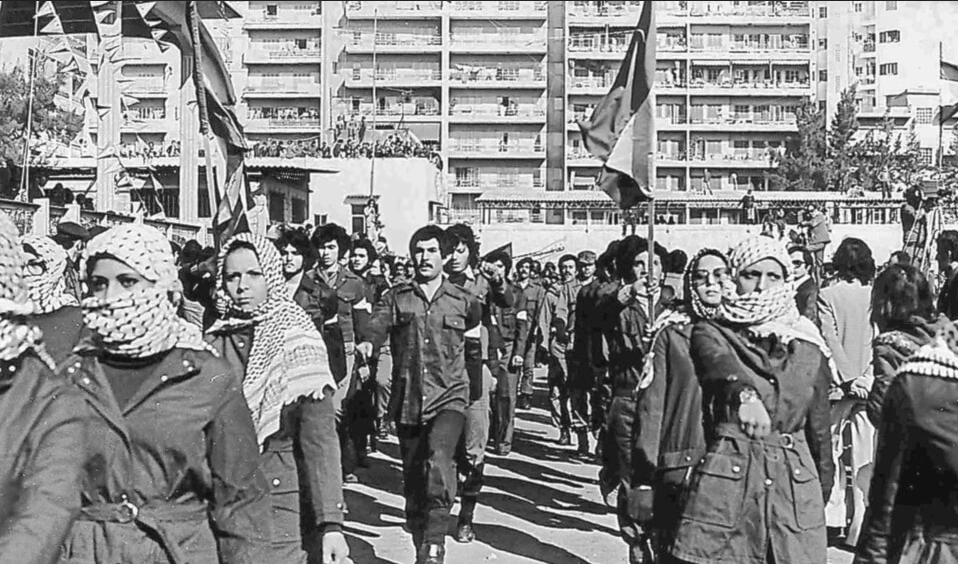
Forty-three years ago, on the evening of September 16, 1982, Israeli forces besieged the Sabra and Shatila camps in Beirut. What unfolded over the next 48 hours was a harrowing episode in our protracted struggle against zionism, Western imperialism, and Arab reactionary powers. This atrocity, far from an isolated act of barbarism, epitomized the structural logic of US imperialism and the Zionist colonial project: where the elimination of the native is not incidental but central to maintaining political and economic dominance.
Just weeks earlier, the Palestine Liberation Organization (PLO) had been expelled from Lebanon under US orchestration. Washington guaranteed “safety” for the camps while quietly green-lighting the Zionist army and their Phalangist allies to move in after the Palestinian fighters departed.
What made the massacre possible was not just Israeli–Phalangist collusion, but the absence of the PLO itself. For years the PLO had protected and mobilized the refugee camps in Lebanon, acting both as a shield and political horizon for Palestinian liberation.
The civil war in Lebanon, with its colonial baggage, sectarian militias, and externally-backed factions, provided ideal conditions for this strategy. When Bashir Gemayel, the CIA- and Mossad-backed Phalangist president, was assassinated, zionist officials were quick to blame Palestinians, offering a pretext for the massacre.
What made the massacre possible was not just Israeli–Phalangist collusion, but the absence of the PLO itself. For years the PLO had protected and mobilized the refugee camps in Lebanon, acting both as a shield and political horizon for Palestinian liberation. Its expulsion was not only the work of Israel or the US alone; it was also enabled by Arab reactionary regimes. In 1982, for instance, Hafez al‑Assad’s Syria positioned itself as champion of the Palestinian cause while simultaneously working to contain and weaken the PLO, refusing to confront Israel directly during the siege of Beirut, and thus leaving the camps exposed to massacre.
The lessons of 1982 reverberate today. We are witnessing the same regional project, driven by the same constellation of US, Gulf, and allied powers, to isolate and dismantle liberation fronts and maintain the neocolonial order. This project centers on disarming anti-systemic movements and reshaping state institutions to pacify popular demands for self-determination.
In Lebanon, similar Gulf- and Western-backed calls to disarm the resistance are framed as (re)-establishing Lebanese “sovereignty.”
This September, countries such as the UK, France, and Canada moved to recognize a Palestinian “state,” a gesture explicitly conditioned on Palestinian disarmament. In Lebanon, similar Gulf- and Western-backed calls to disarm the resistance are framed as (re)-establishing Lebanese “sovereignty.” In practice, they aim to recast the Lebanese state as a compliant, externally aligned apparatus: a labor reservoir, an investment platform, and a selectively armed force oriented toward internal policing rather than national defense.
Appeals to entrust the protection of Lebanese lands to the Lebanese Armed Forces (LAF) are posited within the rhetoric of national protection, but the arrangement mirrors the Palestinian context.
In both cases, recognition of sovereignty becomes conditional, sustained through foreign military aid and obedience to the very powers backing Israel.
European recognition of Palestinian statehood is offered only alongside demands for disarmament, neoliberal restructuring of state institutions, and protection of Israel’s security. Likewise, LAF’s supposed autonomy is undermined by its dependence on US and Gulf funding. In a slip last month, Ambassador Tom Barrack gave the plot away, describing the Lebanese Armed Forces as “well-meaning” but “under-equipped,” before conceding the real intent of said aid: “Who are they going to fight? We don’t want to arm them so they can fight Israel… you’re arming them so they can fight their own people, Hezbollah.”
These parallel conditions reveal a political equilibrium in which mediation masks subjugation. The actors presenting themselves as neutral arbiters are the same ones enforcing military asymmetry. True sovereignty cannot be actualized if a state’s survival depends on external military aid, economic subsidies, and alignment with the very powers backing its adversaries. Under such terms, Lebanese “stability” and Palestinian “statehood” become hollow recognitions that institutionalize dependency.
That contradiction becomes even clearer when viewed through the lens of Washington’s commitment to preserving Israel’s “qualitative military edge” (QME), a policy ensuring Israel’s military superiority over all regional actors. By this logic, no Arab state, and certainly no future Palestinian state, are permitted independent military capacity. Disarmament of resistance is thus not a policy preference but a structural requirement of the regional order.
True sovereignty cannot be actualized if a state’s survival depends on external military aid, economic subsidies, and alignment with the very powers backing its adversaries.
Lebanon offers a clear illustration. The US approved $95 million in Foreign Military Financing for Lebanon in 2025, after disbursing $236 million in 2021. Saudi Arabia remains another major funder. These flows tie the army’s capabilities to donor priorities. Macron’s endorsement of a Saudi-led effort to equip the Lebanese Armed Forces continues this trajectory: consolidating military power within ruling-class formations while marginalizing grassroots resistance and popular claims to self-defense.
In Gaza, states like Qatar and Turkiye play the role of mediators. Qatar hosts the largest US air-base in the region, deepens its defense agreements with Washington, and positions itself as a broker in Gulf–Western energy deals (from pipelines with France to gas projects involving the UK). Turkiye relies on EU trade, NATO membership, Gulf capital and Western markets. Both present themselves as allies of Palestine, yet their strategic dependencies ensure that at critical moments they echo calls for disarmament. Mediation here manages Western hegemony more than it supports Palestinian or Lebanese sovereignty. Taken together, these dependencies explain why a state that publicly speaks the language of Palestinian solidarity will, at critical moments, echo calls for disarmament of Palestinian resistance.
This dynamic echoes what Ghassan Kanafani diagnosed in The 1936–39 Great Revolt in Palestine (1972): imperial powers maintain control not only through force but through the political neutralization of revolt, using local elites and Arab regimes to convert resistance into compromise.
Disarmament, then, is not merely a US-Israeli priority. Arab ruling classes have long benefited from weakening effective fronts of Palestinian resistance.
That structure reappeared this October, when foreign ministers of Türkiye, Jordan, the UAE, Indonesia, Pakistan, Saudi Arabia, Qatar, and Egypt endorsed a US-Israeli framework focused on “humanitarian assistance,” “reconstruction,” and a “two-state solution” tied to new security arrangements. As Kanafani warned, such mediation turns liberation struggles into managed negotiations that sideline and disarm resistance.
Disarmament, then, is not merely a US-Israeli priority. Arab ruling classes have long benefited from weakening effective fronts of Palestinian resistance. A strong resistance movement has broad popular appeal across the region; a diminished one becomes a bargaining chip, traded for diplomatic leverage, economic benefits, and regime survival. Leaders like Abdel Fattah el-Sisi and King Abdullah II understand that disarmament serves them twice: it aligns them with the dominant order and prevents regional resistance victories from inspiring domestic dissent.
“Arab betrayal” is therefore not simply moral but structural. It is rooted in an order built to protect imperial and Zionist power and sustained by Arab regimes whose political economies depend on foreign investment, security coordination, and integration into global markets. This structure enabled the genocide in Gaza, the massacre at Sabra and Shatila, the occupation of Lebanese territory, and the continued bombardment of Yemen. It is the same structure that frames disarmament as the price of survival, reproducing a century-long pattern in which Arab peoples are asked to surrender sovereignty in exchange for managed underdevelopment.
The real question is not whether resistance will disarm, but who gains from the disarmament, symbolic statehood, and deepened dependency on foreign power. This is why we insist: Gaza is the compass. Gaza, alongside the cradles of Lebanese and Yemeni resistance, lays bare the colonial architecture of US power and its regional partners, whose cruelty is matched only by cowardice. Here, the courage of anti-imperialist resistance is reduced to a bargaining chip in negotiations for power and survival.