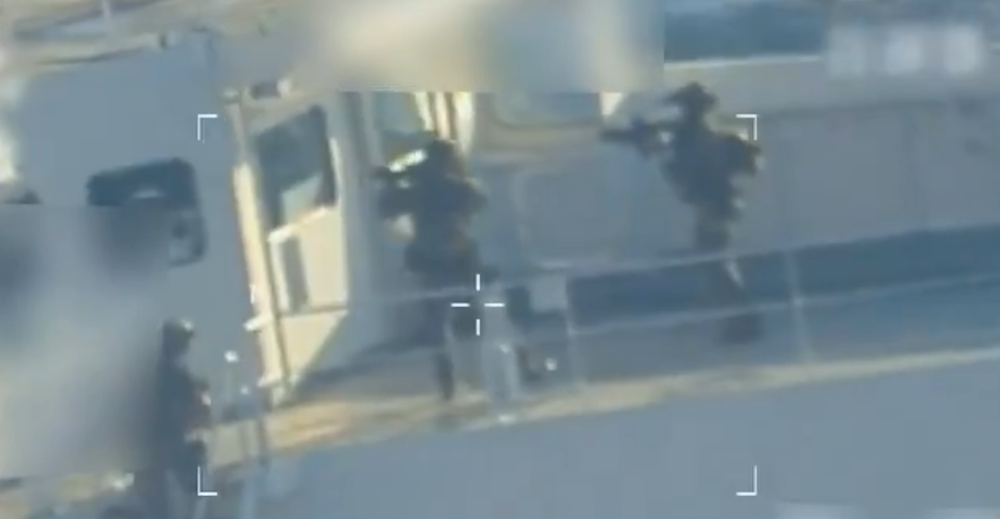
The United States has seized an oil tanker off the coast of Venezuela, US President Donald Trump said Wednesday, a move that jolted global oil markets and is likely to heighten the conflict as US imperialism threatens Venezuela.
“We’ve just seized a tanker on the coast of Venezuela, large tanker, very large, largest one ever, actually, and other things are happening,” Trump said.
A person familiar with the matter, who was granted anonymity to discuss the sensitive seizure, told Politico that the vessel had been bound for Cuba.
The Cuban Embassy in Washington did not respond immediately to requests for comment, as per the report.
Piracy, military buildup at sea
The operation comes as the Trump regime has ordered a significant military build-up in the region, deploying an aircraft carrier, fighter jets, and tens of thousands of troops. Analysts say the tanker seizure marks a shift towards a more aggressive effort to target Venezuela’s oil sector, the country’s main source of revenue.
Vanguard, a British maritime risk consultancy, said it believed the tanker Skipper was the vessel seized early Wednesday. Washington previously sanctioned the ship, then known as the Adisa, for allegedly participating in Iranian oil trading, again acting as a unilateral, rogue decision-maker on the international stage.
Oil futures rose on news of the seizure. Brent crude finished up 27 cents, or 0.4%, at $62.21 a barrel, while US West Texas Intermediate rose 21 cents to $58.46.
Venezuela denounced the US regime for committing a clear act of “international piracy.” Caracas is now calling on the world to reject what it described as a blatant act of aggression and theft.
In a strongly worded statement issued by the Venezuelan Foreign Ministry on Wednesday, Caracas condemned the US seizure of its vessel, labeling it a “vandalistic, illegal, and unprecedented aggression” designed to normalize looting under the guise of sanctions enforcement.
“The Bolivarian Republic of Venezuela strongly denounces and condemns what constitutes a blatant theft and an act of international piracy,” the statement read. “Venezuela calls on all Venezuelans to stand firm in defense of the homeland and urges the international community to reject this aggression that seeks to normalize itself as a tool of pressure and plunder.”
Oil markets and supply tensions
Venezuela exported more than 900,000 barrels per day last month, its third-highest monthly average this year, after state-run PDVSA boosted imports of naphtha to dilute extra-heavy crude. Despite mounting pressure on President Nicolas Maduro, Washington had previously refrained from directly disrupting Venezuela’s oil flows.
Rory Johnston, an analyst at Commodity Context, said the seizure adds to market unease. “This is just yet another geopolitical/sanctions headwind hammering spot supply availability,” he said. “Seizing this tanker further inflames those prompt supply concerns but also doesn’t immediately change the situation fundamentally because these barrels were already going to be floating around for a while.”
Escalating pressure on Maduro
Maduro has long argued that the US military build-up aims to topple him and seize control of Venezuela’s vast oil reserves. Since early September, the Trump administration has carried out more than 20 strikes on suspected drug-smuggling vessels across the Caribbean and Pacific, killing more than 80 people.
Experts have raised legal concerns over the campaign, noting that US authorities have provided little evidence that the targeted boats were carrying narcotics or that lethal force was necessary instead of interdiction and questioning.
Those concerns intensified this month after reports that the commander overseeing the operation ordered a second strike that killed two survivors.
A Reuters/Ipsos poll published Wednesday found broad US public opposition to the deadly maritime strikes, including among roughly one-fifth of Republicans.
Trump has repeatedly floated the prospect of US military meddling in Venezuela. In a sweeping strategy document released last week, he said the administration’s foreign-policy priority is to “reassert its dominance in the Western Hemisphere.”
What this means for Cuba
Cuba’s long-running struggle under the US embargo has pushed its economy into one of its most challenging periods in decades, with ordinary families bearing the heaviest burden. The restrictions, tightened further in recent years, have sharply limited access to fuel, medical supplies, spare parts, and basic goods, creating a cycle of shortages that affects nearly every aspect of daily life.
Public transportation routinely grinds to a halt, hospitals face chronic scarcities, and households are forced to navigate rising prices and dwindling resources.
For many Cubans, the embargo is not an abstract geopolitical tool but a visible, persistent source of hardship embedded in the rhythm of everyday survival.
Those pressures intensified after the recent seizure of a Venezuelan oil vessel reportedly bound for Cuba, a development that deepened an already severe energy crisis.
The country relies heavily on Venezuelan shipments to stabilize its fuel supply, and the interception of the cargo immediately triggered longer blackouts, constrained industrial activity, and disrupted food distribution networks.
Communities already struggling to secure basic necessities now face worsening electricity shortages and soaring transportation costs. This latest act highlights how US meddling, including decades of sanctions and aggressive maritime actions, directly harms Cuban civilians, deepening suffering and undermining the resilience of the island’s economy.