Introduction
The publication of this interview on December 19th marks day 48 of the historic Prisoners for Palestine hunger strike—the largest prisoner hunger strike in the u.k since 1981, when prisoners from the Irish Republican Army undertook a prolonged and militant refusal of food in protest of the british government’s withdrawal of their special status as prisoners of war.
The eight Prisoners for Palestine hunger strikers—Qesser Zuhrah, Amu Gib, Heba Muraisi, Jon Cink, Kamran Ahmed, Teuta “T” Hoxha, Lewie Chiaramello, and Umer Khalid—have taken up their predecessors’ same weapon of the body, declaring their refusal to eat until all five of their audacious demands have been met. Many of them have been held on “remand” (pre-trial detention) for over a year for alleged direct actions taken against Elbit Systems, the weapons manufacturer in britain which makes 80-85% of the zionist entity’s land weaponry and drones. These weapons are currently being used in the holocaust of Gaza, to lay waste to Palestinian lives.
The hunger strikers’ demands are as follows: end all communications censorship; release them on immediate bail while awaiting trial; a fair and transparent trial with all records related to Elbit released in full; the deproscription of Palestine Action; and lastly, the permanent closure of every Elbit facility on british soil.
The strike has been met with a wave of international support: Italian prisoner Stecco has chosen to expand the strike across Europe; federal defendant Jakhi in the so-called u.s. declared his solidarity with the hunger strikers and undertook a 10-day solidarity fast; recently liberated Lebanese political prisoner Georges Abdallah released a statement of admiration and solidarity, along with Abdel-Nasser and Ammar, Palestinian prisoners who were liberated by the resistance earlier this year in the Al-Ahrar Flood exchange.
Earlier this year, in August of 2025, T. Hoxha —who is currently on hunger strike again—was the first of the Palestine Action prisoners to initiate a solo hunger strike when the prison officials at HMP Peterborough revoked her job in the prison library, withheld her mail, and represented her as a danger to the other prisoners because of her political beliefs. Hoxha’s strike gained international attention when Casey Goonan—at that time the only federal defendant from the 2024 Student Intifada—announced they were joining the strike in solidarity with her, refusing to eat until her demands had been won. A week later, Malik Muhammad—the subject of this interview—also joined the strike in support of Hoxha’s demands.
This historic act of internationalist solidarity undertaken by political prisoners across multiple geographies directly paved the way for Palestine Action’s current larger hunger strike, serving as a model of militant anti-imperialist solidarity in the service of Palestine from those facing the brunt of the state’s repression.
It is necessary for us to maintain internationalist solidarity because ‘that’ isn’t happening ‘over there’ to ‘them’ but oppression is ‘HERE’ and happening to ‘US’ all. Our movements are stronger together. The people are stronger together. Don’t let them separate us. And remember as Palestinians starve in Gaza, so do the unjustly held 12,000 Palestinian prisoners, and the ones in US prisons and ‘detention’ (death) centers, prisons in the UK, Australia — they are all the same. The prisoners are living under forced displacement, oppression, occupation.
— Malik’s response to Hoxha’s August 2025 hunger strike
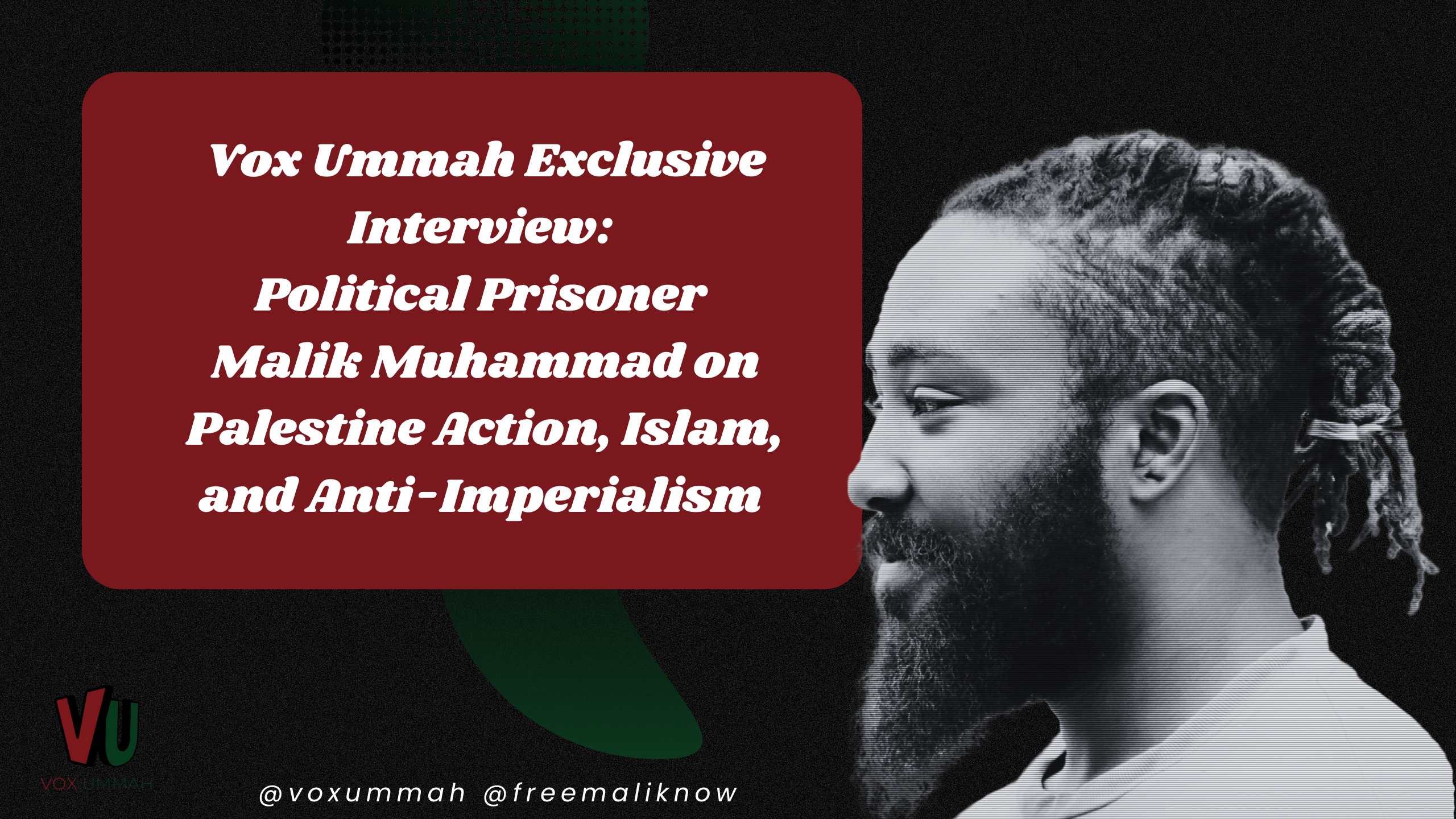
Malik introduces themself as an “anti-fascist, anarchist, a revolutionary, a writer of everything creative.” They are a Black and Palestinian direct actionist serving an absurd ten-year sentence in Oregon for their legitimate actions during the George Floyd Uprising of 2020. In retaliation for their organizing behind bars, they’ve spent the majority of the past two years in solitary confinement, in a battle against mail censorship — the same mail censorship that is being waged against our Palestine Action comrades in britain.
Reading their many writings and interviews is an exercise in frustration. Here is a serious militant and revolutionary who is burning to engage with the larger struggle, but has been trammelled at every turn. James Yaki Sayles defines political prisoners as “conscious and active servants of the people”, but how can our prisoners remain conscious and active elements when the people allow them to languish and die alone behind bars? Georges Abdallah, liberated after 41 years in a French prison, attributes his ability to remain a part of the wider movement to his comrades on the outside. By constantly supplying him with news of the resistance in the outside world they gave him the necessaries of political development; by publicizing his voice they made it into a weapon of theory in the service of resistance.
I was surrounded by men and women dedicated to the cause who allowed me to keep resisting, by making my resistance part of the struggle against the genocide in Gaza. They gave me a permanent voice on the outside, allowing me to speak about the struggles of various peoples and other political prisoners. So, I wasn’t just a prisoner. I was a fighter who was in prison.
For those of us who consider ourselves supporters, sisters, and defenders of political prisoners, our primary responsibility is to serve as intermediaries between them and the international war against imperialism. Hundreds and thousands of revolutionaries and potential comrades are crying out to be seriously engaged with in this struggle on every level. This interview aims to be a bridge into this war for our sibling Malik, who calls on those of us on the outside to transmit their call to action to our political prisoners in the u.s.—the only way that international hunger strikes are possible.
Interview with Malik Muhammad
How do you see the Prisoners for Palestine hunger strike as part of a broader, international struggle against imperialism?
Imperialism is upheld through state-sanctioned violence, and part of that violence involves the systemic kidnapping of people they call prisoners. To recognize freedom as a collective struggle is to know that none of us are free until all of us are—including and especially those who have been stolen from us under the guise of “public safety.” They want to silence and lock away the fighters and their voices. What I see in the case of my Pal Action siblings is a settler colonial state trying to distract from the sins of its past — namely, Britain’s complicity in zionism and the Nakba. A state that at once “decries” a genocide it won’t even acknowledge is happening, all the while violently repressing those who object to it. The state’s only tool is a hammer, the only language it speaks is violence. But the perpetual struggle for freedom transcends generations.
When you were organizing in 2020, did you see yourself and the Black liberation movement as part of that war against imperialism? How have your politics developed since then, especially in the two years since the Toufan Al-Aqsa?
Afrikan liberation is the struggle against imperialism and settler colonialism. First Nation liberation and sovereignty and Palestinian liberation are one struggle, and cannot be separated from each other. They exist in an interconnected and interwoven web of oppression and resistance. What affects one directly affects the other. As my dear sibling Lisa says, “that” isn’t happening “over there.” No. We are told to believe so but that’s not the case.
I feel that resistance against this unique fascist state is important because of its central role in the exploitation of land, lives, and cultures at such rapid rates, all while destroying the planet. So while my direct actions [in 2020] were taken against this [u.s. settler] state, they didn’t happen in a vacuum–just like the actions of the Palestinian resistance. The oppressed are never the ones who initiate violence. How could we be, when the state is the one who constantly perpetuates violence against us?
My politics haven’t changed much. I’ve been an anarchist ever since I was a kid and discovered radical blogs on Tumblr. [In regard to Palestine], I would say that in spite of my anti-state beliefs, for a time I held onto hope for a two-state solution. It’s hard to tell a people to “fuck the state” when they don’t even have one to call their own to begin with, when they’re still fighting and struggling for their right to exist at all. It was the same with Afrikans here [in the so-called u.s.], which is why the Black Power movement often had statist ideals.
But [the events of] October 7th reinforced for me that “resistance is essence”, and under occupation, it is a right. It reminded me that perhaps the freest we can ever be is in the moments when we are resisting, when the people take fate and destiny into their own hands and take action. As Jonathan and George, Assata and Mutulu, Oso, Hanson, Peltier, Xinachtli, Tyler and Luigi, the IRA and my Pal Action siblings, all faithful resisters within the death kamps, the ones we don’t hear about, and the slave rebellions lost to history.
Like John Brown meeting the hangman’s noose, we do only what we feel called to do by our creator. The genocidal campaign the zionist entity has waged against the Palestinians after they were forced to hear the cries of the unheard on October 7, that barbaric, internationally-sponsored terror, that all reaffirmed to me that my hope will always be in the people, not the state. The mutual aid, the resistance in the face of genocide, people pulling bodies from rubble, the fighters and the martyrs–all that carnage mixed with all that resilience. Beautiful resistance and faith. That reminded me of my core belief that resistance is essence.
One of the demands of the prisoners in the UK hunger strike is to be able to “send and receive communications without restriction, surveillance, or interference.” Shine White, Xinachtli, and almost every political prisoner reports censored and withheld mail. Why is freedom of mail such an indispensable thing for a prisoner?
Letters and communications are a lifeline for us. The state wants to break us by locking us away. They want us disappeared and forgotten about. And even if we aren’t forgotten about, they want us to feel like we are anyway. I’ve had mail withheld for so long. I know guys who have gotten garbage bags full of mail after a whole year.
They try to break your spirit, make you feel like there’s nothing to fight for, and that you should just give up. That’s why it’s imperative to always correspond, even more so when the mail is withheld. They can hide a few parcels from their higher-ups and deny there ever was any, but if you flood their inboxes it helps pressure the [prison officials.] And when the prisoner does eventually get that huge stack of mail, it’s a beautiful reminder that they’re loved, and their strength can be renewed.
The oppressor’s only tactic is to intensify their repression, to wait us out. So our memory must be longer than the state’s. That’s why we should never forget [the prisoners.]
How should the outside movement be working to bring political prisoners into the anti-imperialist struggle?
Any way you can. I don’t think there’s a one size fits all solution. Like anarchy, it’s fluid, and there’s room for a diversity of tactics. Never be afraid to dream or think bigger than the established box. Do what has been working and leave behind what hasn’t, and try things you never have. Our imagination must also be bigger than the state’s. They only know one use for a hammer, while an anarchist recognizes the versatility of that tool.
Writing to and communicating with a political prisoner is the bare minimum. Building and platforming their voice, strategizing in ways that would directly aid those inside, making sure they know that they’re part of a movement that transcends the bars and gates and walls, that they’re only on a different front but still fighting the same fight. More than that though, making sure they know that they’ll be free by any means. See, Assata was [freed]. So they should know that they’ll be freed by any means. And that they’ll be supported in any actions they take.
What makes a hunger strike effective or ineffective? How much of its power comes from public pressure vs the will of the strikers themselves?
Hunger strikes are most effective when you know your ‘why.’ The will must be there, but it’s all in the ‘why.’ The power is always within the people. Under repression, to refuse to eat, to starve yourself purposefully, is powerful in itself. The power is with you the second you refuse. The state threatens violence to coerce and control. So we say, “You can beat me, deprive me, but my intent is to still not eat. I’m the one with the power. And you just pretend.”
Public pressure is imperative too: You [on the outside] have power too. It’s imperative to keep the striker alive with that public pressure. Because when you go down that path, you know why. And you’re prepared to die for it. You know your red lines, the demands that you will accept instead—but you are still prepared to die for it. The public’s job is to not let you go that way.
That’s where pressure is imperative. You support in all the ways you can, apply pressure in all the ways you can, and you also accept that the power is with that person, too. That they must be trusted to make the best decisions for themselves, even if that means it meets an disagreeable end. They eat only at their own will. You hope to expedite that, spread their message, even if they go.
A hunger strike is never ineffective. As revolutionaries, we never die. We just spread, and multiply. Like our ideas, they’re always here. Because [as Fred Hampton said], you can jail a revolutionary, but you can’t jail the revolution. You can kill a revolutionary son, but you’ll only martyr another one. You can steal a revolutionary daughter, but you’ll only add water for the revolution to drink from. So–we have the power, you have the power. The state has none.
Are there any verses from the Quran you reflect on most in regards to the struggle you are waging?
“Beat back the oppressors wherever you find them.”
Are there any Islamic figures you think about most during this period of struggle?
The prophet Mohammed (peace be upon him) and his refusal of riches to renounce Allah. He said, “You can give me the moon in my left hand, and all the stars in my right hand. And still I would never renounce the teachings of Allah.” It’s that resistance, that steadfast dedication that inspires me.
How does the struggle for Palestine in the global north become re-ignited in a meaningful way? How does the global north escalate?
International solidarity. Radical direct action, autonomous groups acting together, sabotaging systems to directly hinder the genocidal IOF. The global north needs to hear us now, or be us later. Militancy and direct action is imperative. Resistance is essence, and under occupation, it’s a right.
The world is occupied, and whether you live in a prison, or an open-air minimum like the so-called u.s. or u.k, or a harsher maximum open-air prison like gaza, the state occupies land, lives and people. Do we play at revolution, or do we make it? October 7th should be a rallying cry for radical direct action everywhere. Palestinians have managed to resist one of the world’s most powerful and best-equipped militaries. As George Jackson said, “Their reliance on their technology will be their downfall.” The system is fragile, and can be brought down. A stone thrown can crumble a nation. The system must be raged against because none are free until we all are free.
Is there anything you’d like to say directly to the hunger strikers or any of the prisoners associated with Palestine Action?
Resistance is essence, siblings. You’re never forgotten. Know your “why” and the “how” will come. We are not separated by these man-made monstrous constructs. We are connected in spite of them—and in some ways, because of them. The state creates its own monster, so be Frankenstein’s monster and destroy him. Refine yourself inside—plot, plan, rally, foment, organize and resist. Prison is only another front of the struggle. Until we all are free, none are. So remember: resistance is essence; under occupation it’s a right. I love you siblings. Love, rage, and solidarity.
Conclusion
During the hunger strike led by T. Hoxha in the summer of 2025, people called for international protests at british embassies, press and media, and direct pressure on the prisons and the government through continuous phone calls and emails.
Prisoners for Palestine is calling on us to take these actions once again. But the hunger strikers’ demands have a right to be enforced through greater measures. Again and again, the u.s. left has shouted down calls to direct action & basic property damage in the name of “a diversity of tactics”. The effect of this, ironically, is a impotent political movement almost entirely reduced to legal parades and useless finger-wagging at politicians. A hunger strike is a last-ditch tactic taken up by prisoners who have no weapons left but their own bodies. It throws the movement at large into sharp relief: while our imprisoned comrades scrape away at the concrete with broken spoons, we put our jackhammers and our pipes into some backyard shed and close the door.
Aren’t our comrades’ lives worth the same as Bobby Sands’, or Assata Shakur’s, or Abdel-Nassar and Ammar’s? When will it seriously be time for a diversity of tactics? Who will bring out the tools? Two years after the Toufan Al Aqsa, Palestine Action remains one of the few examples of genuinely effective solidarity. And now its prisoners, who took up the crowbar and the hammer, are left to starve by their imperialist government, their bodies degrading alone in concrete cells.
The strikers’ demand for bail can be answered by the british public. Self-liberated Sean “Shibby” Middlebrough, of the Filton 24, answered it on his own behalf. But the call to shut Elbit down must be answered by the general public, and it must be answered in defense of not only the lives of these hunger strikers, but the lives of every Palestinian left to be killed in winter floods — in lines to buy rotten food — in bombed out hospitals — in the tunnels of Rafah, the most honorable men of our time — in “israeli” torture chambers — and, for Malik Muhammad and his comrades, in the heart of the empire, the british-amerikan prison cell.
TAKE ACTION NOW
Contact script for political prisoners
british embassy locations (worldwide)
STAY UPDATED
Prisoners for Palestine website and Instagram
Free Malik Now website and Instagram
This interview was conducted in collaboration with Malik Muhammad’s representative team. Vox Ummah has not edited any of the content. We hope you take the time to read this interview, and after digesting its content, renew your struggle for the Palestinian cause and stand in solidarity with those facing state repression because of their principled stand against Imperialism.
If you want to get involved, here are 8 different ways to stand in solidarity with the hunger strikers.
source: Vox Ummah