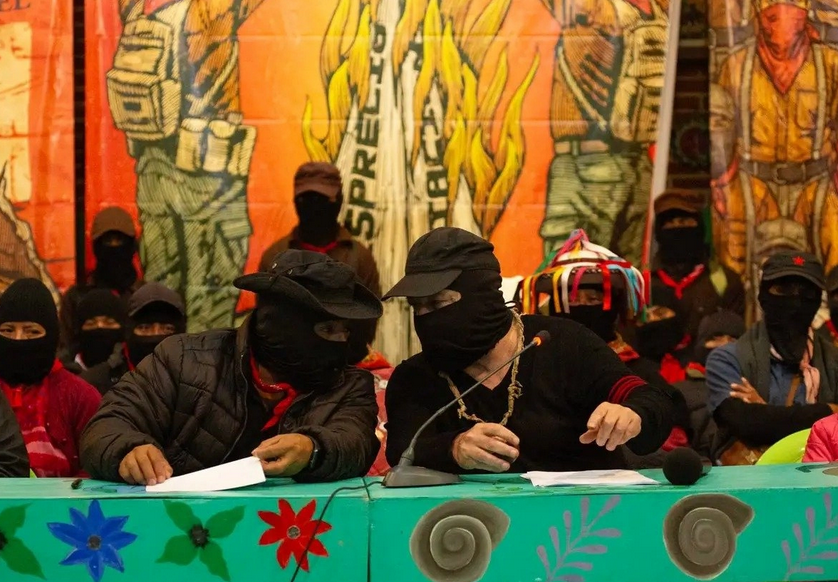
The encounter takes place within the framework of the 32nd anniversary of the Zapatista uprising in 1994 and is being held at Cideci-Unitierra in San Cristóbal de las Casas, Chiapas, from December 26th to 30th. The Zapatista Army of National Liberation (EZLN) reported that more than a thousand attendees from 40 different regions are present, in addition to 500 Zapatista Indigenous people from various Tseltal, Tsotzil, Ch’ol, Tojolabal, Zoque, Mam, Calchikel, and Mestizo backgrounds. It should be noted that this contribution, due to its regular schedule, only includes the presentations from the first three days. A popular celebration and dance are planned for December 31st and January 1st, 2026, at the Caracol of Oventik. The participation of the Zapatista Sixth Commission in all sessions is significant. Sub-commander Moisés and Captain Marcos are also present. They inaugurated the aptly named seedbed. Captain Marcos explained that they asked their guests for an “analysis of the pyramids and the manipulation of narratives within the economic system, bad governments, laws and the judicial structure, resistance movements, the left and progressivism, human rights, the feminist struggle, and the arts.”
He noted that they were asked to present their ideas to foster critical thinking among the attendees, as well as to contribute to the formulation of acts of resistance and rebellion, and that their interventions should not be limited to current events. “We are asking for seeds of medium and long-term vision that will resist and rebel against the onslaught of the immediate.” For their part, he said, the EZLN representatives would try not to repeat the platitudes that abound in the media.
In his opening remarks, he outlined key elements that support the disappearance of nation-states in neoliberal contexts. He pointed out that this imposition of ideas includes the theft of half of Mexican territory by the United States in 1848, the Spanish Conquest, and other transformative moments in Mexico, including the current administration. He asked, “Do you really think the Mexican government will demand an apology from US President Donald Trump for the so-called 1847 War? Don’t hold your breath.” He added that when the Zapatistas communicate their thinking, “we are speaking to you, but we are looking far away in terms of time and geography.”
Sub-commander Moisés, in his various interventions, addressed the context of defining the project of the commons, especially the principle of non-property ownership and the complexity of strengthening the Zapatista movement’s conviction regarding this project, its practices within the new structures created with the disappearance of the Good Government Councils, which in previous meetings have been linked to the formation of the pyramid not only in the states, but also in these spaces.
It is, I believe, about understanding the dynamics of power. I don’t know if they have a political statement planned for January 1st regarding the 32nd anniversary, but for now, the group has identified and acknowledged its history and its future direction. The distinction made by Sub-commander Moisés between the struggle through violence and the greater complexity of a peaceful political struggle, such as the one involved in defining the common good, was very important.
The second session revolved around the use of history as a strategy of the political class. Raúl Romero pointed out the use and abuse of history by the dominant classes to subjugate the dominated classes. In response, “oppressed peoples fight to recover their history,” and he provided numerous examples of a kind of official counter-history in serious cases. Along the same lines, Carlos Aguirre Rojas distinguished between history based on concrete, verifiable events and the many different interpretations of those events that seek to erase them. He presented a radical critique of currents, especially academic ones, of coloniality, decoloniality, and postcoloniality, since these approaches ultimately place the source and origin of current problems within countries in external factors.
The third session focused on human rights, and in it, both Tamara San Miguel and Eduardo Almeida, from the Human Rights Network (NODHO), addressed their persistent violation and reconstructed their defense strategies, always in support of victims and the dilemmas of continuing to demand justice through legal channels.
The lawyer Bárbara Zamora focused her presentation on the analysis of the discriminatory content that fosters dispossession in laws found in the Salinas-era counter-reform to Article 27 of the Constitution, the agrarian law, the hydrocarbons law, the mining law, and the civil code, and concluded with the impact of recent reforms regarding injunctions. In short, the Zapatista movement is a political movement that has been an active concern throughout its history.
Original article by Magdalena Gómez, La Jornada, December 30th, 2025.
Translated by Schools for Chiapas.