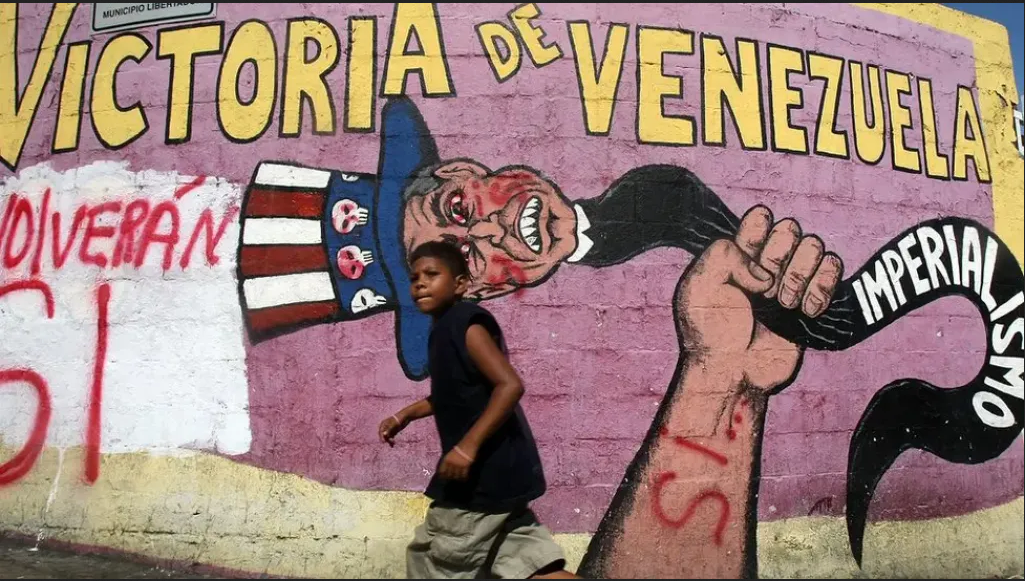
It’s not that the Monroe Doctrine has returned: it never left. President Trump’s advisors simply told him to follow in the footsteps of his predecessors: “Apply our foreign policy principles,” they said. His “neo-Monroeism” is an updated copy of that doctrine which, beginning in 1823, served to contain the geopolitical threat of the British, French, Dutch, Portuguese, and Spanish in Latin America. After the dying Spanish empire left a vacuum, it would have to be filled by the United States, in a struggle that would give it defensive justification for the continent, which stretched from Cuba and the Caribbean to Nicaragua and Central America. Much later, it was not the eternal enemies, first the Soviet “communists” and then the Russians, who were the main target of the Monroe Doctrine during the Cold War; no, it turned out to be China as well.
With proven oil reserves in the world, 950 trade sanctions, expelled from the international financial system, with more than $300 billion withdrawn from bank accounts abroad, and with the United States stealing the Citgo oil company in 2023, Venezuela was forced to ally itself with other powers, as President Maduro told the Chinese state agency Xinhua; In addition, China is one of its main creditors and importers of Venezuelan oil.
If there is one thing that capitalist propaganda (investors, banks, and companies) is right about, and that their lackeys shout about in horror, it is that Venezuela has indeed had the construction of socialism in mind. Hugo Chávez said it: “… what did all this produce? A coup in 2002, a lockout, oil sabotage, a counter-coup, discussions, and readings. I came to the conclusion (…) that the way out of poverty is socialism […]” After having taken as his original project and trying to believe in “humanizing” capitalism, whose roots were in the third way, he would say: “Today I am convinced that it is impossible […] I am convinced that socialism is the way […] I believe that it must be a new socialism, with fresh ideas, coupled with a new era that is just beginning.” That is why I dared to call it ‘21st-century socialism’ as a project. I believe it is a challenge.” (Interview with Chilean Manuel Cabieses in 2005, quoted by Beatriz Stolowicz, El misterio del posneoliberalismo [The Mystery of Post-Neoliberalism], vol. 2 ILSA, Colombia, p. 742, footnote 3.)
This socialist alternative became a challenge and a project for the neoliberal state, with a social democracy distinct from the welfare state, populism, and real socialism; and as an alternative, it was attacked for being a threat to capitalism and for anticipating a domino effect in Latin America. Nationalist or populist governments were subjected to pressure, disqualification, indebtedness, and “natural or induced destabilization,” as sociologist Pablo Gonzáles Casanova wrote. Today, Venezuela represents what James Monroe believed: America must be reconfigured for and by its corporations… Except that China is unlikely to allow its investments to be withdrawn, unless this trade dispute crosses the line into war.
Source: Schools for Chiapas