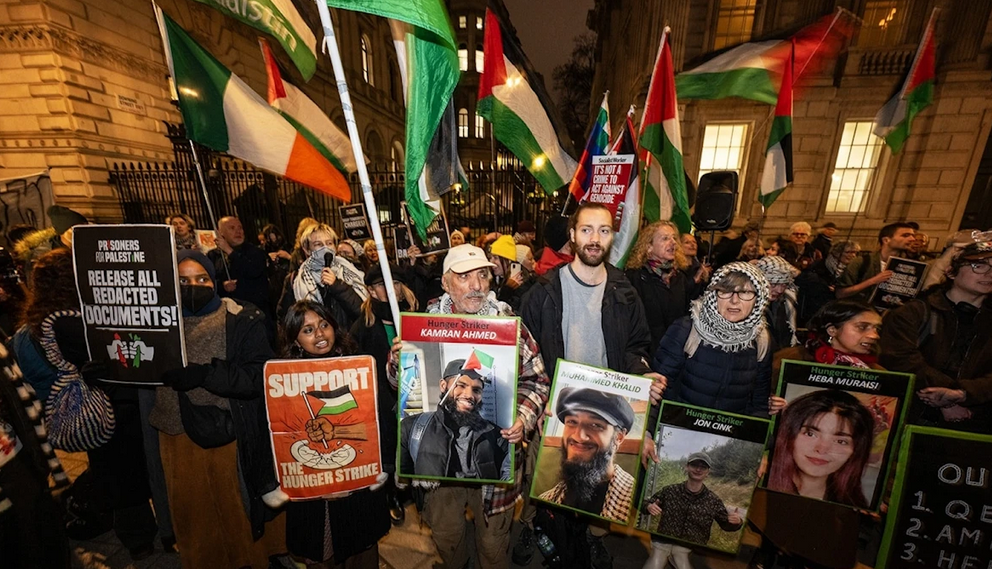
Twelve days into the new year, two of the imprisoned members of Palestine Action, Heba Muraisi and Kamran Ahmed, have entered what doctors describe as the most dangerous and medically irreversible phase of the hunger strike. Their protest has become a matter of survival, placing unprecedented pressure on the British prison system, now facing one of its most serious political hunger strikes in decades.
Medical professionals, including Dr. James Smith, warn that after two months without sustenance, the human body begins cannibalizing itself to sustain basic organ function. Fat reserves are exhausted, muscle tissue is broken down, and the risk of organ failure escalates rapidly. According to doctors who have either examined the prisoners or reviewed their conditions, the hunger strikers’ bodies are now “breaking down”, with some experiencing severe neurological impairment.
Several activists have already been forced to suspend or end their strikes in recent weeks after reaching the brink of death. Teuta Hoxha was among those who halted her protest following acute medical deterioration.
Reports from inside the prison system and from visiting physicians describe conditions that are increasingly dire. Activists have suffered partial loss of vision and hearing, tremors, and loss of motor control. Heba Muraisi, the longest fasting member of the group, is reportedly struggling to breathe. This suggests that the muscles responsible for respiration are beginning to fail. Last week, Kamran Ahmed was transferred to hospital after his condition became life-threatening.
Observers have increasingly drawn parallels between the current hunger strike and the 1981 Irish Republican hunger strike, the largest and most politically charged prison protest in modern British history. That strike, which led to the deaths of ten prisoners, including Bobby Sands, reshaped British and Irish politics and forced international attention onto the conditions inside UK-controlled prisons.
The current strike is now widely regarded as the most prominent in UK prisons since 1981, both in terms of duration and the scale of political implications it carries. As in 1981, prisoners have turned to their own bodies as a final means of protest after legal and institutional avenues failed to produce relief.
On New Year’s Eve, Belfast saw hundreds of Irish people gathering in solidarity with the starving activists whose struggle serves as a reminder of what happened 44 years ago. Standing beneath a mural of Bobby Sands, Pat Sheehan, a survivor of the 1981 Irish Republican hunger strike, warned in comments to Al Jazeera that history is once again approaching a deadly threshold. Sheehan, who spent 55 days on hunger strike before it was called off, said he was “in theory… the next person to die” when the protest ended. By that point, he recalled, his liver was failing, his eyesight had deteriorated, and he was vomiting bile. “Once you pass 40 days, you’re entering the danger zone,” he said, adding that those currently fasting for more than 50 days “must be very weak now.” Yet Sheehan noted that hunger strikes often harden resolve as they continue, explaining that if participants are psychologically prepared, “their psychological strength will increase the longer the hunger strike goes on.”
Appeals from lawyers, doctors, and MPs to British ministers to intervene have been met with outright refusal. Government officials argue that engaging with the hunger strikers would “create perverse incentives that would encourage more people to put themselves at risk through hunger strikes.” The government has attempted to normalize the situation by suggesting that hunger strikes are routine within the prison system. According to The Guardian, officials have claimed that “over the last five years we have averaged over 200 hunger strike incidents every year,” implying that no extraordinary response is warranted. However, the figures cited refer primarily to short-term food refusals by individual prisoners, a fundamentally different phenomenon from a prolonged, collective hunger strike that now presents an imminent risk of death by starvation.
Frome police raids of pro-Palestine marches, to the alienation of activists and the cowardly official response, a non-surprising pattern takes shape as the United Kingdom continues to uphold a legacy of imperialism and genocide affiliation. Yet the hunger strikers remain intent on carrying on until their demands are met.
source: Al Akhbar