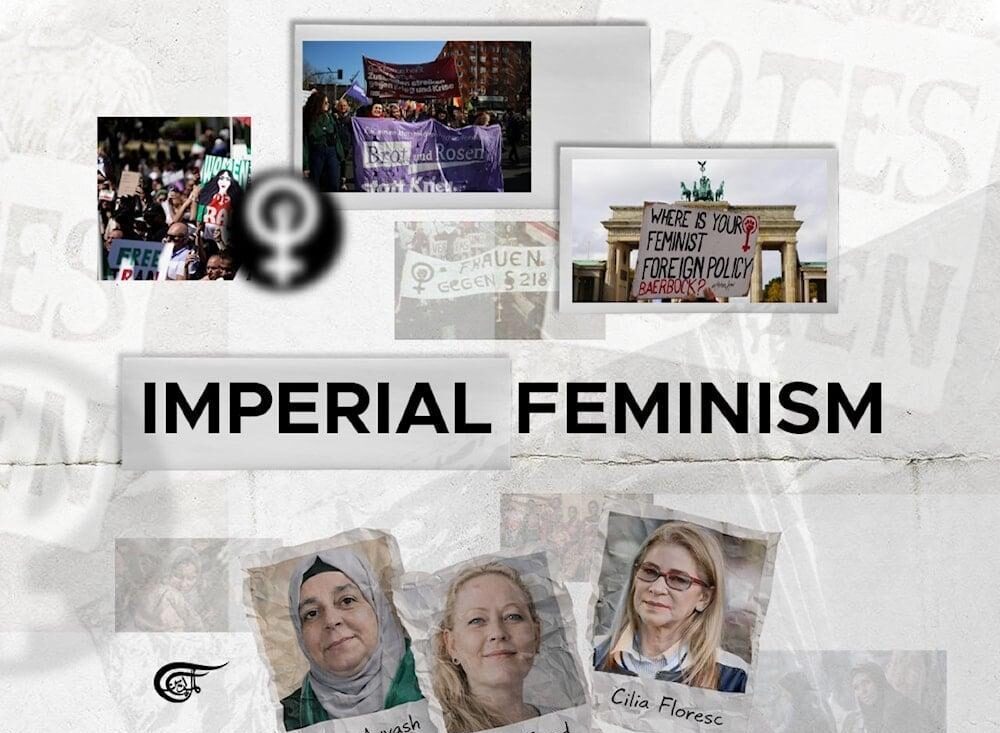
One of the most striking hypocrisies of contemporary Western feminism is not its concern for women’s rights, but its ruthless selectivity. In today’s media ecosystem, women do not appear as human beings with complex lives and contexts; they appear as symbols, activated or erased depending on political utility.
This is not feminism. It is narrative warfare.
Consider the arrest of Umm al-Baraa, Hayam Ayyash, the widow of the martyred Palestinian commander Yahya Ayyash.
She was detained not for an act of violence, but for remembering her husband. Where? On Facebook!
Her dignity, endurance, and refusal to disappear quietly should have resonated with any movement claiming to defend women against oppression.
Yet her story was met with near-total silence in feminist circles. Why? Because her suffering exposes occupation, not patriarchy, as defined by imperial frameworks.
Now, let us consider Cilia Flores, the wife of Venezuelan President Nicolas Maduro. When she appears in Western discourse, it is rarely as a woman with agency, but as an extension of a demonized political system.
Her existence becomes a rhetorical tool, used to personalize sanctions, delegitimize a state, and humanize regime-change fantasies. Concern for her rights is neither consistent nor sincere; it is conditional.
In the US itself, when a woman is killed in Minnesota, the tragedy is filtered through domestic political calculations. Her life is mourned loudly or quietly, depending on who benefits from the outrage. Justice becomes secondary to alignment.
Even within the so-called heartland of women’s rights, grief is curated!
Iran provides perhaps the clearest example of this moral manipulation. While some women who burned images of Sayyed Ali Khamenei are elevated in international media as “symbols of resistance,” the reality of countless Iranian women is erased or distorted.
A nurse, burned alive by Mossad-backed riots, had her humanity flattened into a slogan; her life and social reality went unexamined.
Meanwhile, manufactured narratives glorify foreign-based “icons”, spreading spiteful myths rather than truth.
In this way, the genuine struggles, achievements, and dignity of Iranian women—scholars, scientists, activists—are obscured, replaced by propaganda that misrepresents both their agency and their lived realities.
What mattered was how efficiently her story could be folded into an already prepared indictment. Context was stripped away to make the narrative lighter, faster, and more useful.
Deliberately, global attention is disproportionately lavished on carefully framed images: women smoking cigarettes, removing headscarves, or burning portraits of Sayyed Khamenei.
These scenes are elevated into icons of liberation, endlessly recycled because they photograph well and serve a psychological objective. They signal defiance in a form easily digestible to Western audiences—and easily weaponized against a targeted state.
What is never asked is whether this obsession reflects genuine concern for women, or merely the needs of an imperial storyline. Where is the outrage for women crushed by sanctions? For mothers in Gaza living under siege? For widows whose loss is criminalized rather than mourned?
These women do not disappear by accident; they are actively excluded.
This is the essence of imperial feminism: a framework that does not defend women universally, but recruits selected women into a geopolitical campaign.
It celebrates transgression only when it weakens an adversary. It mourns death only when it indicts an enemy. It speaks loudly when silence would undermine power, and falls silent when truth would disrupt it.
Smoking a cigarette or burning a photo does not, by itself, constitute liberation. Nor does remembering a husband constitute incitement. But the elevation of one act and the erasure of the other reveals the core problem: women’s bodies, grief, and gestures are being instrumentalized.
Emancipation that walks comfortably alongside sanctions, occupations, and psychological warfare is not emancipatory; it is managerial. It manages outrage, distributes sympathy, and disciplines dissent.
Until this hypocrisy is confronted, the claim of universal solidarity will remain hollow.
True justice for women cannot coexist with selective visibility. Either women matter as human beings—everywhere, without exception—or they are merely tools in a war of images. And today, far too often, the choice has already been made.