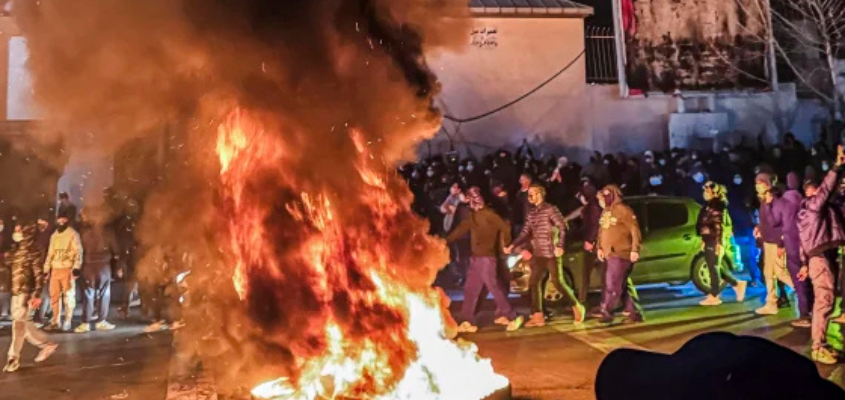
The strategy of tension refers to the NATO strategy in post-World War II Europe to defeat the ascendant communist parties. In Italy, this was referred to as Operation Gladio, and involved money laundering, ballot stuffing, murder, and kidnapping. Outside of Italy, this strategy of tension took many forms: funding fascist stay-behind armies in Germany, setting up fake press agencies full of hitmen as in Aginter Press, and coordinating assassinations and decapitation operations. When viewed historically over the longue duree, the imperialist class that implemented the strategy of tension in postwar Europe is still a hegemonic force in geopolitics. Today, the targets are not so much powerful communist parties (although the targeting of socialist China is part of the imperialist strategy today) but instead targeting any renascent social formations seeking sovereignty from the US dollar system and attempting to build a multipolar world. The aim of this article, then, is to view the recent unrest in Iran through the lens of the strategy of tension to show how what was once a tool of a newborn NATO has now morphed into a full-bore system of hybrid warfare. Some of this analysis will take us back to 1979 and the birth of the Islamic Revolution, with an aim of showing that history cannot be read in its immediacy, but rather should be viewed as the development, integration and disintegration of social formations according to the overarching structures of the world-system: capital and imperialism.
The Islamic Revolution took place in the waning period of Arab nationalism and towards the twilight of the Soviet Union, in a period where the hegemony of US capitalist-imperialism was concretizing its control over West Asia through its attack dog, “Israel”. The previous ruling classes of Iran: the Shah and imperial court, the big capitalists, and the landlords were content to normalize relations with the Zionist state and participate in Western security operations and schemes across the region and the world. This system, protected by the brutal Savak secret police, wore down the popular classes of workers, merchants, clerics, and peasants. With the Islamic Revolution, the popular classes took control of Iran and guided the country on a path of sovereign development, anti-colonialism, with the state taking control of major industries and nationalizing the patrimony of the Iranian people. Max Ajl describes it thus:
The last major Jacobin-style revolution of the last millennium, the 1978–1979 revolution in Iran, marked a turning point in the history of the region. Mass mobilizing the population…it drew on a mix of Marxism, dependency theory, liberation theology, and Arab republicanism… By the early 2000s, Iran’s doctrine of “strategic depth” merged with ideological commitment in layers of the state to anti-imperialism and anti-Zionism, and increasingly it became a semi-industrialized semi-periphery.
This takes us to the events of the last two and a half years and especially the last few months. Operation Al Aqsa Flood was a decisive blow to the Zionist-imperialist system of domination. The IOF and their American backers have been thoroughly exposed as paper tigers. This operation by the Palestinian resistance would not be possible without Iranian financial and material support, which does not come with ideological strings attached, as Marxist as well as Islamic groups in Palestine receive this support. Since 1979, Iran has had a target on their back because of this unwavering–and in fact, constitutional–support for Palestine and the oppressed peoples of the world. The level of Iranian support is a key factor in the anti-colonial movements against Zionism. Turning to Ajl again:
Iranian weapons and training are free, representing “the possibility of access to weapons for the poor”… Indeed, their blueprints are often open-access or freely shared from Iran to its state and sub-state partners.
Ever since the birth of the Islamic revolution, with the Iraqi invasion and kinetic warfare failing in the first round, an entire edifice of hybrid warfare has been set up to destabilize Iran and promote regime change. Sanctions and external meddling in the financial system have been two main practices.
Imperialism is the current phase of capitalist accumulation, and as such it defines the structural forms of accumulation on a world scale. Hegemony of the US dollar, financialization, and wars of extermination and regime change define the current epoch of capitalist-imperialism. Thus, the first signal of the attack on Iran in late 2025 was when the US used their regional satrapies—Saudi Arabia, UAE, and Turkiye—to destabilize the Iranian currency. This caused protests among the merchant class who are rightfully concerned about their businesses which are already squeezed by maximum sanctions. These protests were portrayed in the western media as anti-state and anti-revolution, when in reality there were no such sentiments among the merchant class protesters. Currency manipulation is a tool of the sanctions regime that brings the hammer down on ordinary people, and this tool has assumed critical importance as sanctions become among the favored strategies of imperialism. Yet, in Iran, other more kinetic interventions are made; namely, the mobilization of internal dissent and mercenaries.
After the currency devaluation, internal fifth columns of Mossad agents and disgruntled monarchists were activated to join the protests and indulge in violent outbursts which caused unrest and thus, a government response. According to Dr. Mohammad Marandi, the main groups in Iran serving imperialist designs are fourfold: MEK, an exiled political organization that receives funding and training from the U.S. via Albania. Then, there are the pro-Shah monarchists whose main base of support is in Los Angeles. Thirdly, what remains of ISIS after Qassem Soleimani and the IRGC routed them from 2013 onward. Finally, there are the Kurds in the north of Iran who are separatists receiving US training and munitions, similarly to the Syrian Kurds who have been mobilized by the US military to de-Arabize the north and with whom the imperialists facilitate oil sales. This element of the strategy of tension is a key link in the chain, which enables western media outlets to sway their audiences into believing there is a popular movement against Iran from within.
Western media operations are another key element in the strategy of tension because they shape the narrative. The merchants who protested because of the currency devaluation are shown in the media as one of many groups who want to overthrow the revolutionary government. In one amazing clip from Sky News in the UK (viewable in the interview with Dr. Marandi above), the host talks about ‘bodies piling up in the street’, and other trauma farming narratives. Then, when she is corrected by Dr. Marandi, she walks back her statements, but it is already too late. The image of a bloodthirsty regime has already been crafted. In the American media, outlets from the likes of liberal NPR all the way to conservative Fox News speak in a unified voice, portraying Iran as a house of cards ready to fall. When confronted with the images and videos of millions of Iranians out in the streets defending their state and revolution, Western media pundits and celebrities like Elon Musk call the videos A.I., or say that millions of people were forced to go out and protect their revolution by the government. We are dealing with a sort of Schrodinger’s Iran: both on the cusp of collapse and powerful enough to force millions of people to defend the government in the streets. The final consideration in this analysis of the strategy of tension is how the left in the West responds to Iran, and how their maldeveloped view of imperialism shapes this perspective.
In many circles of the Western left, a third positionist posture is often taken when dealing with the question of Iran. ‘Neither Washington nor Tehran’ or ‘neither Tel Aviv nor Tehran’ seems to be the clarion call of these leftists. For example, in a recent Jacobin Radio episode, the position is portrayed as such by the guests: “Iranian protesters overwhelmingly reject both the Islamic Republic and the shah’s dictatorship”. Or we can look at an interview in ROAR magazine regarding the Syrian crisis, where the guest being interviewed insists that “they [anti-imperialist Marxists] tend to think that imperialism is an essence ensconced in the US or in the West and will never think of Russia or China or Iran as imperialist powers”. Arab anti-imperialist, socialist scholars such as Ali Kadri and Anouar Abdel Malek, before him, contend that this third positionism has to do with the fact that “imperialism as a central factor in the power structure of modern times was viewed in its immediacy and not as a contemporary expression of a historical process”. For Kadri–originally speaking about Chomsky’s third positionism in the Iraq war–this is tantamount to supporting imperialism:
What purpose other than backing the imperialist invasion does such a statement serve[?] Neither consequentialist nor deontological ethics, nor any other ethic for that matter, can be invoked to support such a view. Although there is no puritanical theory without ideology, the ethic of such ‘beautiful souls’ negates everything and achieves nothing.
Put plainly, the Western left believes that the real forces challenging Zionism and imperialism should be replaced with morally untainted and ideologically pure forces which will end imperialism and abolish the value form in one broad stroke. The calls to ‘free Palestine’ from the Western left become a whisper when questions about Iran, the axis of resistance, or in fact, non-Marxist, Islamic revolutionaries enter the discourse.
All of this combined: media operations, currency manipulation, mobilization of fifth columns, and use of the pliant left in the West to promote certain narratives form the current strategy of tension used by the imperialist forces to destabilize and destroy Iran. The reasons for the imperialists to destroy Iran are manifold: Iran’s support for the Palestinian revolution, the fact that Iran represents a sovereign and autonomous center of development and accumulation in West Asia, and relatedly, Iran being the number one supplier of energy to China. While regime change has failed this time around, as it did in Venezuela, we should be vigilant and continue to challenge the Zionist-imperialist assaults on the global south.
Hanna Eid is a Palestinian American writer, researcher, and a Union electrical worker. His writing concerns mainly imperialism and anti-imperialism in West Asia and West Africa.
souce: Black Agenda Report