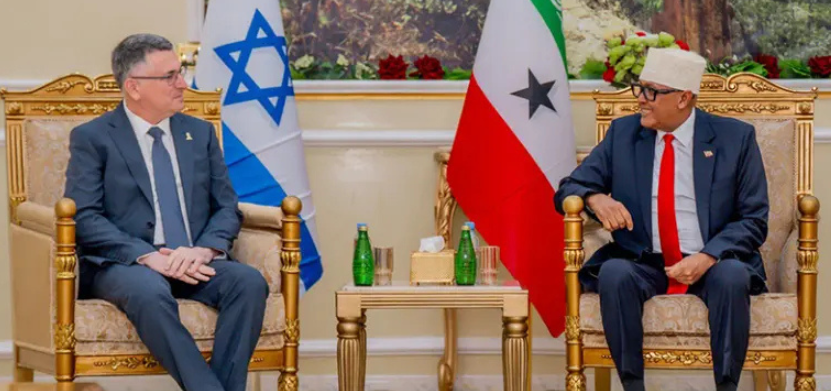
Since 1991, a reactionary element in “Somaliland” has been attempting to secede from Somalia. Those tensions were raised on December 26 when the Zionist entity many call Israel recognized this effort. Its intent is to have a place to which it could permanently expel Palestinians from their rightful homeland and, along with the US, gain a stronger military hold in the region. The entire international community has condemned this move, with the exception of the US. AWB spoke with longtime independent journalist Ann Garrison about the situation and the ramifications of “Somaliland” secession going forward.
BLACK ALLIANCE FOR PEACE: Thank you for joining us again.
ANN GARRISON: You’re welcome. Glad to be with you.
BAP: For those unfamiliar with the complex history of the current situation in Somalia, talk about 2-3 factors and events one could start at to get up to speed on the current tensions?
AG: Thanks for asking that question. Somalia receives so little media attention that it’s often hard to know where to start. I’d actually like to talk about 4 factors.
First, “Somaliland,” the secessionist state within Somalia, no longer exists within the colonial borders of British Somaliland.
Maps published by the New York Times and other corporate media show Somaliland within those borders, but that just indicates their ignorance and indifference to Somalia’s recent history and facts on the ground. It’s typical of their ignorance and indifference regarding Africa as a whole.
The secessionists based in Hargeisa, the state capitol, still control roughly half the former colony, but nationalists won the other half in the Las Anod conflict, which took place between early February and August 2023. There were hundreds of deaths, thousands injured, and over 200,000 displaced before nationalists prevailed and raised the Somali national flag above their new capital, Las Anod.
The border between the secessionists and nationalists is still patrolled by armed forces on both sides, but nationalists maintain military and administrative control. They elected an 83-member regional parliament, and on July 31, 2025, Mogadishu formally recognized the territory as Somalia’s Northeast State, one of its seven federal member states.
The nationalist victory makes it inaccurate to talk about “Somaliland” because the secessionists in Hargeisa still claim that it includes what is now the Northeast State. The quotation marks around “Somaliland,” which you also used, are the best solution for now.
Israel has made obscure Somalia a hot topic, the African frontier of Greater Israel. It came out that even Jeffery Epstein and his associates had sick and twisted designs on “Somaliland,” particularly Berbera Port, but there’s still very little interest in the Somali people.
Second, polarization around Israel, Palestine, and Somaliland will destabilize Somalia, the Horn of Africa, and the wider region.
As you noted in your introduction, much of the world is incensed by the idea that Israel will expel survivors of the Gaza Genocide to the secessionist state. It should be noted that Somalis, including many “Somalilanders,” are among the most incensed because they support the Palestinian people. Israeli and Hargeisa’s announcement inspired protest across Somalia, but Hargeisa quickly suppressed protest in the area under its control.
Somalia is one of only 26 to 29 nations that have never recognized the State of Israel.
In late December 2025, Dr. Dan Diker, president of the Jerusalem Center for Security and Foreign Affairs, an Israeli think tank close to the Israeli government, stated in an X space discussion that “Somaliland’s” leaders had made a “very generous offer” to absorb up to 1.5 million Palestinians, approved by “Somaliland’s” president around December 20, 2025.
Saudi Arabia, Turkey, and Sudan all condemned Israel’s recognition of the secessionist state and its presumed intent to exile Palestinians there, but Kenya, Ethiopia, and the UAE, all of which have increasingly closer ties with Israel, have remained silent. In Kenya, Israel has an outsized presence, including military cooperation. Its embassy is the largest in Nairobi.
Ethiopia has traditionally supported Palestine, but it abstained on recent UN General Assembly resolutions, most notably on the September 18, 2024 resolution demanding that Israel end its unlawful presence in Occupied Palestine. It welcomed Israeli Foreign Minister Gideon Sa’ar in Addis Ababa in May 2025 as the genocide continued.
The UAE are signatories to the Abraham Accords normalizing relations with Israel, along with Bahrain and Morocco. Sudan also signed but its signature has become irrelevant since the Gaza genocide and the Sudanese civil war began.
The UAE has also been a large investor in both Somalia and “Somaliland,” but Somalia has canceled all its lease agreements with the UAE and expelled it from the country since Israel recognized the secessionists.
Somalia and Saudi Arabia have signed a military cooperation agreement to counter Israel’s recognition of Somaliland. How will the US respond to its Gulf allies lining up on either side of this? With regard to Israel’s move, the US has said that Israel is a sovereign nation with the right to recognize whomever it pleases.
“Somaliland” has lobbyists in the US, including the Heritage Foundation, Texas Senator Ted Cruz, and Idaho Senator James Risch, but the US doesn’t need to recognize “Somaliland” to get Berbera Port and whatever else it needs strategically. “Somaliland” never says no to the US as is.
The African Union has adamantly opposed Israel’s recognition of “Somaliland.”
Given all these alliances and counter alliances, it should be obvious that, as the Black Alliance for Peace wrote, Israel’s action and US blessing will further destabilize Somalia and the Horn of Africa.
Third, “Somaliland’s” Berbera Port is a geostrategic prize.
The secessionists control Berbera Port on Somalia’s Gulf of Aden coast, where the Bab el Mandeb Strait connects the Red Sea to the Arabian Sea and the Indian Ocean. Berbera sits at the interface of Europe, Africa, and Asia. Ten to twelve percent of the world’s global maritime trade was passing through the Bab el-Mandeb, including roughly 10% of its oil, until 2024, when Houthi rebels began attacking ships associated with Israel, causing a 50% decline and forcing cargo carriers to use a much longer and more costly route around the Cape of Good Hope. Recent reports say it’s now dropped by 60%. Berbera is also, as you mentioned, an ideal location for firing on the Houthis.
Just east of the Bab el Mandeb Strait is the Strait of Hormuz, which connects the Persian Gulf to the Gulf of Oman, the Arabian Sea, and the Indian Ocean. Roughly 20% of the world’s oil passes through the Strait of Hormuz, which Iran has threatened to close if attacked by the US and Israel.
These are the most contested waters in the world, with chokepoints so critical that all the world’s major powers and some mid-level powers maintain a naval presence here. The US, France, China, Japan, and Italy have naval bases in Djibouti, a tiny nation on the Bab el Mandeb between Eritrea and Somalia, but Djibouti’s lease agreements stipulate that none of them can use these bases to attack another nation. The secessionists have not indicated that they would impose any such restriction on bases in Berbera Port.
Russia, just to indicate the significance of these waters, is reported to be negotiating with Sudan to build a base on its Red Sea coast. It’s also reported that Eritrea may collaborate with Saudi Arabia to develop its Assab Port, also on the Red Sea.
The US 2022 National Defense Authorization Act referred to “Somaliland” more than to any actual African nation, describing plans to establish a US military base in Berbera. Then and now, however, the US has reiterated its respect for the territorial integrity of Somalia, even though it negotiates with the secessionists as if “Somaliland” were independent.
Fourth, Somali society is organized into clans.
The modern nation state is a governance structure established in Europe after the 1648 Treaty of Westphalia. Europe imposed it on Africa, often trapping people who don’t speak the same language or share the same ethnicity or clan in a single, unfamiliar governance structure.
Somalia is almost unique in SubSaharan Africa in that its people speak the same language and share the same culture. Many Somalis also speak English and/or Arabic, but Somali is most widely spoken throughout the country. Clan competition for resources is the primary source of conflict.
The future of African nations divided by ethnicity, like Sudan and South Sudan, depends on whether they can forge a national identity that supersedes ethnic identities. Somalia’s future depends on whether it can forge a national identity that supersedes clan identities.
A passionate Somali identity has at times emerged in conflicts with Somalia’s neighbors, Ethiopia and Kenya, because Somali populations were included within these nations’ unnatural colonial boundaries. The dream of “One Somalia” has inspired border wars including the Ogaden War with Ethiopia and the Shifta War with Kenya, but at the same time, clan conflict divides Somalia internally.
The Isak clan controls the prized Berbera Port and Hargeisa, and many Somalis call it “a one-clan enclave.”
BAP: In 2011, South Sudan was severed from the formerly unified state of Sudan becoming the newest recognized sovereign state in the world. Needless to say, its recognition did not bring any more stability to the region as espoused by the West. In fact the opposite continues to this day. Can you compare and contrast the two situations? What could we learn from the West playbook under the Obama administration, facilitating that split?
AG: First, I recently did a long interview with Ahmed Kaballo, Sudanese editor of Sovereign Media, which is posted on the Black Agenda Report YouTube Channel. That’s the best source I can recommend for understanding Sudan and South Sudan right now.
As to the balkanization of Somalia, Sudan, South Sudan, or any other African nation, it’s often promoted by outside powers like Israel in Somalia. The UAE’s proxy, the Rapid Support Forces (RSF), is fighting for a second partition of Sudan, which would make the new partition a de facto UAE colony.
Larger states are better able to defend themselves militarily and to develop more resources, playing to regional strengths, but size is of course not enough in itself; popular organization and good leadership are prerequisites. Nigeria and DRC are large but they have neither, and they are among the most exploited nations in Africa.
In Sudan, before partition, the grievances of the Southern people were 100% legitimate, but as Ahmed said, “If you have a corrupt military dictator like Omar al-Bashir, the solution is to get together to get rid of him and build something better that serves everyone.”
Sudan has become the world’s worst humanitarian crisis since partition. South Sudan has become its poorest country.
Sudan is in its second civil war and South Sudan is in its second since partition.
BAP: In the Black Alliance for Peace statement condemning the recognition of Somaliland, it refers to the current Somali government as “comprador.” Can you talk about how the Somali federal government has been complicit in creating the pathway to this point, even though it officially opposes the move?
AG: In Sudan, General Abdel Fattah al-Burhan, despite his responsibility for the current war, can at least be seen as the defender of Sudan’s sovereignty. Somalia’s President Hassan Sheikh Mohamud doesn’t seem to defend anything but enriching himself and his family and staying in power.
He has not objected to the US’s drone bombing campaign, even as it accidentally hits innocent families, and despite its absolute failure, for 19 years, during which Al Shabaab has only grown stronger.
With regard to the secessionist state’s promises to militarily collaborate with the US and give it full access to Berbera Port, he has claimed that he’s the one with the right to give it all away.
The previous president, Mohamed Abdullahi Mohamed, aka Farmaajo, understood that sovereignty required sovereign security forces. He sent Somali troops to train in Eritrea and tried to negotiate a timetable for foreign forces’ departure.
President Hassan Sheikh Mohamud squandered the forces trained in Eritrea on feckless missions and made no attempt to expel foreign forces.
BAP: Opposition to terrorism is the most common pretext for the militarization of the Horn of Africa. To the degree such entities such as Al Shabaab do exist, who funds such groups and why?
AG: Al Shabaab taxes and otherwise extorts funds from the population in areas that they control and extorts wealth in other areas by threat.
Countries looking for a strategic edge in Somalia also fund Al Shabaab. The US and UK have been known to acquire intelligence from Al Shabaab assets, and intelligence isn’t free.
BAP: What would “Somaliland” independence mean for neighboring Ethiopia and what role has that country played in arriving at this point in the situation?
AG: Ethiopia is a large landlocked nation determined to gain sovereign sea access. This might have been negotiated during the period between 2018 and 2020, after Somalia, Ethiopia, and Eritrea signed a regional agreement to collaborate on security, culture, and regional trade and development. The US undermined that agreement by backing the TPLF in the Northern Ethiopian Conflict and moving to replace Farmaajo with Hassan Sheikh Mohamud.
In January 2024, Ethiopia outraged Somali nationalists by signing an MOU with “Somaliland” to lease a stretch of its coast for a commercial port and naval base. Ethiopia reportedly agreed to recognize “Somaliland” in exchange, but the details of the MOU were never revealed, and it was never implemented.
“Somaliland” can’t hope to become a UN member state because China would veto its application in the Security Council. It might become a quasi-state like Kosovo, which is recognized by NATO nations but not by Russia, China, or the UN. That might reduce resistance to Ethiopia’s lease of that stretch of its coast.
BAP: Why should people in the US, especially working-class Africans, care about what is going on in Somalia, and how do the current attacks on the Somali community living in the US tie into all this?
AG: Malcolm X said that the African struggle is global, shifting his focus from purely American civil rights to a struggle against colonialism and imperialism. I couldn’t say it better, and of course working-class Americans have most reason to care because those in what Black Agenda Report calls the Black Misleadership Class have long since abandoned the struggle for African liberation.
The rest of the anti-imperialist movement in the US should of course oppose US aggression in Somalia and everywhere else.
As to Trump’s ugly attacks on Somali Americans, they degrade him and all the Americans applauding, but they also give him an excuse for doing whatever he wants to Somalia. If it’s “not even a country,” then why should he respect its sovereignty?
BAP: Complex issues, what would you like to add that we did not address?
AG: LOL. This is 2500 words, as much as BAR can publish, but I wrote 3500, so maybe you can publish the long version on the BAP website.
Ann Garrison is a Black Agenda Report Contributing Editor based in the San Francisco Bay Area. In 2014, she received the Victoire Ingabire Umuhoza Democracy and Peace Prize for her reporting on conflict in the African Great Lakes region. She can be reached at ann@anngarrison.com. You can help support her work on Patreon.
source: Black Agenda Report