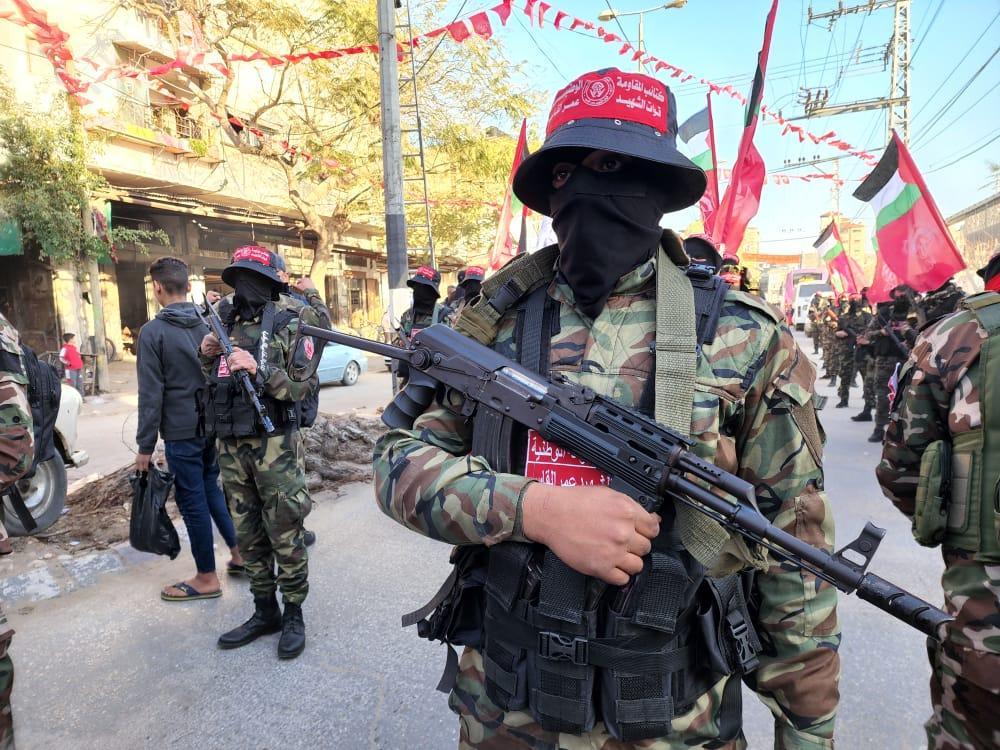
The answer does not lie in a single event, but rather in an equation that combined political realism with steadfastness in struggle, and field action with mass mobilization, within a vision that consistently sought to reconcile national rights with the demands of the historical moment.
From Founding to Articulating a Political Vision
Founded on February 22, 1969, in the midst of a turbulent Arab and Palestinian context, the Democratic Front did not simply add another organization to the map of Palestinian factions. Rather, it sought to reframe the concept of Palestinian struggle from a leftist, democratic perspective that linked national liberation with social and economic emancipation.
It stood out early on with its bold political program, particularly its 1974 Phased Program, which called for establishing a national authority over any liberated part of Palestine. Despite the fierce controversy it sparked at the time, it later became one of the cornerstones of the Palestinian national program and contributed to shaping the approaches adopted by the institutions of the Palestine Liberation Organization (PLO), the sole legitimate representative of the Palestinian people.
In this sense, the Democratic Front did not limit itself to the role of a combatant in the field, but sought to be a partner in shaping the national decision-making process and developing its intellectual and political framework.
Three Pillars Shaped Its Path
Over the course of 57 years, the Democratic Front’s experience has been based on three main pillars, which continue to form its intellectual and organizational structure:
First: Revolutionary Realism
The Democratic Front adopted the principle of “revolutionary realism,” which involves assessing the balance of power with political awareness without abandoning strategic goals. From this perspective, it developed the concept of comprehensive uprising, culminating in comprehensive national defiance, as an advanced form of popular struggle that integrates popular resistance with various forms of struggle within a unifying national vision.
Second: Organizing the People and Building a Social Base
The Democratic Front viewed the masses as an organized force that should be framed within effective democratic structures: labor unions, student organizations, women’s groups, and professional bodies. It clearly linked national liberation with social justice, arguing that defending the occupation is inseparable from defending workers’ rights, students’ rights, women’s rights, and the rights of marginalized groups, and that the national project is incomplete without its social dimension.
Third: Integrating Forms of Struggle
The Democratic Front adopted the principle of complementarity between political action and resistance, and between diplomatic engagement and field action, according to the prevailing political and legal circumstances and available opportunities.
It participated in defending the refugee camps in Lebanon, played a prominent role in the First Intifada (1987) through popular committees and field mobilization, and continued its presence in the Second Intifada (2000), with its leaders and cadres present in various confrontation arenas, including the battles to defend Gaza during the recent war of extermination.
Between Current Challenges and Future Stakes
Today, the Democratic Front – like all components of the Palestinian national movement – faces profound challenges: ongoing internal divisions, declining effectiveness of national action institutions, accelerating regional transformations, and attempts to liquidate the Palestinian cause or reduce it to partial solutions.
Nevertheless, the Democratic Front continues to propose political initiatives based on restoring national unity on the basis of a comprehensive resistance program and genuine democratic reform of the PLO institutions, which reaffirms the principle of partnership and pluralism.
A Renewed Legacy, Not a Fleeting Memory
On February 22nd of each year, the Democratic Front commemorates its launch, not just as a celebratory event, but as a moment of review and renewal.
History is not measured by the number of years, but by the ability of an idea to survive and evolve. Over the course of 57 years, the Front has produced martyrs, wounded, and prisoners from its leadership, fighters, and cadres, in defense of the inalienable rights of the Palestinian people: freedom, self-determination, independence, and the right of return.
This is a journey that confirms that the national project is not preserved by slogans alone, but by organized action, a renewed political vision, and a will capable of adapting to changes without compromising national rights.
After fifty-seven years, the question remains open: how can the Palestinian national project be rebuilt on the foundations of unity, resistance, and social justice?
This is the challenge that constitutes the essence of the political battle in the coming phase.
Wissam Zubeidi