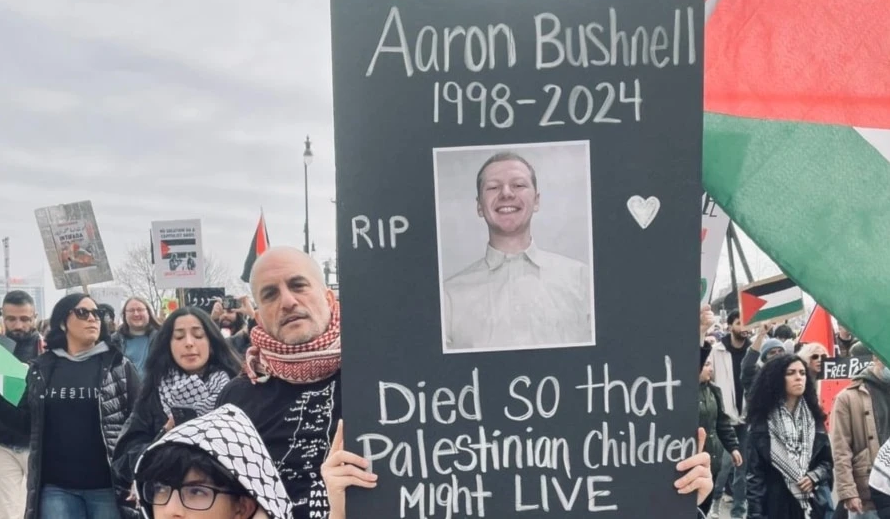
It has been two years since Aaron Bushnell, a 25-year-old active-duty US Air Force member, stood in front of the Israeli Embassy in Washington DC, doused himself in accelerant, and ignited a flame that he intended to be “an extreme act of protest.” As he burned, Aaron did not scream for help; he shouted “Free Palestine” until his breath failed him.
On the morning of February 25, 2024, Bushnell posted a final question on his Facebook: “Many of us like to ask ourselves, ‘What would I do if I was alive during slavery? Or the Jim Crow South? Or apartheid? What would I do if my country was committing genocide?’ The answer is, you’re doing it. Right now.”
Unlike the self-immolations of the Vietnam era, such as Thich Quang Duc in 1963, Bushnell’s protest was built for the era of instant, unedited transmission. He livestreamed the entire event on Twitch. The footage was raw, visceral, and, to many, deeply traumatizing. Besides his resolve, the video captured the surreal reaction of the state: while a police officer scrambled for a fire extinguisher, a Secret Service agent kept a gun trained on Bushnell’s burning, collapsing body, repeatedly ordering the dying man to “get on the ground.”
Immediate media coverage was the epitome of institutional hesitation. Major outlets like the New York Times initially ran headlines that stripped the act of its political intent, describing it simply as a “man setting himself on fire” without mentioning Gaza or his military status in the lead.
As the days turned into weeks, a predictable split emerged. Conservative commentators labeled him an extremist or mentally ill, while progressive and “anti-war” voices hailed him as a martyr who had reached the “limit of what a soul can bear.” This tension highlighted a deeper discomfort in the US psyche: the refusal to acknowledge that a stable, high-performing member of the military (Bushnell was a cybersecurity specialist and DevOps engineer) could be driven to such an end by a purely political and moral conviction.
In the two years since, what we can call the “Bushnell Effect” has manifested in tangible ways within the Department of Defense. His death sparked a quiet but significant surge in conscientious objector applications. Active-duty members, inspired by his refusal to be “complicit,” have stepped forward to seek discharges, citing moral injury.
Bushnell’s act forced a conversation about “legal pluralism”, the idea that an individual might answer to a higher moral law that contradicts state policy. While the US government maintains its strategic alliances, the internal pressure from the rank-and-file has become a persistent thorn in the side of the Pentagon.
Aeron Bushnell’s name is now part of the geography of the conflict. In the West Bank, the town of Jericho named a street after him, a gesture that underscored the global perception of his act: a rare instance of an American “insider” sacrificing everything to bridge the gap between Western privilege and Palestinian suffering. Hamas issued a statement, expressing their “heartfelt condolences,” to Bushnell’s family and commemorating his sacrifice as one that “immortalized his name as a defender of human values and the oppression of the suffering Palestinian people.”
For those who gather at vigils today, Aaron Bushnell is a reminder that the cost of complicity is sometimes paid in the most public and painful way imaginable. His ashes, per his will, are to be scattered in a “Free Palestine”, a final journey toward the liberation he called for with his last breath.
Source: Al Akhbar
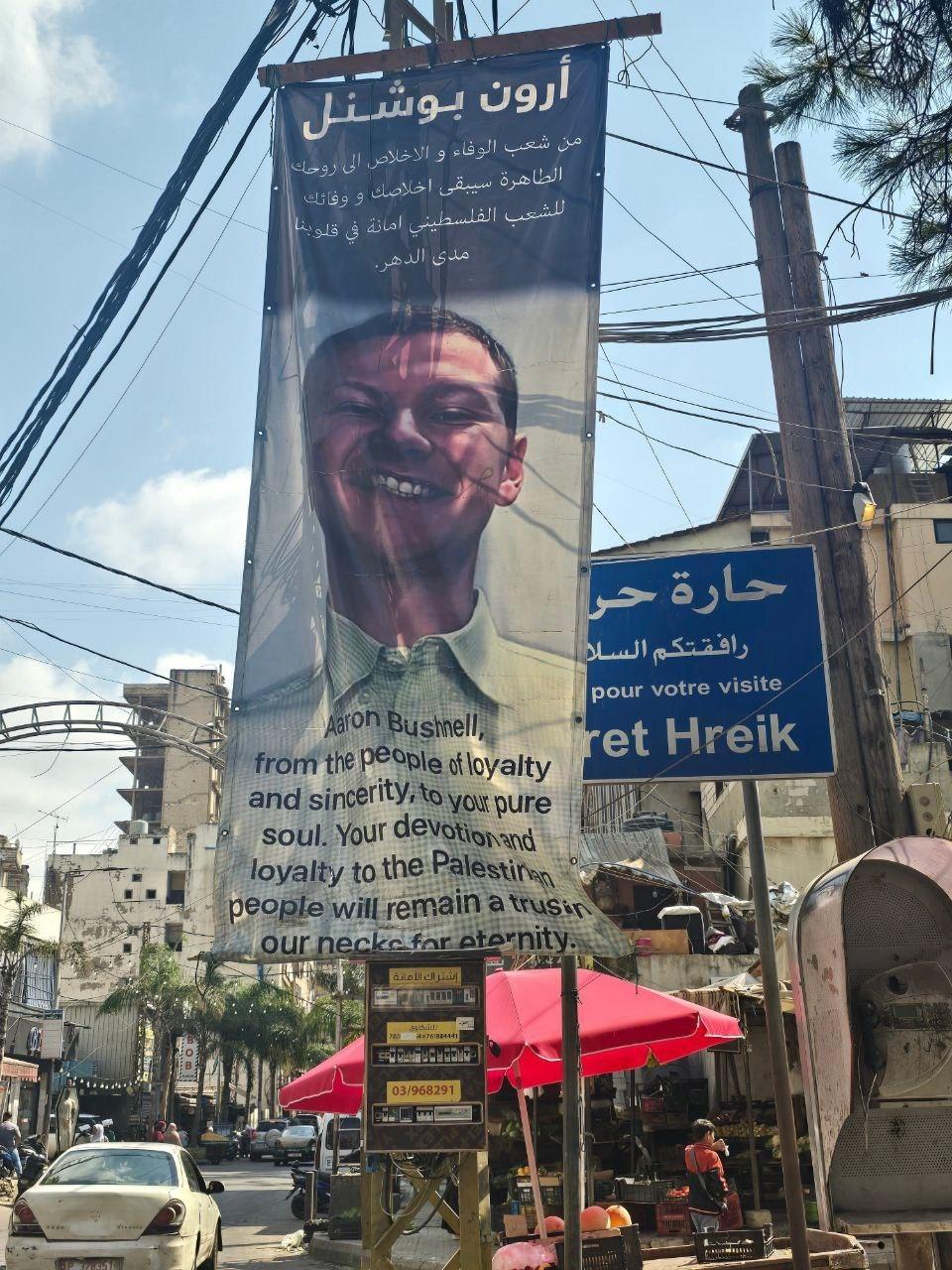
Combine with the above article: In the Haret Hreik neighborhood of Dayihe, Beirut, a banner is raised to honor Aaron Bushnell, who self-immolated in front of the zionist embassy in Washington in solidarity with Palestine and in rejection of his country’s position supporting the genocide war waged against.
“Aaron Bushnell, from the people of loyalty and sincerity, to your pure soul. Your devotion and loyalty to the Palestinian people will remain a trust in our necks for eternity.”