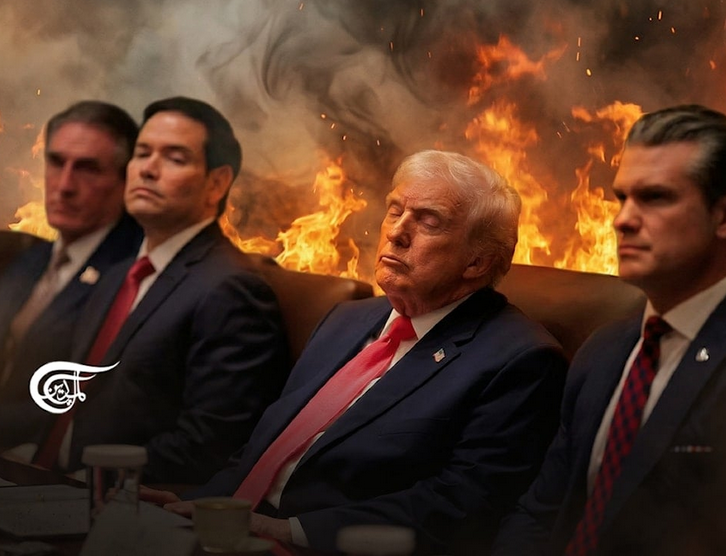
Over recent weeks, an ominous US military buildup throughout the waters and territories of West Asia has gathered pace. Concurrently, murderous mass protests – openly sponsored by Western leaders – have raged with fluctuating intensity throughout major Iranian cities. All along, President Donald Trump has issued dire threats of impending “bad things” if Tehran rejects curbs on its nuclear research and missile production. But as the drums of war reach a belligerent crescendo, urgent notes of warning are being widely sounded.
The Western media has singularly failed to question the ultimate objectives, let alone legality or morality, of US military action against the country. Instead, outlets have typically outlined the potential merits of “intervention”. The BBC has gone to the extent of publishing an explainer guide to different attack “scenarios”. On February 19th too, the British state broadcaster expressed bewilderment that efforts by Washington and Tel Aviv to intimidate Tehran into dismantling her vital national and regional security architecture have floundered:
“Why do Iranian leaders, at least publicly, remain defiant in the face of the world’s most powerful military and its strongest regional ally in the Middle East?”
The BBC attributed this intransigence to Iranian displeasure with the terms sought by Trump, noting that “from Tehran’s perspective, [US] demands amount not to negotiation but to capitulation.” However, senior officials in Washington precisely endorse this view. On February 21st, White House envoy Steve Witkoff spoke of how the President was “curious” as to “why, under this sort of pressure, with the amount of sea power and naval power” in West Asia, Iran’s leadership “haven’t capitulated.”
Two days later, an answer to the apparent enigma of Tehran’s refusal to be bullied into rendering herself a defenceless target for Judeo-American imperialism was provided. Axios, the Wall Street Journal and Washington Post published virtually identical ‘exclusive’ reports on how top US general Dan Caine has privately cautioned the Trump administration of “significant risks” attached to taking military action against Tehran; in particular, the very high prospect that even a “limited strike” would produce prolonged conflict, which would be deeply destructive for all concerned.
A scathing February 24th Financial Times editorial echoed Caine’s admonitions. A nameless “Israeli intelligence official” told the publication how despite the vast recent buildup, Washington only boasts military capacity to sustain a four- to five-day “intense aerial assault, or a week of lower-intensity strikes.” This raised the risk of sizeable “American casualties”, and resultant “domestic blowback”. Cited polling data indicates the overwhelming majority of US citizens oppose conflict with Iran. Meanwhile, think tank apparatchik Aaron David Miller laments:
“Nobody wants this. We’re sleepwalking towards a war, in search of a strategy…the President has put himself in a box. He has put himself in a situation where unless he manages to extract a considerable concession from the Iranians to avoid a war he doesn’t want, he’s going to be forced into one. This is a crisis of his own making.”
‘Available Forces’
Analysis published by ‘think tank’ the Center For Strategic and International Studies (CSIS) reinforces how for all the sound and fury, Washington’s overhyped military buildup in fact could neither fight nor sustain a vaguely protracted conflict. Of the US Navy’s 292 available battle force ships, “most are in port or in maintenance and training, with less than a fifth of the force at sea for operations.” Of this significantly truncated total, apparently just 41% are deployed to West Asia.
This force is “far smaller” than Washington fielded in 1991 and 2003 against Iraq, “for major combat operations and regime change.” The assets are more comparable in size and clout to Operation Desert Fox, a four-day bombing campaign against Baghdad in 1998. If all the US Navy’s 13 available destroyers are in range, they could only launch 150 – 250 Tomahawk missiles, “alongside long-range missiles from strike aircrafts.” The Tomahawk total is twice that expended during the disastrous, nine-month-long Operation Prosperity Guardian, which targeted Yemen’s AnsarAllah.
Even if the Empire was to burn through the entirety of its exorbitantly expensive and difficult-to-replace Tomahawk stockpiles striking Tehran, CSIS forecasts it “unlikely the US will attack Iranian leaders.” The Islamic Republic has repeatedly demonstrated considerable “resilience” in the face of relentless Judeo-American belligerence, suggesting “decapitation will not destabilize the regime.” Moreover, Washington is concerned about Iranian “retaliation” to such operations. “Available forces” in theatre are simply “insufficient for regime change beyond limited targeted strikes,” with “logistics for an extended air campaign” lacking.
CSIS also robustly dismissed any suggestion of a forthcoming US invasion of any kind. “The large number of cargo aircraft…and tankers” homing in on West Asia “does not indicate any deployment of ground forces.” These assets facilitate air operations exclusively, and are insufficient to support even “an extended, multi-week air campaign.” There will also be no repeat of the January lightning strike abduction of elected Venezuelan leader Nicolas Maduro. The US “lacks Marines [or] special operations forces for raids or ground operations.”
Unstated by CSIS, the Empire’s flaccid encirclement of Iran represents the absolute maximum force deployment possible. An official factsheet published by the Government Accountability Office paints an utterly damning picture of the US military’s parlous contemporary state. “Nearly two decades of conflict has degraded US military readiness,” it states, leaving America’s armed forces unable “to adapt to growing threats posed by major powers (such as China and Russia) and other adversaries.”
A welter of deleterious issues blight every component of the Empire’s bloated military machine, although the Air Force and Navy – which reap the bulk of US war spending – are particularly impacted. Although hundreds of billions are sunk into the pair annually, their fleets of air and sea craft are decrepit, with “a lack of parts, maintenance delays, and other problems” limiting. Moreover, US facilities for repairing weapons systems and equipment, and naval shipyards generally, are in “poor condition”.
‘Lethal Force’
Adding to the US Navy’s woes, there are “an insufficient number of sailors” in its ranks, leading to chronic understaffing, and in turn mass “service member fatigue”. On several occasions, this has produced “fatal ship collisions”. Yet, the most damning factor lethally impacting the Empire’s “military readiness” is unmentioned by the GAO. Namely, even Washington’s much-reduced roster of pilots and sailors aren’t prepared for a war in which an adversary can actually fight back.
In July 2024, the Associated Press published an extraordinary, little-noticed report on the US Navy’s return Stateside after nine gruelling months failing to crush Ansar Allah under Operation Prosperity Guardian. The outlet described the effort as “the most intense running sea battle the Navy has faced since World War II.” Pilots and sailors were “relieved” to be home, having been bombarded relentlessly by Ansar Allah drones, and ballistic and cruise missiles. And Yemen’s anti-genocide blockade of the Red Sea wasn’t disrupted one iota.
As such, the Pentagon was forced to investigate “counseling and treatment for possible post-traumatic stress” not only for all pilots and sailors involved, but their families too. Some sailors described seeing “incoming Houthi-launched missiles seconds before they are destroyed by their ship’s defensive systems.” Astonishingly, one pilot told AP the ship’s crew “weren’t used to being fired on given the nation’s previous military engagements in recent decades.” He described the experience as “incredibly different”, “traumatizing”, and “something that we don’t think about a lot.”
Undeterred, in March 2025, the Trump administration launched a fresh broadside against God’s Partisans [Ansar Allah]. US military and political chiefs were determined to avenge Operation Prosperity Guardian’s abject failure. The President bragged Yemen would be “decimated” via “overwhelming lethal force until we have achieved our objective,” while the Pentagon planned a ground invasion once relentless aerial assaults had wiped out Ansar Allah. Two grand aircraft carriers, a huge fleet of bombers and fighter jets, and air defense systems duly flooded the region.
After almost two months, the Empire beat a hasty retreat from the Red Sea yet again. Along the way, multiple MQ-9 drones costing tens of millions each were shot down by God’s Partisans, while several F-16s and F-35 stealth fighter jets were almost struck by the Resistance group. Pentagon planners were aghast at the threat of American casualties, and the wretched endeavour burning through billions in finite weapons and munitions, to the extent stockpiles were dangerously drained.
Any conflict with Iran will be considerably more bruising. Within minutes of any standoff erupting, US military bases across West Asia will be decimated by Tehran’s ballistic and hypersonic missile arsenal. The Strait of Hormuz, through which $500 billion in oil and gas flows annually, will be shut down, paralysing the global economy. Washington’s aircraft carriers – a redundant relic of a bygone, unipolar age – will be blitzed from every direction. And the Zionist entity could suffer a fate worse than the 12 Day War.
On February 25th, Politico reported that the White House “would prefer Israel strike Iran” before any US assault commences, as retaliation from the Islamic Republic would offer some justification, and manufacture public consent, for all-out war. Unstated by the outlet, outsourcing responsibility for starting the war to Tel Aviv would shift blame for an inevitable fiasco of historic proportions onto the Zionist entity. It is not just Trump, but the Empire, that is in every way stumbling into a “crisis of his own making.”
Kit Klarenberg
source: Al Mayadeen