US President Donald Trump announced that the United States has begun what he described as “major combat operations in Iran,” following the aggression on Iran just announced by the zionist regime earlier in the day.
The announcement comes after zionist warplanes carried out unprovoked attacks across multiple Iranian cities in what Israeli officials called a so-called “pre-emptive strike,” coordinated with Washington.
Trump announces major combat operations in Iran
In a televised statement, Trump declared that US strikes on Iran were underway, framing the unprovoked attack as an alleged “defensive measure.”
“Short time ago, US began major combat operations in Iran,” Trump said. “Our objective is to defend the American people by eliminating imminent threats from the Iranian regime.”
Escalating his rhetoric, Trump said, “We’re going to annihilate their navy,” and added, “We are going to destroy Iran’s missiles.”
He further stated, “We are going to destroy their missiles and raze their missile industry to the ground. We will ensure that Iran does not obtain a nuclear weapon.”
Trump also claimed that the United States “has taken every possible step to minimize the risk to US personnel in the region,” while adding that “Americans may be lost and we may have casualties.”
The US President alleged that Iran had attempted to rebuild its nuclear program and reiterated that it must never be allowed to obtain a nuclear weapon. He also claimed that Iran is developing long-range missiles capable of threatening the United States and other countries.
Zionist emergency measures and anticipated retaliation
Following the joint US-zionist strikes on Iran, zionist media reported the implementation of nationwide emergency measures, warning that several days of military operations are ahead.
Zionist media Yedioth Ahronoth reported that more than 30 sites across Iran were targeted, including the Iranian leader’s residence and the Islamic Revolutionary Guard’s intelligence headquarters.
Security Minister Israel Katz declared a special and immediate state of emergency, while the IOF spokesperson announced changes to the Home Front Command’s defense policy, moving the entire entity to a state of essential alert. The measures include suspending educational activities, banning public gatherings, and restricting workplace access except for vital sectors.
Meanwhile, US officials confirmed Washington’s backing of the strikes.
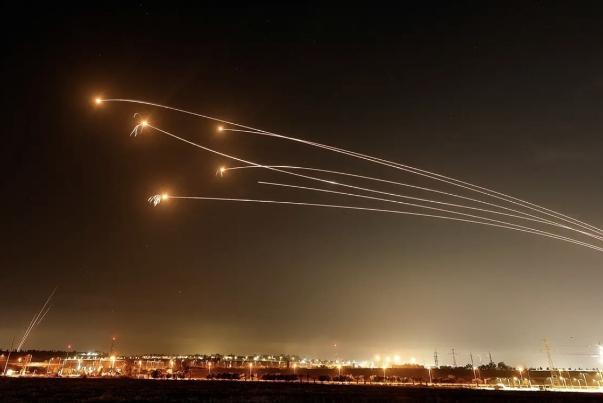
Iranian officials proceeded to launch a wave of strikes on targets all over the region.
For instance, Iran’s Islamic Revolution Guard Corps (IRGC) announced in its fourth statement that the fifth wave of True Promise 4 has expanded operations beyond previously declared targets, striking US naval and logistical assets across the region.
The IRGC stated that the Abdullah Al-Mubarak Air Base in Kuwait was targeted with four ballistic missiles. The base was also struck by 12 drones, leading to the destruction of its main infrastructure.
The statement added that the strike on the US base resulted in the casualties.
The Harir base in Iraq, home to US special forces, was targeted in an attack, and Prince Sultan Air Base in Saudi Arabia was accurately hit by missiles and drones.
According to the IRGC, an MSP vessel, tasked with transporting ammunition to US ships at Jebel Ali Port, was struck by four drones. The vessel was forced out of service due to extensive damage and successive explosions.
In addition, an MST combat support ship, assigned to refuel US vessels in the Indian Ocean, was struck by Iranian Qadr 380 missiles.
More advanced, precise, and powerful missiles launched
The IRGC announced earlier, in its third statement, that the third and fourth waves of True Promise 4 are being continuously launched, deploying more advanced, precise, and destructive missiles than those used in True Promise 3.
The IRGC warned that subsequent waves would be even more powerful.
According to the statement, the third and fourth waves feature upgraded missile systems with enhanced precision and destructive capability, warning that “the enemies must know that coming waves will be more destructive than previous operations in True Promise 3.”
Haifa naval base and military yard targeted
Among the targets identified were the occupation army’s naval base and military naval yard in Haifa, a key strategic coastal location.
The IRGC also listed Ramat David Air Base and the Ministry of War in HaKirya among its targets. Ramat David Airbase is one of the most strategically significant air force installations in northern occupied Palestine. Located southeast of Haifa in the Jezreel Valley, it serves as a critical forward operating base for air operations along the northern front.
Military-industrial sites in Bet Shemesh and Ashdod
The statement further identified the military-industrial settlement of Bet Shemesh and a military-industrial facility in Ashdod as targets.
Ashdod is home to port infrastructure used for military logistics, industrial zones that include companies linked to defense manufacturing and maintenance, and facilities connected to major Israeli defense firms such as Israel Aerospace Industries, Elbit Systems, and Rafael Advanced Defense Systems.
Moreover, Ashdod is strategically important because it hosts one of the largest ports in occupied Palestine and includes industrial areas linked to weapons production, electronics, and naval-related defense activity.
Destruction across Tel Aviv
In turn, zionist media reported significant damage in Tel Aviv as a result of the latest salvo of Iranian missiles, noting the destruction of a building and a direct hit on an Israeli target in Tel Aviv.
On Sayyed Khamenei’s legacy
Aged 86, Sayyed Ali Khamenei has guided the Islamic Republic of Iran from the early days of the post-revolutionary era through decades of struggle and transformation. After taking part in the 1979 Revolution that overthrew the oppressive, US-backed Pahlavi monarchy, he served as president throughout much of the 1980s before being appointed as the Leader of Iran in 1989 following the death of Sayyed Ruhollah Khomeini.
In that position, he became the highest authority in Iran’s political and religious system, shaping domestic policy, overseeing national institutions, and directing Iran’s strategic orientation for nearly four decades.
During his leadership, he maintained Iran’s sovereignty in the face of international pressure, steered the country through regional conflicts, and fostered alliances with movements and governments across West Asia.
His tenure also oversaw significant developments in Iran’s nuclear program and the expansion of the Islamic Revolution Guard Corps as a central element of national defense and regional influence, making him one of the most significant figures in contemporary Iranian and regional history.
Iranian institutions mourn Sayyed Ali Khamenei
The Iranian Revolution Guard Corps (IRGC) extended its highest condolences, describing Sayyed Ali Khamenei as a towering religious scholar and “leader of the martyrs of the Islamic Revolution.” They hailed him as a uniquely virtuous and courageous figure, whose martyrdom at the hands of “malicious terrorists and oppressors” underscores the righteousness of his leadership and the value of his lifelong service.
The IRGC affirmed that Sayyed Khamenei’s martyrdom “would not halt the path he was treading, but rather strengthen the Iranian people’s determination to continue his legacy, warning that the hand of Iranian justice would pursue those responsible,” vowing that “the IRGC, armed forces, and Basij would carry forward his mission in defense of the nation.”
The Supreme National Security Council of Iran said Sayyed Khamenei’s martyrdom would be a catalyst for a “great uprising against global tyrants.”
The Iranian Presidency and government announced 40 days of national mourning and seven days of official holiday.
The presidency added that until his final moments, Sayyed Khamenei guided the Islamic nation in confronting the forces of tyranny, describing him as a symbol of selfless service, resistance, and hope for the oppressed and the free.
Concluding, the Iranian Presidency warned that this major crime would not go unanswered and that Sayyed Khamenei’s sacred blood would only inspire continued struggle against injustice, emphasizing that Iran, relying on divine support, would navigate this crisis united and with pride.
Ansarallah proclaims solidarity
Ansar Allah stands ready to respond to regional developments in solidarity with Iran in light of the US-zionist aggression, leader Sayyed Abdul Malik al-Houthi said on Saturday.
“We are, within the framework of our solidarity position with Iran and in readiness for all developments, prepared to move across various activities,” Sayyed al-Houthi said in a speech addressing the latest escalation.
Al-Houthi stated that the US-zionist attack on Iran is part of a broader effort to enable the occupation to dominate the region and advance the Zionist project of “Greater Israel.”
He stressed that the aggression against Iran constitutes an unjust assault on a Muslim country without any legitimate basis.
The Ansar Allah leader added that Iran, its Islamic Revolution Guard Corps, and its armed forces are fulfilling their “sacred duty of struggle” in confronting enemies with strength and resolve.
Hezbollah expresses solidarity with Iran
Hezbollah stressed that the aggression would only strengthen Iran and its people, stating that decades of sanctions, threats, and attacks have demonstrated that the country remains steadfast and resistant to surrender.
The Islamic Resistance announced its “full solidarity with the Islamic Republic of Iran, its leadership and its people,” and called on states and peoples of the region to confront the aggressive scheme, warning that its consequences would affect all without exception if left unchallenged.
The statement concluded by asserting that the US and Zionist enemies would receive “a major slap” and achieve nothing but failure from “its tyrannical criminal aggression.”