(A note of clarification for those unfamiliar with certain terms: GAL stands for Local Autonomous Government, and GALes is the plural. CGAZ is like the coordinating body for the GALes, organized by geographical proximity. ACEGAZ is the assembly of the GAL coordinating bodies. The INTERZONA is where those in charge of all the Zapatista zones meet (the comandantas and comandantes, that is). The PERMANENTE is an assembly of comrades who are learning to govern. But don’t pay too much attention to these names because, as the COMMON is still being built, the structure keeps changing in form and name. End of explanatory note.)
Once upon a time, there was a boy. A Zapatista. Not very big, but not very small either. He is of Mayan descent and lives with his family in a community where there are Zapatistas and partisans—that is, what we now call “non-Zapatista brothers and sisters.”
This kid is a real handful. As soon as he learned to walk, he’d wander out of the house and off he’d go. When they went out to look for him, his parents always found him in trouble: he’d tried to catch a wasp, or he’d covered his whole body in mud—completely naked, but covered in mud—because he’d started playing with the little pigs. Another time they found him in the pasture, apparently talking to a cow that had just had a calf. “I was just asking her about her calf,” he said when they scolded him.
Well, since the boy was so mischievous, his dad and mom took turns watching him.
But you know how men are—they say they’re watching him, but they’re just on their phones, checking Facebook or WhatsApp and stuff like that.
Moms, we know, if they’re going to watch you, they’re really going to watch you. And it’s like they have eyes everywhere, even in the back of their heads, because any mischief you try to pull off in secret, they catch you right away.
Well, we also know that moms scold a lot. It’s not just that they say, “Don’t do that”—no, they start telling you a whole bunch of things that sound like they’re praying, and what’s worse is that they scold you in your native language, in Spanish, and sometimes even in English, French, Italian, German, and even Farsi.
This boy’s mom scolded him, saying, “You goddamn devil child, you’re going to hell for all the mischief you get into.”
And that’s how this boy’s day went: him getting into mischief, his dad playing dumb, and his mom scolding both of them.
Well, the day finally came when the boy had to go to the public school. So all the boys and girls are at school on the first day of class, and the education promoter arrives.
So the rumor goes that the education promoter was head over heels in love—in a way you wouldn’t believe—with a health promoter. But the problem was that she and he were from two different puyes, that is, from two different caracoles (“puy” means “caracol” in the Mayan language). She was in one puy, and he was in another puy that’s out in the middle of nowhere. She and he met at an anniversary party for the uprising. They didn’t say a word; they just danced together. And even though it was freezing cold, they didn’t feel the cold. He was even sweating, and she was blushing, blushing bright red with embarrassment. They didn’t say a word to each other, but the education promoter looked into it thoroughly.
You see how our comrades are—they have a secret system of investigation and communication—so this comrade first investigated the most important thing. That is, whether or not the guy has a wife.
Once she found out he didn’t have a wife, the compañera looked for a good excuse to see him.
And the idea came to him because the theater folks frompuyes get together every so often when SubMoy calls on them to put on a play.
And she figured out a way for the boy to join the theater group too, so they could see each other, and maybe talk, and maybe hold hands, and maybe hug, and maybe share a little kiss, and maybe… Oh my goodness!
Well, it was known that there would soon be an arts festival and that the theater folks would be called upon to prepare a play about community and nature. So, is the education promoter even paying attention in class? No, she’s completely distracted, thinking about something else; she can’t concentrate and is just sighing, wondering when she’ll get to see her beloved. But all the girls and boys are already here, and they’re already fighting over a chamoy candy that Verónica, Ceci, and Hermelinda Damiana brought (who are the new recruits of the Popcorn Command).
So, since the class monitor is distracted because she’s in love, when she goes to take attendance using the list the teacher gave her, she can’t find it. She looks for the list, but it’s not there.
And it’s a big problem, but the class monitor may be in love, she’s not stupid, and she says, “Okay, everyone is going to say their name so we all know each other’s names.”
So every girl and boy goes around saying their name, and when it’s the mischievous boy’s turn, he says, “My name is Condenado (Damned) and my last name is Chamaco del Demonio (Devil’s Child).” “That’s what my mom calls me all the time—‘Damned Devil’s Child’—so that’s my name.”
The promoter, as I said, was head over heels in love, so she didn’t care and wrote him down on the list: “Condenado Chamaco del Demonio. 4 years old, almost 5, from GAL such-and-such,” and all that stuff about cgaz, acegaz, interacegaz, permanente, interzona, and those weird names that are common among the Zapatistas.
When he checked the list, the teacher trainer didn’t notice because he was arguing with his wife, who was scolding him for supposedly flirting with their friend Ruperta.
And the teacher defended himself: “But how could you think that, woman? Ruperta is 80 years old.” “It doesn’t matter,” said the jealous wife, “she’s got 80 years of tricks—so many that not even a truck could carry them all—and she’s a husband-stealer.”
And there they were, fighting and fighting, and the teacher didn’t notice that on the list there was a boy named “Condenado” whose last name was “Chamaco del Demonio.”
And so that boy’s name remained on his school record. And that’s how his classmates knew him.
But the matter reached the meetings of the Word of God. And there they heard the tunel (pronounced with an acute accent, who is in charge of the sacraments) say that one must be careful with bad people, “they are the damned,” he said, “and one must not associate with the damned.”
And sure enough, the next day, no one went near the boy named “Condenado,” and they didn’t play with him or anything. So they left him alone.
But Condenado, the Devil’s Child, wasn’t sad; instead, he organized his own games and went into the woods to gather herbs, because his grandmother knew about medicinal plants and he used to accompany her.
He also went with his dad when he went to the milpa, and with his mom when she went to gather firewood, and there his dad and mom taught him which animals are dangerous and should be avoided, which are harmless and won’t hurt you, which look alike but are different, and what they’re called.
So the boy learned the names and habits of many animals, as well as the names of many plants and what they’re used for. And the boy made a notebook: on one page he wrote the names of all the animals he knew, and on another page the names of the plants.
Then one day the boy was looking through his notes and noticed that the ants weren’t there. So he went and asked his dad about the ants.
His father was arguing with his mother because the pozol was sour, it just wasn’t right, and the two of them were nagging each other, just as couples who love each other tend to do. The boy asked again if ants are good or bad. And the man, since he was still arguing, just told him, “Ants are ants.”
So the boy thought that meant no one knew whether ants were good or bad, and that’s why he had to study them.
And the boy began to study the ants: where they walk, where they live, what they do. And he learned that there are different kinds of ants. He observed and analyzed several anthills, and saw how organized the ants are—that is, they have divided up the work and roles: some go out to explore, some gather food and bring it back to the anthill, some care for the young, some defend the colony, and some just slack off, depending on the situation—that is, they’re lazy.
But the boy wasn’t satisfied and thought he needed to investigate further. So he came up with a mischievous plan: he went to see the Monarch and told him he had to find and show him videos of the ants. The Monarch looked at him—he was just a little kid—and asked who had told him to do that. The boy told his lie that it was an order from SubMoy.
The Monarch didn’t believe him and asked the boy his name. The little boy said his name: “Damned Devil’s Child,” and then the Monarch got scared that maybe he really was the devil’s, and, no matter what, he had to find the videos and show them to the boy.
That night, the Monarch couldn’t sleep because he was afraid of the devil. Because the Monarch gets scolded by SubMoisés, and he gets scolded by Captain Marcos. If the devil is going to scold him too, well, that’s just too much.
But that’s how the boy learned more about the ants, how they’re organized, and the roles and jobs they have.
-*-
Once, after a really intense rain—that is, after a storm—the boy went to check on an anthill near his hut. There were little streams of water around the entrance to the anthill.
And the ants coming out of the ant hill’s entrance seemed confused, wandering back and forth. Suddenly, one of them crawled into the hole, and other ants followed behind her, marching as if they were an army.
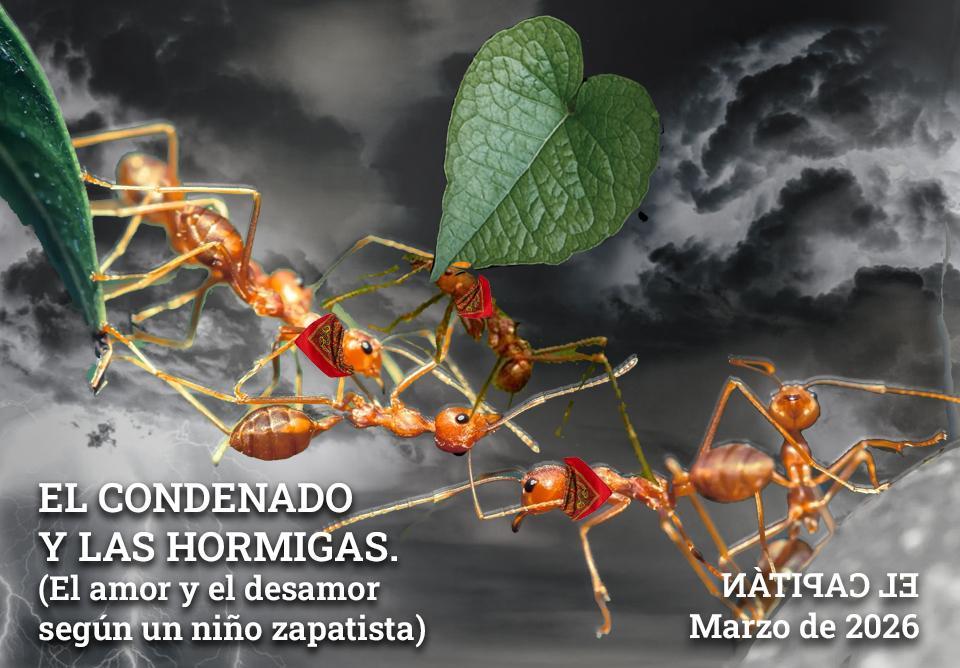
There is no one in command, but the soldier ants quickly organize themselves and grab each other’s legs, forming a bridge over one of the streams. Then the other ants follow, crossing the bridge and heading where they need to go to find food and explore.
Once the sun dries up the little streams, the soldier ants let go and return to the anthill, and then head out again to do their assigned work.
The boy is very impressed by what he saw and is left thinking about it.
-*-
On another day, while they are at school with the love-struck and distracted education promoter–the poor thing, sighing with love—the GALs from that town arrived and told her that at the GALs’ general assembly, the highest Zapatista authority, it had been decided to invite SubMoy to give a talk, and he would be in town that day, and SubMoy asked about the school and they showed him, and SubMoy said: “I’m going to give a talk to the girls and boys, so that from a young age they understand what is being done.”
And with that, SubMoy comes into the classroom, but the education promoter barely notices him and is just in a corner sighing and sighing for her distant love.
Then SubMoy realizes that the compañera hasn’t even seen him and greets the boys and girls. “Good morning,” he says to them, “my name is Subcomandante Insurgente Moisés and I’m going to give you a little talk.”
And, right away, SubMoy begins to explain what the común is, and the pyramids, and political work, and the sciences, and the arts, and military training to defend oneself, and all that.
And the children remain silent, as if they didn’t understand a thing, just as those from the Interzona remain silent, not wanting to participate because it quickly becomes clear that they didn’t understand a thing since they were distracted by their cell phones or picking their noses.
So, since everyone is quiet and even the town’s GALs are staring at their muddy boots—basically, they’re just standing there like ducks—SubMoy asks the boys and girls if they understood the explanation.
No one says a word; it’s completely silent. Even SubMoy thinks he’s at an Interzona meeting, and he’s about to leave when a boy raises his hand.
SubMoy stops at the door, turns back, and tells the boy to speak up.
The boy just says, “Ants.”
SubMoy raises an eyebrow, as if he doesn’t understand, and says, “Okay, go ahead and explain that about the ants.”
And the boy begins to describe what he saw in the anthill—how the ants were organized, how each one had its own job, how they support each other, teach each other, and even heal one another, and what happened after it rained, and how one group of ants was tasked with caring for, protecting, and supporting their ant community.
SubMoy listened carefully, turned to look at the committee members accompanying him, and gave them a look that seemed to say, “Aren’t you ashamed that a kid gets it, but you grown-ups can’t even explain it?” The committee members kept playing dumb, acting like they weren’t even there.
Then SubMoy congratulated the child and asked him his name. And the child replied, “Condenado Chamaco del Demonio,” but one of the GALs approached and told SubMoy that he is the grandson of an elderly couple, Zapatistas since before the uprising.
SubMoy asked the boy why he was called that, and the boy looked at the education promoter, who was still sighing, and said, “Because of love”; then the boy looked at the teacher trainer and added, “And because of love lost.”
SubMoy laughed heartily for a while, shot a dirty look at the promoter, shot a dirty look at the teacher trainer, and invited the boy to eat with him the raw tamale that the local women cooks had prepared.
“All single women,” said Captain Marcos, “because they don’t know how to make tamales, and that’s why they never even catch a cold, let alone find a partner.”
In reality, it was SubMoy’s trick to get the boy to eat the tamale first, and if it didn’t make him sick, then SubMoy would eat it too.
-*-
No one even said hello to the Captain. That’s what he gets for talking trash about the cooks.
But the Captain didn’t care, because he ate all the chamoy candy and marshmallow pops that were meant for the Popcorn Command.
And in the end, the Captain’s tummy still hurt from eating so much candy.
Tan-tan.
From the Mountains of the Mexican Southeast
The Captain
January-February 2026.
Originally published at Enlace Zapatista on March 18th, 2026.
Translation by Schools for Chiapas.