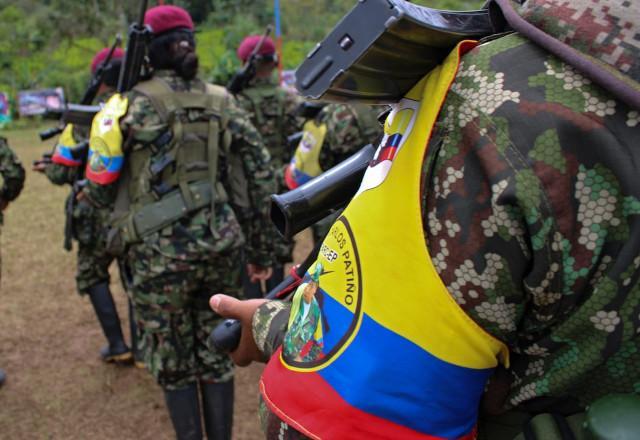
Today, paradissident groups have a presence in more than 22 departments of Colombia, expanding their dirty war tactics against the people, murdering, disappearing, and constantly harassing communities while deepening drug trafficking in the regions and forging alliances with other paramilitary factions. While these actions have had serious impacts on communities and grassroots organizations, one effect that has received little attention is the terrible damage they have done to the legitimacy of the revolutionary and insurgent tradition in the country.
The History of Struggle That Is Bleeding Out Today
In Colombia, the history of revolutionary and insurgent projects is long and rich in events, proposals, and methods, at least for study. The influences and motivations for change that fueled each project were varied, ultimately culminating in small “victories” or the annihilation of these visions for the country. With many of these groups, including liberal guerrillas, the State established agreements that often resulted in assassinations after promises of amnesty, as with Guadalupe Salcedo, or in persecution and extermination, as happened with the Patriotic Union, after negotiations and promises. There were also cases where insurgent projects fell into the DDR (Disarmament, Demobilization, and Reintegration) trap, laying down their weapons and surrendering them under false pretenses and projects that the establishment promised but never fulfilled, or only partially fulfilled, without addressing the underlying causes of the conflict. The truth is that the FARC-EP was one such project, which, like all others, had its successes and failures, and which notably deepened the struggle against the oligarchy and imperialism. As the ELN, we understood very well that this was a force that was part of the country’s revolutionary projects, with whom we could engage in dialogue to jointly advance the revolution. An example of this was the formation of the Simón Bolívar Guerrilla Coordinating Board, which, although it ultimately remained just another attempt at unity, helped us understand this force as legitimate, even though we had different methods and approaches. Within it, we recognized great leaders like Manuel Marulanda Vélez, Alfonso Cano, and Mono Jojoy, and we are certain that they felt the same way about our commanders.
Prior to the signing of the agreements in 2016, as part of a strategy to weaken and dismantle this guerrilla group, state forces focused on eliminating several leaders of this project, demoralizing its strength and undermining the effectiveness of its military strategy. Several years were dedicated to striking blows against the FARC-EP, which, coupled with misguided decisions (such as accepting drug trafficking as a source of funding, which led to the political and ideological disintegration of a large part of its ranks), resulted in a strategic defeat for its leadership. In other words, demoralization reached such a point that the certainty of victory was lost. Peace then emerged as a horizon that could offer an option to end the war with dignity. Thus, in 2016, after lengthy negotiations and significant concessions to overcome that historical impasse, the peace accords were signed between the FARC-EP and the government of Juan Manuel Santos. The peace accords constitute a turning point, marking the beginning of a new chapter in history—the story that brings us to the present moment.
The FARC-EP Dies and the Paradissidents Are Born
Prior to the peace agreement, and as a result of internal tensions and divisions stemming from various factors—including the number of concessions made during negotiations, which were not universally supported by the armed forces; the fragmentation of a faction whose primary interest lay in drug trafficking in the regions; and internal power struggles and disagreements that fueled divisions—some groups refused to accept the agreements and remained determined to continue their armed struggle. These groups formed a new structure, eventually commanded by Gentil Duarte and known as the “Central General Staff.” Furthermore, after the signing of the agreements and during the period designated for their implementation, some of the key leaders at the negotiating table surprised the Colombian people by taking up arms again, calling themselves the “Second Marquetalia,” citing the government’s failure to uphold the agreements. These two factions constituted the first phase of the reorganization of these “armed groups.” The main problem became evident after these groups, abandoning the legacy of the FARC-EP, became mere remnants with no real reason to wage war other than their drug trafficking businesses. Although there were some differences between them, both ended up acting in the same way, generating terror in communities and killing at any cost to maintain their economic interests and territorial control in the regions. Later, the Central General Staff subdivided, giving rise to the General Staff of Blocs and Fronts, which today is just another such force, lacking a political vision and instead focused on business interests that only harm the country.
In the countryside and cities against the revolution
Today, nothing remains of the FARC-EP’s revolutionary project, only an empty shell that has been used to establish a foothold in territories, but also to harass and intimidate those who stand in the way of their business. The strategy has not only been confined to the regions, their municipalities, and rural areas, but has also been evident in the country’s cities. Although the methods vary, a modus operandi of territorial control based on micro-trafficking in the cities is evident. However, the ways in which they have ultimately influenced the social and organizational fabric have been varied, and in this case, it is worth noting that perhaps the point of greatest consolidation of these groups occurred primarily during the social uprising, when, through the dissemination of a false revolutionary discourse, they attracted the attention of many young people who, not knowing where to channel their righteous anger, ended up joining the dissident groups, deceived by the narrative and legacy of the FARC-EP. Furthermore, they were exploited through underhanded tactics, taking advantage of the vulnerabilities of working-class youth by offering money to work for their groups. This was the case for many young people, including el de Coco, el de Bigotes, and many others throughout the country. For the rest of the country, they have implemented different methods, depending on the degree of territorial control and the capacity for co-optation through rhetoric and resources.
Thus, in southwestern cities like Cali, Popayán, and Nariño, the method has been the infiltration of social organizations through their funding, instrumentalizing them to carry out their plans. In places like Putumayo and Caquetá, among others, the modus operandi has been coercion, given the territorial control they have established since their formation in these areas. In other regions such as southern Bolívar, the Aburrá Valley in Antioquia, Chocó, and the Urabá region of Antioquia, the way to establish control has been through opening up to other paramilitary groups in direct alliance for strategic plans. Finally, in northeastern cities like Cúcuta and Bucaramanga, the method of funding organizations, making them functional to their territorial control plans, has also been implemented.
These logics not only complicate the interpretation of the various territorial actors, but in the long run, they delegitimize any revolutionary project, since ultimately, they represent a contradiction between discourse and deeds. These groups have not only damaged their own tradition and the legacy of the FARC-EP, but they also call into question any project that calls itself revolutionary. Today, as the ELN, we know that the actions of these groups contribute to the counterinsurgency war that has been waged against us throughout our years of struggle and resistance, but we also know that we have been transparent with the people, in every word, in every action, in every moment in which we have spoken to the people and they have listened to us. Today it is up to us to tell the people for whom we fight not to be fooled, that they must discern and not fall for tricks, that our tradition of struggle remains intact, and that today we are the ONLY revolutionary project in this country and that we will not take ONE STEP BACK.
By: Octavia Rebelde, Antorcha Correspondent
Source: https://insurgenciaurbana-eln.net/las-paradisidencias-contra-la-revolucion/