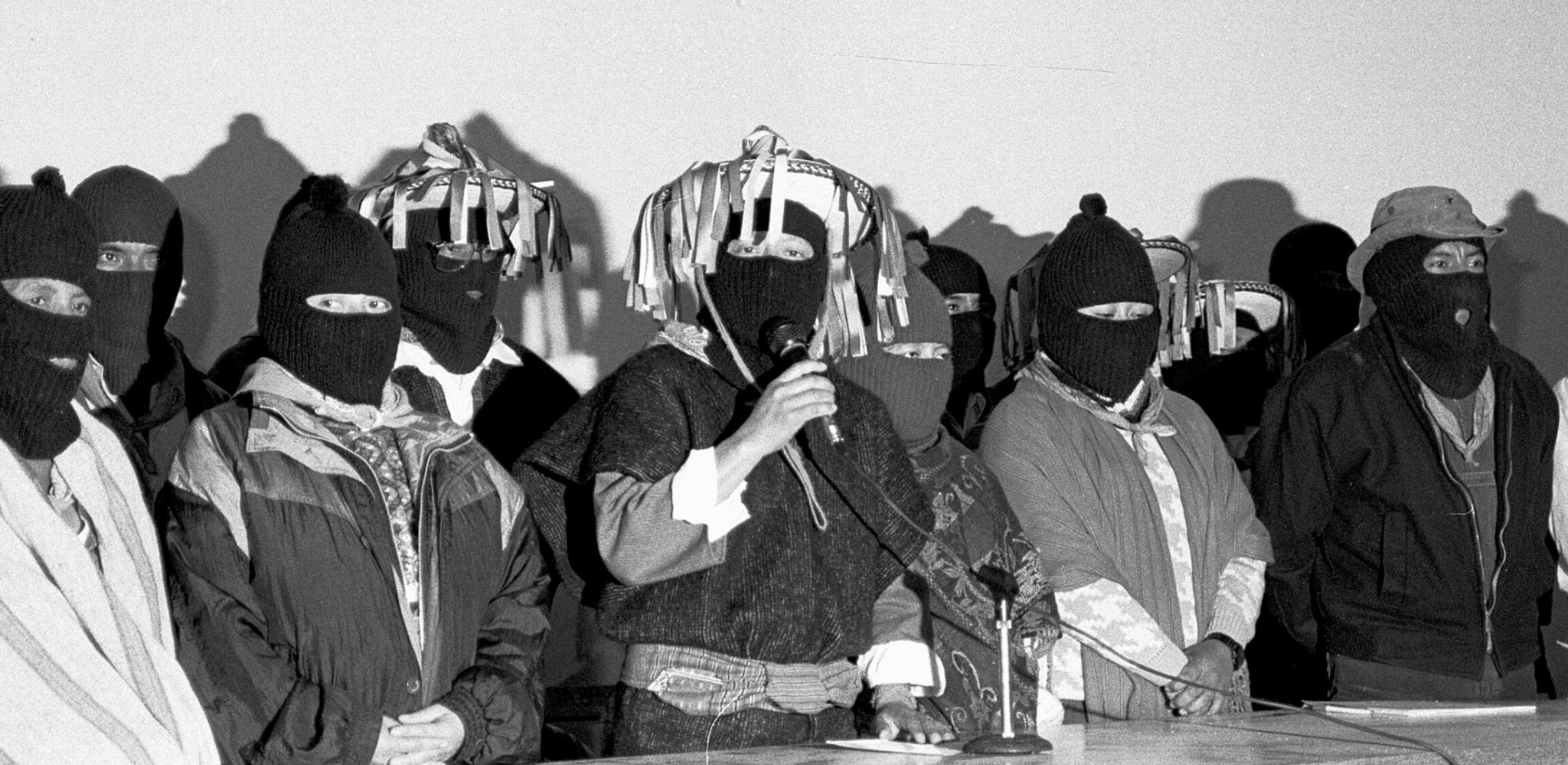
Last February marked the 30th anniversary of the signing of the San Andrés Accords on Indigenous Rights and Culture between the Zapatista Army of National Liberation (EZLN) and various branches of the Mexican government—historic documents in which the government committed to recognizing the rights and culture of indigenous peoples in the Constitution and within the structure of the Mexican political system.
“There is no doubt that they are of significant importance,” says Carlos González, a lawyer specializing in agrarian law and a founding member of the National Indigenous Congress (CNI), “because they embody a historic process—the Zapatista uprising [1994]—and the process they managed to generate together with organizations, communities, and academics during the discussion and drafting of the agreements.”
The lawyer, who participated in the San Andrés Agreements Forum as part of the National and International Day of Justice for Samir and Self-Determination for the Peoples, highlights three elements he considers significant in the Agreements: the recognition of territorial rights; the recognition of communities as public-law entities with governmental functions; and the capacity to manage fiscal budgets within the framework of the Mexican state structure.
“The failure to comply with these agreements” is also significant, he argues. They were signed in 1996. Following that, a proposal—a legal draft—was drawn up to incorporate them into the Constitution, something that “did not happen” in subsequent constitutional amendments.
In the 2001 constitutional reform, he explains, neither the first set of rights—that is, territorial rights—nor the second set of political rights, which would allow the peoples to exercise autonomy, were recognized. “It was a true betrayal of the San Andrés Accords,” he summarizes. This betrayal led to “our peoples deepening the exercise of autonomy without seeking constitutional recognition or legal recognition from the Mexican state,” he says.
The administration of President Andrés Manuel López Obrador (2018–2024) promoted the 2024 constitutional reform, and according to its own propaganda and that of its allies, the San Andrés Accords are finally being incorporated into the Constitution. “The truth is that it didn’t do so thoroughly. This reform carries more weight for what it fails to recognize than for what it does recognize,” says attorney González.
While, on the one hand, it recognizes communities as public legal entities, on the other, it once again fails to recognize territorial rights. The concept of territory “as a legal concept with clear and precise content, as provided for in international law, conventions, and treaties, is left out of the wording of the constitutional reform. As long as the territorial rights of indigenous peoples are not recognized, it is very difficult to speak of the full exercise of autonomy.”
Furthermore, the lawyer emphasizes that the context in which the agreements were drafted was different from both the country’s current reality and its constitutional framework. “If we compare this country’s constitution before the agreements were signed with the one we have today, they are completely different.”
“After the agreements, a series of changes were made to the legal framework to adapt it to the ‘needs of dispossession and exploitation by large corporations,’” he notes. A whole cycle of neoliberal reforms ensued, beginning with the 1992 reform of Article 27 regarding land and water, and the 1994 Free Trade Agreement with the United States and Canada. “Reforms will continue with the Mining Law, amendments to the Water Law, the Biosafety Law, amendments to the Forestry Law, and a host of changes in the administrative sphere, to facilitate the dispossession and privatization of water and natural resources.”
“Given the current legal framework, the idea that—with the San Andrés Accords incorporated into the Constitution in a ‘half-hearted manner,’ as was done in 2024—our peoples will achieve full recognition of their autonomy and rights is, in our view, a pipe dream,” he argues.
The Important
Beyond the agreements that were signed, for Gilberto López y Rivas—who advised the Zapatistas at the time—the significance of this moment in Mexican history lay in the San Andrés dialogue process—which took place between November 1995 and February 1996, prior to the signing—and brought together at least 2,000 people. “It was a constituent congress from the perspective of grassroots Mexico and the indigenous peoples, where sectors of Mexican civil society had the opportunity to raise awareness, to learn, and to deepen their understanding of the collective rights of the peoples, particularly the collective right to territory and autonomy and to the defense of the codes and norms of life that these peoples uphold,” he says.
Furthermore, this process allowed for the participation of nearly 40 indigenous peoples who, a few months later, in October 1996, joined the CNI. “I believe that the most important aspect of the San Andrés process—in organizational and political terms—was not the San Andrés Accords themselves, but rather the formation of the National Indigenous Congress and, subsequently, the Indigenous Governing Council. In this sense, the formation of the CNI was one of the most significant outcomes.”
Before, During and After the Accords
Similarly, Carlos Beas, coordinator of the Union of Indigenous Communities of the Northern Isthmus (UCIZONI), who also advised the EZLN during this process, focuses his analysis on the San Andrés talks and, furthermore, on the Mexican context before and after the signing of the agreements.
According to Beas, indigenous peoples have always been present in Mexico’s major social struggles, but they were not recognized as indigenous peoples. Mexico’s democratization struggles in the 1950s and 1960s—the teachers’ and doctors’ union movement of that era, for example—“were led by indigenous leaders, who were recognized as union leaders but not as indigenous peoples.” Or then in the 1970s, “a major independent movement of struggle that would build an initiative for mobilization and land seizures—there were many indigenous organizations that did not call themselves indigenous organizations; they were peasants.”
According to him, it was in the 1980s, when changes began to take place. In Oaxaca, for example, a proposal for self-determination and autonomy emerged in the Sierra Norte. “It is important to focus on the agreements reached in the dialogues that took place within society itself. On this occasion, indigenous organizations were already openly raising the demand for indigenous rights.”
He points out that, in the first declaration from the Lacandon Jungle, in the ten points announced by the EZLN, “not a single one called for indigenous rights. It called for housing, health care, water, justice. But it did not speak of the specific rights of indigenous peoples.”
It will be in the discussions taking place within the framework of the San Andrés Accords “that the EZLN recognizes and takes up this demand; this is the importance of the agreements—more than the dialogue with the state, more than the state’s legal recognition—it was the dialogue between society and the indigenous peoples that placed indigenous rights as the first item on the national agenda,” he maintains.
He points out that “the idea that there was an atmosphere of complete harmony among the EZLN’s advisors is false. There were intense internal debates; it was a struggle to impose the vision of prioritizing the rights of indigenous peoples.”
The Ucizoni coordinator emphasizes that the San Andrés dialogues “gave rise to various reflections and processes.” After 1996, he notes, three major independent currents within the indigenous movement in Mexico began to emerge. On one hand, the indigenous current aligned with the PRD (which has since migrated to Morena). On the other hand, those we “call the ‘legalists’ (who ended up in López Obrador’s government), mainly comrades from Oaxaca who advocate for constitutional recognition.”
“And a third current, which remains alive to this day as an independent movement, is the one that has been advocating for the defense of our territories and the rights of our peoples—but from an autonomous perspective, free from any state oversight—because we know the state will never recognize the rights of our peoples, much less our rights to self-determination,” Beas asserts.
For him, we must “dispel the illusion of the State as a great benefactor” that will recognize the rights of our peoples. “We have paid dearly for this approach, diverting our focus toward legal recognition. The only thing that has come of it is that a bunch of bastards have taken over the Supreme Court of Justice and the INPI [National Institute of Indigenous Peoples]—it’s that simple. We believe the path forward is very clear. The path that the peoples’ struggle must follow is one independent of political parties and the state—a truly autonomous struggle.”
The Agreements
The Tzotzil municipality of San Andrés Larráinzar, located in the Los Altos region of Chiapas, Mexico—renamed San Andrés Sakamch’en de los Pobres by the Zapatista Army—served as the venue between 1995 and 1996 for a dialogue process involving the EZLN, the state, indigenous movements, and various sectors of Mexican society. Both government delegates and Zapatistas were accompanied by advisors and experts for each of the topics at the four negotiating tables: Indigenous Rights and Culture, Democracy and Justice, Welfare and Development, and Women’s Rights in Chiapas.
As a result of the first round table, Indigenous Rights and Culture, the San Andrés Accords were signed. Following the signing, progress was made at the second roundtable, Democracy and Justice, which continued until September 2, 1996, when the EZLN suspended negotiations, arguing that the government was not fulfilling its commitment to enact legislation. The last two rounds were scheduled to take place between late 1996 and early 1997; ultimately, they did not occur.
Original text by Renata Bessi published in Avispa Midia on March 11th, 2026.
Translated by Schools for Chiapas.