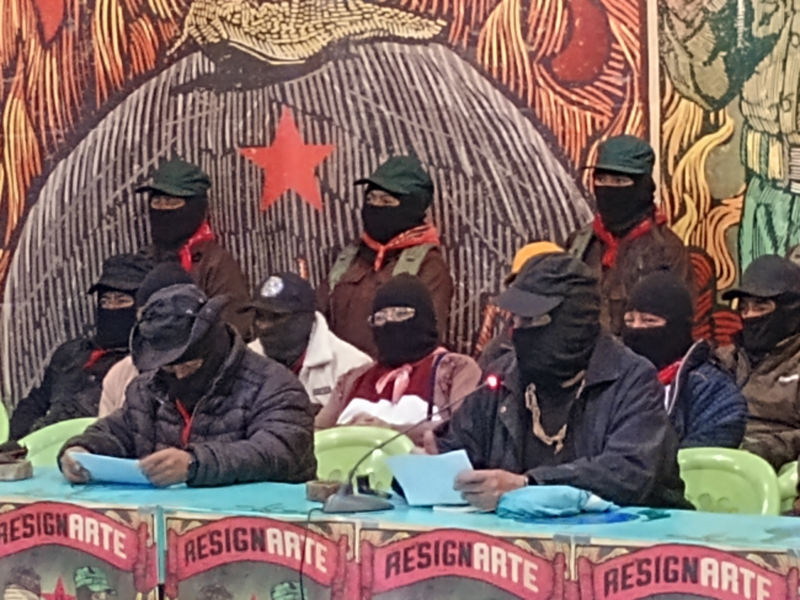
San Cristóbal de Las Casas, Chiapas. The victims of enforced disappearance in Mexico “are not a number to be manipulated in the media, as is happening these days, but rather people with names, stories, relatives, and friends who are nowhere to be found and who must be located and rescued for life, for memory, and for both,” Captain Marcos of the Zapatista Army of National Liberation (EZLN) said.
He added that the struggle of the hundreds of collectives, groups, and organizations searching for their disappeared relatives “has been used for partisan political agendas.”
He said that “there have been attempts to co-opt them, manipulate them, silence them, make them disappear, but they are still there, and no matter what spectacle they put on from above—be it soccer, music, or useless and sterile debates—they will remain there and will not falter until those who are missing today reappear.”
And yes, he added, “perhaps the Mexican soccer team will finally reach the fifth game and it will all be a party and a celebration, and people will say ‘I always knew it,’ and Vasco is Basque, but long live Mexico, you bastards, you bitches, and cheers! But in the uncertain limbo of what was once the Mexican nation, now united only by pain and terror, those who fight tirelessly for the disappeared will continue, among them, one who was once called homeland and who is lost between the frivolous and superficial because truth and justice are part of the disappeared.”
Marcos expressed the above during the third and final day of activities of the April 2026 Semillero: The Storm Inside and Outside, According to the Zapatista Communities and Peoples, held in San Cristóbal.
Unity and Fragmentation in the Struggle
In the 1 p.m. session, she spoke about “A Peep into the Storm in the World: The Fragmentation of Territories and Resistances and Rebellions,” saying that “only those who are clear about the why, that is, their history; the what for, that is, their objective; and the how, that is, their organizational structure, are the ones who do not falter, do not surrender, do not sell out, and do not give up.”
He added: “Here, for example, are some of the parents of the missing students from Ayotzinapa, who, as on other occasions, are with us: Don Mario and Doña Hilda, who, like the rest of their comrades, continue to persevere in the search for their missing loved ones.”
The hundreds of attendees at the meeting held at the Caracol Jacinto Canek*, located within the Comprehensive Indigenous Training Center (CIDECI) in San Cristóbal, chanted: “September 26th is not forgotten, it is a day of combative struggle.”
The captain had previously referred to “the unity and fragmentation of the struggle” and said that “a few months ago” Sub-commander Moisés briefed the militia on what he had discussed in a session of the General Assembly of Local Autonomous Governments.
“He told us that our duty as present-day Zapatistas is to create the material conditions for the survival of future generations; that is, the conditions for them to have life, but that they were already seeing that this wasn’t enough, that we had to transmit to them resistance and rebellion, that is, not surrendering, not selling out, and not giving up, and that this couldn’t be put on paper or in a community assembly resolution. It’s not even something that could be transmitted verbally.”
Resign Yourself or Organize
He pointed out that after several assemblies, they concluded that “one of the proposals was that the legacy should be the example, that resistance and rebellion, not selling out, not surrendering, and not giving up were just empty words if they weren’t accompanied by action; that if we wanted to inherit the Commons, we had to practice it—those of us who are authorities, leaders, organizers, area and inter-zone leaders, officers and militia, and all the titles and roles that arise in our organizational structure.”
This idea of legacy, Marcos explained, “is relevant, because every movement, organization, group, collective, individual who resists and rebels has consciously or unconsciously made a decision in the face of the dilemma posed by this year’s call: to resign yourself or to organize.”
He continued: “Our Zapatista belief is that behind every call for unconditional unity lies an attempt at absorption, hegemony, and homogenization. Every call for unity masks the main issue: who will be in charge and how we will operate. In other words, the implementation of a pyramid structure. We see that fragmentation is not actually division, but rather the recognition of differences. They make us believe that we are stronger if we unite and present a common front, but they don’t clarify that within that union, there are those who command and those who obey.”
He clarified that the Commons proposed by the Zapatistas “doesn’t refer to individual organization but to the objective: confronting the enemy. Many struggles, many battles, and one fight against the system. We don’t know if this vision we have will work, and certainly it can be debated, discussed, and rejected that the fragmentation of organizations leads to a good outcome. What is certain is that there are many examples of unity, with a capital U, ending in failure. We believe that unity should not be confused with the objectives of an organizational community.”
*The Caracol Jacinto Canek is no longer located in CIDECI (translator’s note).
Original article by Elio Henríquez, La Jornada, April 4th, 2026.
Translated by Schools for Chiapas.