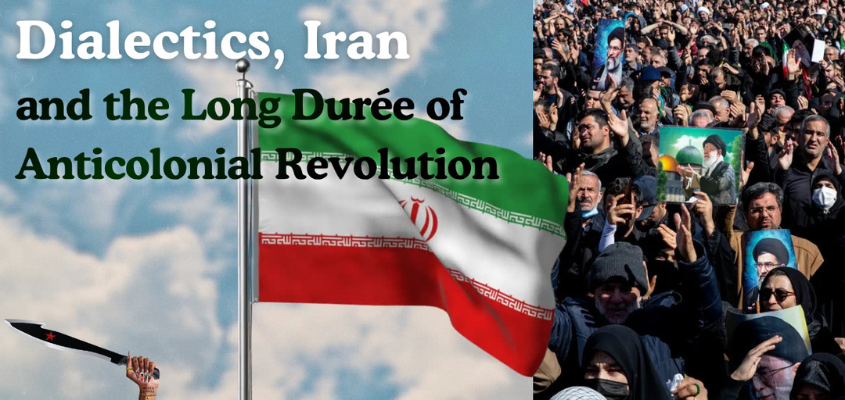
The war on Iran is a class war against any country that refuses to open itself up for foreign profit. Understanding Iran means seeing its fight as part of the same struggle that defines the colonized world.
Originally published in Hood Communist.
Dialectical and historical materialism cannot be understated as critically important in understanding the “war on Iran”. The framework is indispensable for moving beyond the phenomena of geopolitics (sanctions, military posturing, diplomatic tensions) to grasp the essential phenomena: the structural contradictions of imperialism in its current, neocolonial phase. By examining the nation-state as an enclosure, the process of primitive accumulation, and the dialectic between the dictatorship of capital and the dictatorship of the proletariat, we can see the war on Iran not as a discrete conflict between nation-states, but as a critical battle in the ongoing class war that shapes the entire imperialist world-system. This perspective contextualizes Iran’s struggle within the broader anti-colonial and anti-imperialist project, drawing contrasts with the historical experience of post-colonial state-building and exploring the necessary conditions for forging alliances that point toward the dissolution of the current imperial order.
The dominant liberal narrative presents the conflict with Iran as a series of discrete phenomena: a dispute over a nuclear program, concerns about regional “destabilization,” or a clash between a revolutionary theocracy and the liberal international order. Experiencing these phenomena creates a fragmented, superficial understanding. A dialectical and historical materialist approach compels us to go beyond the surface. It demands we ask: what are the underlying social relations that produce these phenomena? What historical processes have led to this? And what are the internal contradictions driving this conflict toward resolution?
Historical materialism suggests that the ultimate cause of all social change and political conflict is to be found not in the ideas of men, nor in the actions of individual states, but in the development of the mode of production and the ensuing struggle between classes. Applying this to the war on Iran means recognizing that the conflict is not fundamentally about Tehran’s political system or its regional ambitions, but about Iran’s place within, and its challenge to, the global capitalist system. The war is a structural imperative of imperialism, a necessary response to a nation that, through its revolution, expropriated domestic capital and now seeks to develop outside the dictates of the international bourgeoisie.
The Nation-State as an Enclosure
To understand the terrain of this conflict, we must first grasp the nature of the nation-state under imperialism. The classical Marxist position, articulated by Vladimir Lenin in Imperialism, the Highest Stage of Capitalism, identified the nation-state as the primary political form through which finance capital organizes the global division of labor and exploits the periphery. However, the nation-state that emerged in Africa, Asia, and the Middle East after World War II was qualitatively different from the colonial administrative apparatus that preceded it. It was, in theory, a vehicle for national liberation.
Yet, as Kwame Nkrumah and other pan-Africanists theorized, political independence without economic liberation resulted in a neocolonial situation. The formal sovereignty of the nation-state masked a profound structural subordination. The enclosures that characterized primitive accumulation under classical colonialism were reconfigured. Instead of direct colonial administration, imperialism now operates through a complex architecture of control: the International Monetary Fund (IMF) and World Bank impose structural adjustment programs; private multinational corporations own or manage key infrastructure like ports and extractive industries; and local comprador bourgeoisies serve as intermediaries for foreign capital in a system of neocolonialism.
In this framework, the nation-state itself becomes an enclosure. Its borders are not merely geographical lines but juridical (the use of lawfare) and economic mechanisms that contain and structure society for the benefit of external capital. The ownership of ports by private interests, the extraction of resources by foreign firms, and the forced displacement of populations for development projects or resource wars are all contemporary mechanisms of primitive accumulation. This is the perpetual process by which capital creates the conditions for its own expansion by separating people from the means of production and appropriating common wealth.
The condition of being “underdeveloped” is not a natural state of backwardness but a product of colonial and neocolonial extraction. The periphery is underdeveloped precisely because its surplus value has been systematically appropriated by imperialist centers. In Black Scare, Red Scare: Theorizing Capitalist Racism In The United States, Dr. Charisse Burden-Stelly similarly argues that the peripheral position of predominantly Black nations and communities is actively produced by the appropriation of their labor, resources, and wealth by imperialist centers. Thus, underdevelopment is not a starting point but an outcome of systemic expropriation.
To break this cycle, a revolutionary state must perform a dual function. First, it must deploy its coercive and administrative apparatus to address the distribution question, ensuring that the society’s wealth is directed toward mass production, industrialization, and the material needs of the population rather than being siphoned off as profit for foreign capital. Second, it must actively dismantle the internal structures that perpetuate underdevelopment, namely the comprador bourgeoisie and the private sector’s control over the “commanding heights” of the economy.
Iran’s Rupture and the Imperialist Response
The war on Iran must be understood as a conflict over this enclosure. Iran, by virtue of its 1979 revolution, represents a rupture. It is a nation-state that has, to a significant degree, refused its role as an enclosure for foreign capital. The nationalization of the oil industry, the establishment of a state-directed economy, and the development of indigenous industrial and military capacity constitute a rejection of the neocolonial model. The primary contradiction, therefore, is not between Iran and the United States as nation-states, but between a project of post-colonial, anti-imperialist development and the imperialist system that requires all nation-states to be open enclaves for the extraction of surplus value.
By strangling the economy, creating scarcity, and applying pressure on the population’s living standards, Western imperialism aims to force a capitulation either through regime change or through a return to a neocolonial structure where foreign capital can once again dictate terms. The war on Iran, viewed materialistically, reveals itself as a class war. It is a conflict between the dictatorship of capital, organized globally through the U.S. state and its allies, and a state attempting to exercise a form of the dictatorship of the proletariat, however imperfect and bureaucratically mediated.
This dialectic of the current siege is the external dictatorship of capital marshaling every instrument of financial strangulation, military intimidation, and ideological warfare against the internal, embattled structures of a state attempting to organize production for social necessity rather than private profit. The U.S. can simultaneously shutter Iranian energy exports while mobilizing its own liquefied natural gas (LNG) to supply Europe at exorbitant prices not because of any coherent geopolitical strategy, but because capitalism’s sole logic is the realization of profit through the circulation of value. The same system that starves one nation of fuel (Cuba) can profit from supplying another, and in that asymmetry lies the essence of imperialism: the capacity to orchestrate scarcity as a weapon while extracting surplus from the very conditions of deprivation it creates.
The siege, therefore, is not an aberration from the normal functioning of the international system but its most naked expression. Sanctions, military encirclement, and the deliberate impoverishment of a population are not punitive measures applied to a transgressor. They are the regular mechanisms through which capital disciplines any territory that threatens to escape its orbit, demonstrating to all peripheral and semi-peripheral nations the price of attempting to chart an autonomous path.
As Dr. Ali Kadri makes clear in his discussions of his book Accumulation of Waste: A Political Economy of Systemic Destruction, capitalism’s drive for primitive accumulation reaches its logical conclusion in death. The system must eliminate rivals (whether competing capitalist powers or, more fundamentally, competing modes of production that do not subordinate social life to the accumulation of value). It must extinguish alternative forms of social organization that demonstrate the possibility of a world beyond capital. And it must, when faced with organized resistance, resort to the physical annihilation of those who refuse to submit.
The Path Forward
The war on Iran, understood through this lens, is not a policy dispute to be managed but a battlefront in a protracted war against any nation or movement that seeks to break free from the enclosures that structure the neocolonial world-system. The revolutionary state that emerges from anti-colonial struggle thus becomes the target of a totalizing violence that recognizes no distinction between economic warfare, political subversion, and military aggression. To grasp this is to understand that the conflict will not be resolved through diplomacy within the existing order, because the existing order requires either the reintegration of Iran as a compliant enclosure for foreign capital or its destruction as a warning to all who would follow.
The path beyond this lies in the conscious organization of the international working class and oppressed nations in a unified front against the dictatorship of capital. The defense of the Islamic Republic of Iran, with all its complexities and contradictions, is inseparable from the struggle to dissolve the system of nation-states that capital has constructed as its primary political form.
Erica Caines is a writer and organizer in Baltimore and the DMV. Caines is the National Co- Coordinator of The Black Alliance For Peace, co- editor of Hood Communist Blog, and founder of #LiberationThroughReading providing African children with books that represent them.e