The planting season in Ukraine usually begins in early April, but so far this year, there is little farm equipment operating in the fields and no start by farmers to sow grain crops. Ukraine was once predicted to become an “agricultural superpower”. This projection was used year after year to mask the country’s alarming deindustrialization following its 1990-91 secession from the Soviet Union. Today, Ukraine risks losing not only its main export potential in grain crops but also its ability to feed an already sharply declining population.
The recent, sharp rise in global prices for fuel and fertilizers, coupled with mass conscription efforts driving males into an army fighting a war against Russia, is making it impossible for Ukraine to properly conduct agriculture. Ukrainian Telegram channel ‘Kartel’ explains in a lengthy note on March 30, “The planting season is being disrupted and we can no longer expect a harvest. Planting depends directly on fuel, which means that price increases automatically impact the future harvest. If farmers cannot purchase the necessary volumes of fuel, this is no longer just a price increase but a major risk of disrupting the production cycle.”
The note concludes, “It turns out that the citizens of our country were not all ‘in the same boat’ during this war. Some, with their last strength, are rowing and trying simply to survive, without rest, without hope of salvation. Meanwhile, the authorities and the elite sit quietly in deck chairs, enjoying the sea breeze as dirty money is laundered through their accounts. The boat is still shared; it just happens that some have a berth in the hold while others have a cabin with a sea view.”
Getting dragged into yet another conflict on the side of the West
Meanwhile, Ukrainian President Volodymyr Zelensky is desperately trying to get involved in the conflict in the Middle East. During recent visits to Syria, Turkey, and Egypt, he sought to interest the authorities of these countries to purchase grain from Ukraine (although there is significantly less available for purchase compared to last year). What matters to by Zelensky, whose electoral mandate expired two years ago now, is drawing attention and seeking to demonstrate an ‘indispensable’ role for it on the global stage.
Zelensky has gone so far as to confidently declare that Ukraine could help unblock the Strait of Hormuz.
The Ukrainian analytical Telegram channel ‘Rubicon’ notes ironically on April 4, “While the world’s most powerful army, with an annual budget of a trillion dollars, has been struggling in vain for two months to unblock the Persian Gulf, Vladimir Zelensky has offered his indispensable assistance in this regard. He has just traveled through the Middle East, promising to teach everyone there how to shoot down Iran’s drones”
“Zelensky couldn’t bypass an opportunity to try to get back on the international agenda,” explains Odessa-based, anarchist writer Vyacheslav Azarov on April 3, commenting on Zelensky’s tour of West Asia. He warns that Zelensky has another unique skill: endlessly prolonging a war that serves, in turn, as a source of superprofits for U.S. arms manufacturers. According to Azarov, interested countries need to think carefully before accepting his offers. Paying a toll to Iran for passage through the Strait of Hormuz would be much cheaper than a Ukraine-concocted “lifting of the blockade”, he observes.
Zelensky said on March 27 that his government is seeking agreements with Arab countries to supply one year’s worth of diesel fuel. Diesel is the primary fuel for Ukrainian Armed Forces equipment and has risen in price by 34% in Ukraine as of early April. Zelensky recently warned that Ukraine could face a diesel fuel shortage of up to 90% if that war continues.
Concerning the situation in West Asia, Zelensky is blatantly manipulating facts, claiming that Iran’s use of FPV drones indicates that it is preparing a ground invasion of the Gulf states. This is one way he is hoping to intimidate the Arab monarchies as he begs them for more funds and fuel for military purposes.
Zelensky visited the United Arab Emirates (UAE), Saudi Arabia, and Qatar during his recent tour, signing yet another series of ‘security’ agreements with them. However, he has previously signed dozens of such agreements with European countries, and these have, in essence, turned out to be worthless.
To whom to sell the services of Ukrainian soldiers
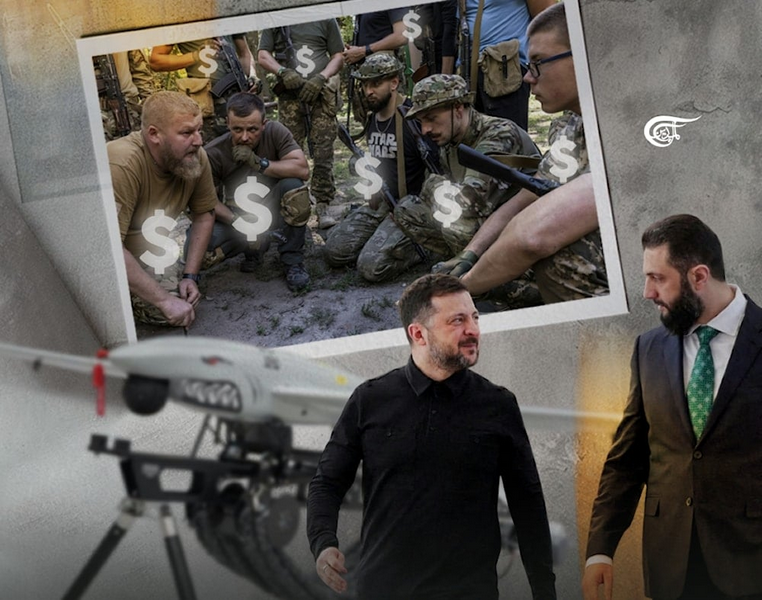
Zelensky is now actively trying to monetize the expertise of Ukraine’s armed forces, peddling its trained soldiers and technicians on the global mercenary market. He is feeding stories to Arab comprador leaders about the effectiveness of Ukraine’s army in combating Russia’s drone weapons, many of which are reportedly produced from Iranian designs.
Ukraine’s stated ‘effectiveness’ in drone warfare is often a clever manipulation of numbers. If ten Russian unmanned aerial vehicles (UAVs) hit targets, the Ukrainian General Staff claims there were originally 100, for an alleged shootdown rate of 90%. It is precisely this showy ‘effectiveness’ that Zelensky is peddling and seeking to capitalize on.
Zelensky has sold the services of Ukrainian UAV countermeasure specialists to the Gulf monarchies. He is attempting to sell plans to combat Iranian drones, even though Kiev still cannot cope with Russia’s drone warfare. 20 such Ukrainian technicians were reported killed in an Iranian strike against arms warehousing in Dubai (UAE) at the end of March.
According to the Iranian publication Pars Today Russian on Telegram on March 30, the deaths of the Ukrainian technicians occurred during the time Zelensky was touring the Gulf and Arab states in the region. The deaths stand in stark contrast to his international appeals and his public statements about “Ukraine’s successful experience” in drone warfare.
“Overall, Zelensky, constantly crisscrossing the globe, comes across primarily as a politician on an endless quest for funding. He tries to capitalize on any situation and any crisis, striving to get as much money as possible” for his military, Pars Today concludes.
In a country that is half-ruined, where the economy survives solely on loans from Western imperialists, Zelensky’s ‘business model’ being sold to other countries boils down to this formula: ‘Give us something now, and we’ll give you something in return… sometime later’.
‘Later’ usually turns out to be Ukraine’s inability to fulfill the terms of the agreements, blaming Russia and ‘force majeure’ circumstances that arise.
In addition, there is another aspect to Zelensky’s visits to the Middle East. Imprisoned legislator Oleksandr Dubinskyy writes that Zelensky is desperately trying to position himself as an ally to the U.S. in a war against Iran. He writes, “Zelensky is trying to drag Ukraine into yet another war—this time with Iran. Beyond financial gain, the goal is to use this as a way to evade pressure for a peace deal that would favor Russia. It will be politically more difficult for Trump to pressure an ‘ally’ (Ukraine) into a peace agreement when it is the same ally who is putting its own soldiers instead of American ones in the line of fire in Iran.”
Ukraine as imperialism’s private military company
Wherever in the world Western imperialism attempts to impose its agenda, Zelensky pops up, offering to send in Ukrainian troops as tools to assist, that is, assist the interests of the US, the European Union, and the UK.
For example, on April 3, Radio France Internationale reported that more than 200 officers and experts from the Ukrainian army are stationed at three sites in Libya, a country that Western imperialism ravaged and destroyed for oil in 2011, overthrowing its government. They are there alongside British, Italian, and American military personnel. One of the points of the agreement by Ukraine with the governing regime in Libya is that it would sell weapons that Zelensky had successfully begged from Western countries to arm his military.
In late March, Indian authorities announced the arrest of Ukrainian mercenaries from drone operator brigades who were attempting to smuggle drones into Myanmar to fight against that country’s government. Earlier, Burkina Faso accused Ukraine of supplying drones to terrorists who killed tomato traders from Ghana in that country.
Back in August 2024, Burkina Faso, Mali, and Niger petitioned the president of the UN Security Council to denounce the Ukrainian government’s “open and assumed support for international terrorism,” particularly in Africa’s Sahel region. The move was followed by comments by Ukrainian officials suggesting that Kiev had played a role in attacks on pro-autonomy Tuareg rebels who had killed many Malian soldiers in the northeastern village of Tinzawaten on the border with Algeria.
Simply put, we see a pattern in Zelensky’s behavior: appeasing Western imperialists by sending groups of mercenaries all over the world.
Ukrainian economist Oleksiy Kushch acknowledges that Ukraine’s entire economic model relies on handouts from the West. “Our whole plan was to get money from Europe. Plan number one—get money from Europe; plan number two—get a lot of money from Europe. They promised us—I suppose this was a third plan—a great deal of money from Europe,” the economist writes ironically.
Kushch asks: What will Ukraine export and import 10 years from now? “One of the export-import models is based on flows of human capital: the export of ‘necessary’ human capital and the import of ‘the unnecessary’. The export of ‘necessary’ human capital is that of private military companies (PMCs)” the economist predicts on his Telegram channel on April 5. He notes that military specialists from Ukraine have now appeared in the Arab countries of the Gulf. They have also been spotted in Sudan.
Kushch emphasizes that the global market capitalization of such services runs into the billions of dollars, while the beneficiaries of this process over the next 10 to 15 years will be multi-billionaires. “In the future, private military companies from Ukraine may appear in Lebanon, West Africa, the Democratic Republic of the Congo, and certain Asian countries in the Middle East. Those paying the bills will be Israel, the Gulf monarchies and Western resource-based transnational corporations,” Kushch concludes.
According to the economist’s forecast, the authorities in Kiev may offer the depopulated Ukrainian territory as a destination for the deportation of unwanted migrants from EU countries and the United Kingdom.
‘A prison of peoples’
Migrants from countries in the Global South who have been ravaged by the West are in no hurry to go to Ukraine, since there is a war going on there, ultra-nationalist, anti-migrant terror is rampant, and wages are the lowest in Europe. In today’s Ukraine, the average person has virtually no rights—no labor rights, no voting rights, and no basic human rights. All rights have been ‘frozen’ for an indefinite period in the name of the war against Russia.
In the Ukrainian army itself, recruited largely from people unwilling to fight, torture and coercive methods against its soldiers have long been rampant. According to Ukrainian military correspondent Anna Kalyuzhnaya, Ukrainian assault units use so-called ‘trees of truth’ to enforce discipline, in the form of soldiers being are tied to a tree and beaten with hoses.
On April 5, Military Ombudsman Olga Reshetilova reported on an inspection of just one military unit, where up to 2,000 conscripted personnel were found to be completely unfit for service. These conscripts nevertheless have no way out except desertion.
Anatoly Kozel, commander of the 53rd Brigade of the Ukrainian Armed Forces, also spoke in April about the increasing frequency of torture within the ranks of the Ukrainian Armed Forces. “From my own experience—such shameful acts as beatings and throwing into basements for detentions do occur,” Kozel said.
In early April, legislator Mykola Knyazhitsky (from the ‘party’ machine of former president Petro Poroshenko’s) stated that in Ukraine, ordinary gangs often collude with the police, posing as military recruiters to kidnap people and demand ransoms.
All of this leaves few people to cultivate and harvest from Ukraine’s fertile soil, thus threatening the food security of a number of countries. Under these circumstances, Ukraine could become a testing ground for the revival of agricultural slavery, using deported migrants to make up for labor shortfalls. At the same time, Ukrainian military personnel in the Global South will contribute to a continued flow of desperate migrants through their terrorist violence and incitement of military conflicts.
At a certain point, when it becomes impossible to replenish the dwindling Ukrainian army with Ukrainian citizens, and as the West’s conflicts with Russia and the Global South continue, perhaps the migrants brought to Ukraine may even be forcibly conscripted. They, too, may end up being rounded up on the streets by military recruiters… just as Ukrainians are today being routinely rounded up for a deadly and futile ‘anti-Russia’ cause.
source: Al Mayadeen