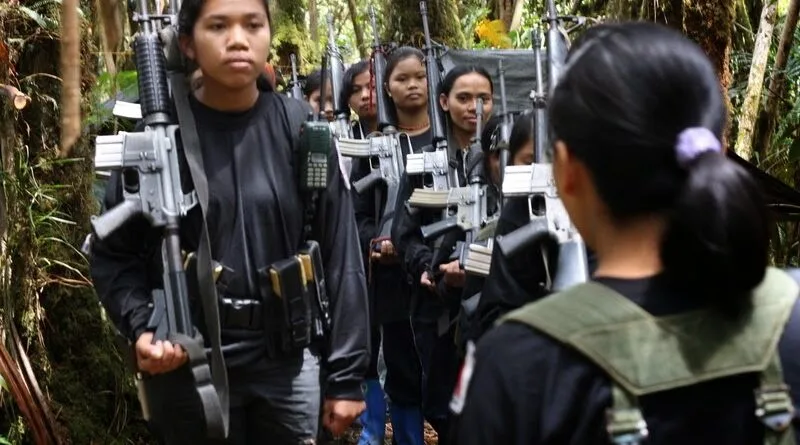
Ka Uma, political officer, NPA Platoon
Contribution from MAKIBAKA
It was on the eve of the new millenium, in 1999, when I went to the countrysides on an integration program with the New People’s Army (NPA).
I was 20 years old then, a student at the university, and was already a member of the underground Communist Party of the Philippines. I realized that genuine change in our society could only come through a people’s revolution. I resolved to dedicate my life to serving the people as a red fighter.
In practice, however, it took me five years to convince myself that I could really be effective as a guerrilla fighter. Life in the countrysides was very difficult, and I had to fight off my desire for the conveniences of urban life, and for the comfort of living in one’s own home.
Besides, I am a lesbian. I was wary of coming out in the beginning. I knew that the Party guaranteed everyone’s right to choose their sexual orientation. I had read “On the Relation of Sexes”—a document that spells out the Party’s principles on marriage, courtship and building a proletarian family, but I was still afraid of ridicule and discrimination. Eventually, I fell in love with a female comrade, and we decided to come out. it was awkward in the beginning. There was talk that some male comrades who had planned to woo either me or my partner were “frustrated”. It became the subject of jokes among our comrades. After the prescribed period, our comrades arranged for our Party wedding. The marriage, however, ended a few years later when my partner suffered a trauma and eventually decided to leave the movement. I filed a case of divorce, which the Party granted after a series of talks to try to patch things up. A few years after, I fell in love with another female comrade. We got married in Party ceremonies. She remains my comrade and partner to this day.
Living with the masses was a source of great fulfillment for me. It helped that my first assignment was an area where the barriofolk—even, and especially the women—have had years of experience with guerrilla war. Years of abuse they had suffered when the military set up camp nearby have militated them for the struggle. Some of them had sons who have sacrificed their lives for the war. While we were their fighting army, they also served as our source of strength—they were our eyes and ears, and made our work of consolidating and expanding our revolutionary front relatively easy.
I steadily rose from the ranks, from being a new and inexperienced fighter to being a political officer of the platoon.
The real test would come soon enough, however, when a large-scale military operation in the area resulted in a series of encounters with enemy forces, wounding and killing a number of my comrades. I was overcome with grief for my comrades who fell, especially since it became clear that several weaknesses on our part—those who were in leadership positions—made us vulnerable to the attacks.
My comrades’ morale plunged, conservatism was high among us. We lost some of our best comrades. I experienced a crisis of confidence, and refrained from volunteering for counter operations against the enemy, worried that my comrades would not have confidence in my military leadership.
It took quite some time, with the help of a series of assessments and criticism-self-criticism, presided over by some senior Party cadres, for many of us to overcome our desire to leave the revolution. It was particularly hard for me, as both my parents were sick and very old, with no one to take care of them. I sought the help of comrades in the city and I also took a short leave to talk to my kin in our hometown. When my father died, I was able to visit his wake one evening. My relatives consoled me, saying I have no reason to feel guilty as I was doing something honorable, and those words strengthened me when I went back to the countrysides. But the next blow came when my partner was captured in an encounter with enemy forces.
I knew I had to steel myself up. I was facing a personal crisis, yet I also knew that it was an urgent task to help raise my comrades’ fighting will. I prepared well for assessments and meetings in order to help my comrades get a good grasp of our situation, our strengths as well as our weakness. I learned the importance of getting a detailed and objective view of events in order to draw up lessons and better prepare for the work and battles ahead. Whenever possible, we went back to the sites of battles to analyze the circumstances and other important details. Through such painstaking process, we eventually were able to launch a string of successful tactical operations against the fascist military forces with the invaluable help of the organized masses in the area.
Being a Party member operating as a fulltime guerrilla fighter for many years, I am always conscious of the need for constant study, both in terms of constantly evaluating the situation, and relying on the teachings and writings of the great Marxist leaders to guide my practical work. Criticism-self-criticism sessions taught me to be more patient, especially when struggling out ideas with comrades who are less experienced, and those who are wont to have a rather narrow view of the problems we face. This has not been easy, and I had been once severely criticized for an ultra-left handling of a comrade who sometimes made an issue of my gender, saying during arguments that I was “only a woman”. He eventually asked to be deployed to another work.
I am currently assigned to “guerrilla zone preparation”—which means that the revolutionary base is not yet established. This requires us to be very mobile, not only because of the military dangers but also because of the need to reach as many villages as possible in order to quickly build a revolutionary base. It also means carrying very heavy load everyday—anywhere between 10-15 kilos, excluding the guns assigned to us.
I remain unfazed, however. I remain fully convinced there is no way to liberate our people but through armed revolution. Also, things have become a lot lighter for me, as my partner is now back beside me, having been released from prison through the help of friends and comrades in the city.
source: NDFP