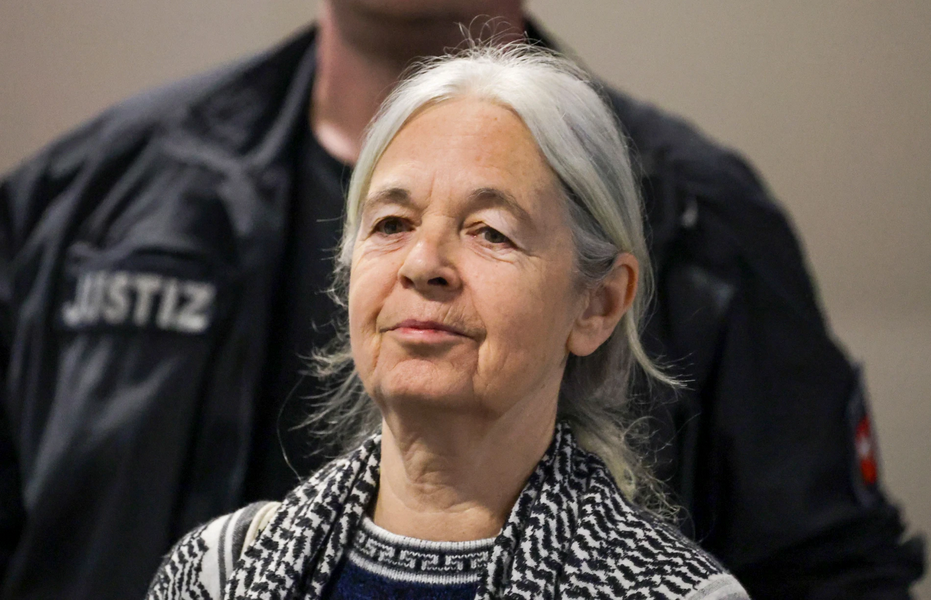
Daniela’s plea from May 12, 2026
Now this first long trial against me is coming to an end. In the course of the trial, the assessment that was made from the beginning was confirmed and it became abundantly clear: the search and the proceedings are politically determined. The point here is to absolutely enforce domination and submission. The public prosecutor’s office underlined this again with its plea. It’s not about individual acts and not so much about me, but about delegitimizing a history of radical left resistance and punishing it in a deterrent way.
I would like to thank everyone who supported me in solidarity, here in the hall, from outside, in front of the prison walls, with letters, cards and thoughts. And also my lawyer Ulrich von Klinggräff, who unfortunately became very ill and can therefore no longer be here.
What I am going to say today is addressed to all of them, as well as to the part of the public that is interested.
I would like to briefly say something about my story, which is also the story of many other comrades. Many of those who have written to me are so young that they did not experience the period from the early 70s to the 90s in West Germany. Or they grew up in East Germany or other places in the world. I wrote this without any claim to completeness, but I hope that what I have said makes it clear why I am defending the search for a better world in which capitalism, racism and patriarchy have been overcome and the fight for it.
And why I am here defending the right to build and maintain a life in illegality, even if it is “only” about evading the repression of the state. This is completely independent of the fact that the latter has been over for me for more than 2 years. That’s why it’s up to me to do it all from here as much as possible.
As a teenager, I felt that living according to capitalist rules was destructive. Humans are social creatures and geared towards cooperation. But subjection to the constraints of isolation through competition produced under capitalism attacks this and creates alienation and distance between one another. Having to function without asking why, and chasing to conform to any images and norms produced by this system creates distance from yourself.
Of course, I didn’t have a concept or an exact explanation for it. But I felt crushed by the pressure and depression that all this created and my defenses against it grew. That’s why I was moved early on by questions about a different life that had to be possible.
That was the case, even though I was very lucky at home. My parents were open people. My mother has probably always been like that. My father, who joined the Hitler Youth as a boy and was on the side of the Nazis in the war as a teenager, dealt intensively with the crimes of National Socialism after 1945 and drew conclusions from them. Both wanted to instill human values in their children. So I was able to have friends from everywhere, both in terms of country, skin color and social status. In the early days of labor migration, some of them were from Spain, Italy and Portugal. Through contact with these friends, I had the opportunity to learn about very different ways of life. That was something special. Only one of my school friends was allowed out on the street with us. Like everywhere else, racist attitudes towards migrants were widespread in our neighborhood. So my parents had to withstand the criticism from teachers who watched my “dealing” with concern. I also noticed how negative and exclusionary the behavior towards migrant workers was. I saw containers in which several Turkish construction workers had to live crammed in only to have their bones broken again during their hard work. They should allow themselves to be squeezed to the maximum at work, but they should not become an equal part of this society. These injustices also upset me. School wasn’t about being together, no, it was supposed to be taught to us that it was always about “being better”, better than your best friend. And about keeping up in order to be able to achieve a career that makes it possible to take part in consumption that is claimed to be desirable. A consumption that is not geared towards real needs, but for which the needs are artificially created in order to increase the profits of corporations. It is still the same today that you are led to believe that it is not what you are that counts, but rather what you have, what you look like and what you achieve. For the growing profit of capital, that determines your value here. Back then I often asked myself what was wrong with me because I didn’t feel any pull to keep up. On the contrary, all attempts to submit to it drained every fiber of my energy. Being depressed by this only disappeared when I met friends from the spontaneous or non-dogmatic left. We looked at texts from the socialist patient collective, such as the book “Making a Weapon Out of Illness,” which really impressed me.
Through these conflicts I learned that my feeling of being lost was not based on an individual problem, but was rooted in social conditions. Understanding this opened our eyes even further to the injustice around us. The brutal imperialist exploitation and oppression in many parts of the world and the wars that came from the rich capitalist countries. Under no circumstances did I want to become an accomplice. It became my conviction that in overcoming these conditions lies the hope of a free and humane life for everyone, which needs to be conquered.
This conviction has never left me since then. Because every decade, every single year and every day brings new evidence that humanity’s problems cannot be solved within capitalism. On the contrary: they are getting worse and worse.
Along with many others, I did not want to submit to this system that alienates people from themselves. We wanted to be seen for who we are, without conforming to lies and images presented by the consumer and performance society. We didn’t want to remain trapped in this and change ourselves and the society determined by capitalism.
That was around the mid-70s. There was still a hint of the 1968 movement of rebellion against the institutions and political positions that were still or newly dominated by Nazis and the ways of thinking in society that were influenced by fascism.
There had been the emergence of an internationalist, revolutionary left, with huge demonstrations in solidarity with the Vietnamese liberation struggle against US aggression and with the fight against the fascist Shah regime in Iran, which was then strongly supported by the revolutionary Iranian left.
But there was also the first demonstrator murdered by the police during this demonstration. On June 2, 1967, the student Benno Ohnesorg was shot by a police officer during a demonstration against the Federal Republic of Germany’s complicity with the fascist Shah regime.
There had been the emergence of an internationalist, revolutionary left, with huge demonstrations in solidarity with the Vietnamese liberation struggle against US aggression and with the fight against the fascist Shah regime in Iran, which was then strongly supported by the revolutionary Iranian left.
But there was also the first demonstrator murdered by the police during this demonstration. On June 2, 1967, the student Benno Ohnesorg was shot by a police officer during a demonstration against the Federal Republic of Germany’s complicity with the fascist Shah regime.
The RAF had already attacked the US headquarters in Frankfurt and Heidelberg, from where the US Army’s air raids in Vietnam were coordinated. The Second June Movement and the revolutionary cells were also founded at that time. And later the Red Zora, organized by women, was added.
Remnants of the 1968 awakening could still be felt in the school. Despite the professional bans, there were some teachers who practiced other forms of teaching with us that were focused on learning together and not on competition. We read books such as those by B. Traven about stories of resistance from Latin America or Katharina Blum by Heinrich Böll. In Religion we learned about liberation theology in Latin America and about priests who had joined the struggle for liberation there. Like Don Helder Camara in Brazil and Camilo Torres in Colombia.
All of this, but also the fact that these teachers were disciplined and transferred before our eyes, made me learn more about global conditions and the role and reality of the Federal Republic of Germany. We were also outraged that at that time it was not part of the curriculum to deal comprehensively with Nazi fascism. Let alone the consequences that had to be drawn from it. In hindsight, it’s no wonder, because there were no fundamental plans.
We acquired our knowledge of this outside of school. I remember a ring binder put together by left-wing students. I think it was called “learning from below”. From this we learned about the responsibility of capital for the rise to power of fascism and about the entire dimension of the human catastrophe, the brutal persecution of the left-wing workers’ movement and the left-wing intellectuals, the cruel policy of extermination against the Jewish population, against Roma and Sinti, about concentration camps and euthanasia, the eradication of all opposition, about the repulsed war of annihilation against the Soviet Union, which cost the lives of more than 25 million Soviet citizens, of raids and occupation in Eastern and Western Europe, but also of Europe-wide anti-fascist and communist resistance to it.
During this time, older students also invited people to film screenings and discussions about the Vietnamese liberation struggle. We formed a school collective in order to be able to enforce demands in everyday school life. Until the age of 15, I had resisted the idea that people who wanted to fight for a better world had to use violence to achieve and defend it. My dream was non-violent change. As we looked at history and the world at large, we became increasingly aware of the fact that the powerful beneficiaries who were most entangled in the capitalist system would fight any fundamental change with the most brutal violence. The example of the US-backed fascist military coup and the assassination of Salvador Allende in Chile in 1973 had shown that the possibilities and existence of any elected socialist government would be crushed if it could not defend itself with arms.
“You’ll have to realize that you have to defend yourself if you don’t want to go under,” was a slogan on many leaflets and on many walls at the time.
During the years of my politicization in Karlsruhe, I repeatedly heard about the RAF through slogans or posters on the walls. Also about the fight of political prisoners against isolation torture and solidarity with them. Soon I consciously followed everything, including their hunger strikes. It had a great attraction for me that there were people who fought so decisively against this system, by which I, like many others, felt oppressed.
I was 16 when I noticed that a person who was on hunger strike against the torture of solitary confinement had been murdered in prison. It was Holger Meins who stood up against the conditions and was killed in prison through targeted malnutrition during state force feeding and through the refusal of medical help.
I was 17 when the Vietnamese liberation struggle defeated US-led imperialism. The incredible victory was also achieved with global solidarity. Despite napalm, despite the enormous military machinery that opposed the liberation movement, and despite the massacres of the Vietnamese population that the US military carried out with the help and complicity of the West, especially Germany.
It was a time of attempts at liberation and anti-colonial struggles in many countries: for example, the Black Panthers against racist oppression and for the revolution in the USA, the fight against apartheid in South Africa or the FSLN in Nicaragua against the dictatorship. I began to understand what humanity can expect from capitalism and imperialism. Yes, I saw myself as part of the global movements that fought for liberation from exploitation and oppression against capitalism and patriarchy and against war and militarism.
In 1976/77 I started visiting political prisoners. The first of them was Johannes Thimme, who was in prison for allegedly supporting the RAF and was immediately put in solitary confinement. I wanted to express my solidarity and counteract the isolation. In response, they began to terrorize me with surveillance. In 1977, civilian police officers showed up in their cars at my front door early in the morning and followed me at walking pace to school.
After 1977, when the attempt to liberate 11 prisoners from the RAF failed, and of the Stammheim prisoners only Irmgard Möller survived the night of October 18, 1977, seriously injured, I decided to move to Wiesbaden. There I met comrades with whom I wanted to continue solidarity with political prisoners. We saw this as an important and urgently needed part of the anti-imperialist and anti-fascist struggle.
It was a life full of resistance activities against isolation and for the reunification of prisoners, solidarity with the liberation struggles in Palestine, South Africa, Nicaragua and El Salvador, and with Turkish comrades against the NATO coup in Turkey.
Through the fight in solidarity with the political prisoners, further discussions and friendships developed with other comrades from Ireland, the Basque Country, Italy, Spain and France. And there were contacts with the left-wing Iranian resistance.
For us, the international liberation movements also stood for the global women’s liberation struggle. Leyla Khaled from the PFLP in Palestine, Assata Shakur and Angela Davis from the black liberation movement in the USA and also the comrades from the armed groups in Western Europe were examples for us. They represented millions of women worldwide.
In recent decades, the example of the Kurdish liberation movement, particularly in Rojava, has shown how much strength arises for all when women’s liberation is a defining part of the struggle.
We lived and organized our everyday lives together. There were squats and the fight against the West runway, against the deforestation and against the expansion of the capacity of Frankfurt Airport and thus the US Air Base. We went there for the partly peaceful, partly militant Sunday walks to the runway wall, political theater, many resistance meetings and events that were directed against the imperialist US and NATO policies. Together we were at demonstrations in solidarity with the liberation movements in Nicaragua and El Salvador, against the state visits of Reagan, the then US President, and Haig, the then US NATO Supreme Commander, and in solidarity with the political prisoners. We saw the RAF attacks against Haig and Kroesen as well as on the US military airport in Ramstein as a base for their wars all over the world and the attempt in Oberammergau as a strengthening of our resistance and vice versa at the time of major mobilizations against the stationing of US medium-range missiles and the US counterwars against the liberation movements.
During this time, the RAF and action directe also proposed the formation of a common resistance front in the fight against the formation of Western Europe into an imperialist bloc and in solidarity with the liberation movements.
State security struck hard with increased repression. Several anti-imperialist comrades known to the state security service were arrested. By constructing an alleged “legal RAF,” the Federal Prosecutor’s Office created the instrument that made it possible to put comrades in prison for many years through convictions without evidence of their alleged involvement in militant actions.
Since our visits to political prisoners, we – and I mean many comrades – were monitored at almost every step. They terrorized us with obvious surveillance, with checks several times a day, during which we were addressed by name and asked to identify ourselves. They often set up checkpoints on the street where we lived so that no visitors could come to us without registering. The other variant was covert observations that we weren’t supposed to notice.
These observations were like contagious diseases that spread from person to person. In any case, we always had to assume that the “Lords of Dawn” were lurking somewhere. It took a lot of effort to be able to safely escape this surveillance for at least a few hours, whether it was to be able to have a conversation without the fear of being listened to, or to spray a few slogans or stick up posters. It is obvious that resistance could never allow itself to be put in chains that would mean having every activity controlled by state security. And of course we didn’t want to expose our emotional lives to guards.
Back in the 70s and 80s, there were always comrades who noticed how the net was being drawn ever tighter around them and who, out of fear and arrest, disappeared from the scene and lived abroad – some, sometimes for years.
At the end of the 80s and the beginning of the 90s it was obvious that there had to be a redefinition and fundamental reflection of revolutionary politics. On the one hand, the international framework conditions had changed profoundly, and on the other hand, it was a matter of coming to terms with past experiences. At the time, I was one of many who did not consider withdrawing in the face of the change in era. We did not want to accept the collapse of the Soviet Union as a final victory for capitalism. It was clear that this weakening of the world socialist movement would have catastrophic consequences. In the Federal Republic of Germany it led to the return of the Bundeswehr as an openly belligerent army and immediately to the war against Yugoslavia, which violated international law. It led to the incorporation of the GDR by the Federal Republic of Germany, which was also implemented over the heads of those who had begun their journey in the GDR with the aim of positive change there and beyond the capitalist system and West German reality, and brought with it the neoliberal attack on social achievements that had been fought for. And a racist mobilization sparked by the CDU as a redirection of any anger and resistance that may arise. At the same time, nationalistic joy was celebrated. This was eagerly taken up by the right-wing and led to deadly arson attacks in West and East in united Germany, such as in Solingen and Mölln, and attacks on migrants, refugees and left-wing people and their structures. I just remember Rostock-Lichtenhagen and Hoyerswerda and reports from people currently on trial as Antifa who were exposed to this atmosphere in eastern Germany in their youth.
Of course, we realized this bitter weakness of the left worldwide and that is also why we had the feeling that we wanted to make every effort to find answers to the questions before us and to continue to exist as a radical left-wing force. The disputes over this took place together with illegals. In the long run it was too dangerous to leave the observation situation again and again and then return again.
I decided not to look into these conditions any further and so stayed away. That was the decision to make resistance the center of my life and the contacts and discussions with other comrades who had the same thoughts about what to do next and the redefinition of revolutionary politics had become a priority for me.
The RAF has not existed for 28 years. The fact that the RAF played an important role in my life is evident from what I have written here. For me, these comrades represented the possibility of breaking with this system and fighting for liberation in fundamental resistance.
By discussing the RAF’s first actions during the Vietnam War, we understood more about the role of the Federal Republic of Germany and the global balance of power and how the fighting can support each other internationally.
Even from the prisons, the prisoners’ fight against isolation torture and for collectivity – to be able to be and act together with those who wanted that for themselves – conveyed a trace of what the fight for liberation is all about. Namely, a society in which the focus is on “for everyone” and not on profit, money, power – not on having, but on being, together.
For me it remained that way for a long time, regardless of the criticism that I already had about some of the actions and the underlying provisions. This is also independent of the recognition of the need to deal with errors in the history of the radical and militant left, including in the RAF.
The idea arose that the armed struggle would have to be politically and bindingly integrated into a countervailing force from below.
But the overall political situation did not allow this. I found the dissolution of the RAF and its justification completely correct.
As radical or militant leftists, we have certainly made many mistakes, but certainly not the one of shrugging off the misery of our time.
Of course I would like to take part in a discussion and preferably in conversations about this era of resistance. Burkhard Garweg was completely right when he wrote that at the end of his letter to Caroline Braunmühl.
A discussion with those who have been part of this history of resistance at some point and all those who want to use their experiences for the future of the resistance.
I don’t think the courtroom is the right place for an in-depth discussion on this.
This makes a discussion more difficult for me right from the start. Visits from former prisoners from the RAF and the June 2nd Movement were rejected with the most insane reasons. Furthermore, during the visits every sentence was recorded for the state security, even before I could think a thought back and forth with visitors.
The BAW has every one of my statements, even the most general ones, about the history of the resistance confiscated as “evidence” of involvement in the RAF, which in turn they interpret as evidence of my involvement in the actions they have attributed to me.
I see this, as well as the extensive summonses with which more and more comrades from the 70s and 80s are being harassed, as a threat not only to me. Of course, the left-wing armed groups did not move in a vacuum at the time. Like me, they touched and influenced many comrades who had their own practice of resistance and challenged their political and/or practical support, solidarity and criticism. But now, after 40/50 years, fining people heavily and threatening them with imprisonment if they are not willing to tell the Federal Criminal Police Office and the Federal Prosecutor’s Office about their lives and name other names who are then to be summoned and to completely ignore the state of health of individual comrades in the summons shows the intention to punish the comrades as a deterrent today as representative of the history of the resistance.
At the beginning of the 90s, on April 10, 1992, the RAF declared that it would stop the deadly attacks on representatives from the state and business for the necessary discussion process and that it would reduce the escalation on its part.
At the same time, solidarity with the struggle of political prisoners and the need to include them in the discussions of the radical left grew. It appeared that the state was moving in a positive direction regarding demands to improve prison conditions and release sick prisoners. But as soon as it became known to state security at the highest level that the Office for the Protection of the Constitution had an informant in Klaus Steinmetz with contact with illegal immigrants, it immediately resorted to escalation again. The prisoners’ demands were closed again. In March 1993, the RAF blew up the new prison building in Weiterstadt, which was nearing completion. At the same time, the state was preparing a large wave of arrests. Then they struck in Bad Kleinen. Wolfgang Grams was murdered and Birgit Hogefeld was arrested. The RAF and resistance prisoners were subjected to new trials and long prison sentences.
In 1998 the RAF disbanded of its own accord. Both the state security agency and its much-quoted experts such as Butz Peters and Alexander Strassner spoke of up to 30 people who could have identified the RAF in the last years of its existence. They have often openly said that they basically have no idea. It should stay that way. A serious social examination and debate about history is not about individual people, but about the political content of the debate.
After 1998, the only people publicly wanted were Burkhard Garweg, Volker Staub and me. There was no question for anyone, whether they were on wanted lists or not, to turn themselves in. The state had set out clear facts about what would happen to us if they got their hands on one of us. They would have liked to celebrate their triumph against the RAF and with it an important part of the fundamental resistance in the history of the Federal Republic of Germany. This was still evident almost 30 years later after my arrest, both in my treatment, presentation and the media coverage of the whole thing.
We didn’t want to subject ourselves to something like that. So it was absolutely necessary not to get caught. Neither did we want to subject ourselves to condemnation rituals that had been practiced for years. There are still long prison sentences for all sorts of actions by the RAF and the resistance that have not yet been convicted, and there is a risk of being shot if arrested.
In illegality we had the opportunity to continue living as radical leftists, albeit within limits and in seclusion in freedom. Here we were able to live in self-determined, solidarity-based relationships with comrades and friends and decide on our future path.
This state is not a friend of political solutions, but a friend of capital. Everyone must submit to this.
Such a long life of illegality has arisen from this story. Not out of a sense of adventure and certainly not out of enrichment. It has been in recent decades and is today a defensive position of resistance. Even though the life I was being taken away from meant a lot to me, there was no plan to try to use violence and shooting to get out of the situation. That’s why nothing like that happened.
When I heard the prosecution’s plea, I thought to myself how many pirouettes did she have to do to lie all this away. In the trial, the alleged willingness to kill is still maintained in order to use the hammer against me. Here all intentions are carried out, some of them vindictive, but above all those of domination. This contradiction shows that it is about demonization, which is intended to further legitimize the search for criminals who are supposedly dangerous to the public and to set an example.
I counter this with the demand: Stop the search for Burkhard Garweg and Volker Straub!
With regard to the psychological consequences for some of those affected by the attacks that were discussed here in the trial, I completely agree with Burkhard Garweg’s statement in his greetings from illegality in October 2024:
“Traumatization of cashiers and money messengers is to be regretted.”
After I noticed during the trial how badly individual victims are still doing today, such as the driver Mirko Kramer from Wolfsburg or Ms. Ulmer from Bochum, a cashier, I have to say that I feel very sorry for them because of the serious psychological injuries described in the trial.
Before I read the trial files, I would have been more likely to imagine the trauma of being robbed by a cashier than an armed money delivery person. It is surprising that money messengers do not receive any training that would enable them to act calculatingly and coolly in such a situation instead of being left in total shock. Especially when the job only exists because of the real danger of robberies. And it is remarkable that in the event of an attack, they first have to stay in the car alone or in pairs for hours. Still to protect the money, even though everything is already full of police instead of them receiving initial psychological care. For the first time in connection with this process, I was confronted with the fact that cash-in-transit drivers and money messengers spoke of traumatization.
When I and my lawyers decided not to question the psychological consequences of the witnesses in the trial, there were two reasons for this. The main reason for this was that nothing should be done that could contribute to retraumatization or deterioration. This is also about very personal things, especially when it comes to pre-existing circumstances from the life history of the individual affected. We didn’t think it was right to harp on it publicly.
The second reason was that I think it is possible and generally justified if those affected would have taken the right to a longer paid vacation after such a robbery or attempted robbery. The fact that something like this happens was proven by the statement of the driver Whitley, whose boss intervened immediately after the attack in Duisburg to put a stop to it. I don’t mention this here because I would accuse anyone who was affected here of doing so. I just want to make a relationship clear: both cashiers and cash transport employees are proletarians and not enemies.
It is well known that working conditions in the cash-in-trade industry are poor and the work is not well paid. The driver Immes’ statement that the first thing the management did after the attack in Stuhr was to inquire about the condition of the car, but not about the well-being of the people, fits in with this. It is astonishing that some cash transport crews still risk so much for “their” company. Especially since there is a directive not to risk your life for the money.
Ex-soldier and driver Whitley said he might have even started a shootout if he had had his gun with him. I had already read in an article about the incident in Wolfsburg that there is an instruction to leave the runner behind with robbers if the driver can drive away. However, I didn’t take this seriously, but rather just as a statement made by the company boss in order to protect his driver, who had saved a lot of money for the company, in public. The fact that he had let his colleague down was initially questioned morally in the regional press. Only after the suspicion was expressed that the attempted robbery had been carried out by the conjured former RAF did the press turn up the heat and write about unscrupulous and brutal robbers.
When I read about the post-traumatic stress disorder of the driver Immes from Stuhr in the files, it seemed logical to me from the start. Although my lawyers have made it clear several times that he was not targeted and that it was even part of his therapy to realize that no one wanted to kill him, the fact remains that he felt that way and was severely shocked, especially since he found himself in a situation that, for someone who had problems in small, enclosed spaces, had to be horrifying just from being locked in. At first I didn’t listen to Mirko Kramer, the driver in Wolfsburg, when he read the files.
He only had direct contact with the attack situation for a few seconds. He even outsmarted the robbers and was quickly out of the danger zone. It wasn’t until shortly before his testimony at the trial that I realized that something had actually completely thrown him off track. The trigger was the attack because it put him in this situation where he had to make a decision. In order to secure the bosses’ money, he decided to follow the instructions of leaving his colleague with the robbers. He said that Mr. Kramer had acted correctly according to the instructions, but also said that these instructions were not humanly correct. That’s exactly what I think too. It’s pure capitalism. He himself said: “I had to hear that the money is more important than the person”. That sums it up.
From the statements of the driver in Cremlingen, Michael Sohn, I gathered that Kramer was not approached by his colleagues after the attack. His actions were even questioned in the press. I think he had doubts about it himself. After he saw the robbers’ car drive away, he drove back to check on his colleague. It’s easy to imagine how frightened he must have been when he couldn’t see him anywhere at first. As I said before, I felt very sorry for him when I saw and heard how bad he had been since then. I hope he will get better soon. I also felt very sorry for the driver Immes from Stuhr. Because he felt his life was threatened and suffered from this shock for a very long time.
Under capitalism, the property and money of the rich are protected from the population at massive expense. Conversely, in cases of “white collar crime” such as the Cum-Ex affair, in which a loot of 30 billion euros was made in order to make the rich even richer, the criminals are protected by the state and the judicial structure by hindering effective investigations.
There will certainly always be situations in which people, due to persecution or a lack of other means of survival, will be forced to steal money as those who do not own property. This necessity has often existed in the history of the left. It has nothing to do with ease or adventure. In any case, all ways of obtaining money that can keep the risk to people as low as possible are preferable. Ultimately, it’s about creating conditions in which people no longer have to have to somehow get money in order to survive. Be it through allowing oneself to be exploited in wage work, through illegal work, self-exploitation or through robbery and theft. Rather than worrying about ensuring survival as dispossessed people, we would have always put our energy into so many useful things, into constructive things, into political disputes, into learning useful things together in friendships. We all have many interests and abilities, which may have to do with, among other things, seeking answers to the questions of the time, such as how to stop the frenzy of destruction and wars and build a different reality.
Some time after this attack occurred in Stuhr, Volker, Burkhard and I were publicly persecuted for attempted murder.
For several years, the public prosecutor’s office and the Lower Saxony LKA obviously didn’t come across any useful leads, which is why they doggedly turned up the heat again after 2023. With interrogations of x how many old friends and acquaintances, searches of parents and other relatives, calls in file number XY and other reports and sent their squads after every clue. Unfortunately, you came across me. Since then, the prosecutor’s arrest has brought terror into the lives of friends and siblings, parents in neighborhoods, the trailer park with real marches, without any consideration for the cause of trauma. But these are legal attacks that are wanted by the class justice system and are of course not prosecuted. This means that the accusers have no moral problems. During the course of the trial, the public prosecutor’s office made it clear that it was by no means concerned with the well-being of the witnesses or those affected by attacks. Why else did she repeatedly probe during interrogations when witnesses said that they weren’t feeling so badly after the respective attacks. The fact that they got over it relatively quickly was sometimes followed up in a mushy manner when someone said, “It was clear that it wasn’t against me.” In any case, the prosecution would have liked to hear something different. How great must the disappointment have been that the space reserved especially for many co-plaintiffs was not fully occupied? For them, those affected are only a means to an end in order to be able to achieve the highest possible sentence against me and to continue the search for Burkhard and Volker. In return, she would obviously have much preferred several retraumatized, severely injured victims.
It is also fitting that in this trial the prosecution is acting as if it doesn’t matter at all how the robbers behave. They even seem to be more upset when it is said that their behavior towards those affected was polite and reassuring. I find this unfathomable, because of course it is neither for the mugged nor for the robbers, no matter how they behave. A few weeks ago, the court got involved in the tenor of the prosecution when it rejected an application from my defense. It was claimed that anyone who commits robberies takes serious retraumatization into account, because it is well known that traumatized people can be found everywhere, from money messengers, valuables transporters, cashiers to the special squad and every random people present anyway. Soldiers and police officers are also known to have experienced trauma. I was actually already aware of the latter when they had come into situations in which people, including colleagues, had died during operations, when they themselves had been involved in massacres or had witnessed them.
I would not expect such traumatized people to be in the police service or armed as money messengers, but rather in psychological treatment or in positions that are suitable for recovery. But what does that actually mean? There is also this fatal assertion here that it doesn’t matter whether people act brutally violent and aggressive during such attacks or not, because if they encounter traumatized people, it’s the same anyway? How irresponsible and wrong are such statements! But beyond that: What does it say about the state of this society when we encounter traumatized and psychologically injured people everywhere we go today, not as a rare exception, but as an increasing rule? It is true that the constantly propagated military training and militarization and the upholding of the right of the militarily stronger in the international conflicts over power and access to raw materials and land are accompanied by the strengthening of the right and the spread of fascist thinking. Violent and patriarchal ideas are strengthened.
Since the dawn of time, femicide, rape and sexual violence – including in police operations – have been omnipresent.
During the isolation during the Corona period, outbreaks of patriarchal violence in families increased.
These are obvious sources of trauma. Otherwise, so many things are happening that are filling more and more people with great uncertainty and growing fear of the future. Every day it is spread through the bourgeois media and certainly also massively on the Internet that the money that would actually be needed for social and ecological issues, for health, education and culture, is now being invested in rearmament. The cold sorting out is becoming more and more dominant in the discussions in the main stream media – entitlement to help and care should no longer exist for ever larger parts of society. Those who don’t have the money for private insurance are at risk of receiving increasingly reduced medical care – and – expensive therapy for grandpa is no longer worth it!
Refugees should be deported somewhere else or kept out – even violently. Unless they are needed somewhere in the economy.
In times of crisis, the capitalist Western states rely on external aggression and internal social brutalization to dismantle societies. In return, contempt for a growing part of the population, which is defamed as useless, is propagated.
Social demands, social circumvention, inclusion and care are attacked as threatening the economy – and that actually means threatening profit growth. The word “reform” today stands for government steps towards the abolition of the welfare state.
The state today oppresses through division, repression and fear. This works at a time when thousands are threatened with the loss of their relative prosperity and therefore have to fear that they will soon find themselves on the side of those who have been insulted as “parasites” and will be dependent on support that is already being cut back.
The question is whether this leads many people to allow themselves to be blackmailed or lured into producing any dirt for the war machine or whether in the disputes over this, those who have long drawn up proposals for a different civil and ecological production are finally noticed and whether this can be organized and implemented together.
Young people should resign themselves to a future perspective as cannon fodder.
Although peace researchers have already refuted Russia’s war intentions or ability to wage war against NATO many times, these continue to be used as a justification for the concentration on militarization and the enormously increased spending on the military and the arms industry and the continued fueling of the war in Ukraine by NATO’s immense arms deliveries.
The feeling of not having any decision-making options arises. If the only perspective is yes! to war and impoverishment, a business as usual! When faced with natural destruction and climate catastrophe, this creates despair. For two and a half years, it has been visibly demonstrated around the world in brutality how representatives of Western governments, which until recently called themselves a “society of values”, deal with people who stand in the way of imperialist and capitalist interests – namely the ongoing genocide of the Palestinian population in Gaza as well as the ethnic cleansing through sheer terror in the West Bank and now also in Lebanon and Iran with the most brutal destruction caused by the war by Israel and the USA. It is the German government that is known to support this through arms sales, business relationships and political bows and to persecute those who oppose it. With a Federal Chancellor who remarked on Israel’s aggressive warfare even before the new expansion of war that violated international law that it was “dirty work that Israel does for us.”
So it is true when the court finds that the streets are full of people traumatized by poverty, racism, patriarchy, police violence and imperialist wars. Accusing me of this exploits the misery and is intended to justify a long prison sentence.
Overcoming mass trauma requires immediate but also profound changes, internationally. Because it is obvious that the extent of the trauma in countries that have been engulfed in war for years, such as Sudan, Palestine, Syria, Lebanon, Iran, Ukraine or that are subject to strangulation by sanctions such as Cuba, must be unimaginably more drastic.
Everyone can really see and understand that! Basically, most people know it.
But unfortunately many are more afraid of taking steps into a different social society that would be unknown than of the comprehensive destruction of living conditions that is clearly on the horizon if they say “Keep it up!” There is an urgent need for a “system change” because, in addition to competition, exploitation and oppression, capitalism also includes fascism, racism, war, violent power behavior in the political system and between people, patriarchal violence against women and queers, against people with disabilities and the destruction of nature.
Depending on the state of the capitalist crisis, all of this fades more into the background or more into the foreground. That is why we will only leave this story of suffering behind us once we have overcome this system. Right now we are at an extremely destructive point in this crisis. The old, false world order is losing its hegemony – finally – because it is absolutely unfair to the vast majority of humanity. But that’s why she lashes out wildly. For us, it must be a direct matter of turning away from military training and militarization, away from external aggression and internal repression and humiliation, social coldness, and complicity in global capitalist and imperialist crimes.
Stop the wars and imperial violence that violate international law! Stop the oppressive sanctions that are causing devastation and millions of deaths!
Instead, it must be about concentrating on ecologically sensible production that is not aimed at profit for the few, but rather at the well-being of all and the restructuring of society in a way that allows people to live in social security and security internationally.
“The alternative is our task worldwide and is a socialism that could be rich in historical experiences (and) also by overcoming the large and small mistakes of history, the large and small attempts at revolution, the urban guerrillas, the anarchists of the communists, the social revolutionaries and the anti-patriarchal and anti-colonial struggles and movements. Achieving this ultimately decides whether life will continue to be possible on this planet and under what conditions. …The question to all of us worldwide is the alternative to capitalism and the systemic as well as our processes towards it is existential and cannot be postponed.” Burkhard Garweg in the greeting to the Rosa Luxemburg Conference in January 2026.
The trace of this lives in all the various resistance activities of those
who know that the youth, the non-rich and powerful in the population are the ones who are supposed to be used as cannon fodder in the war for power and raw materials and therefore oppose militarization, conscription and rearmament, i.e. against the war,
who refuse to give their lives or take those of others for the interests of capital and who do not accept that the resources should be used for weapons, the military, the police and the profits of corporations instead of for the population,
who do not accept militarization because they are aware that in a militarized society violence against women, queers, trans people and people with disabilities will inevitably continue to increase,
who, as students, directly defend themselves with school strikes against a future as cannon fodder,
who oppose their solidarity and internationalism to imperial politics and crimes and do not accept the state violence that the struggle for power and raw materials in capitalism requires and which is increasingly openly represented and used more considerately by those in power,
who do not bow down, although as Jews they are massively attacked by the German state and the media as allegedly anti-Semitic, because in times of international resistance against the extreme violence against Palestinians they are to be deprived of the right to reject or even even question Israeli settler colonialism and the apartheid policy against the Palestinian population of Zionism, as well as Germany’s complicity in war crimes and genocide,
who, as activists, demonstrators, journalists, artists and scientists, insist on their opposition to this, even though Germany’s raison d’état has established unwavering support for Israel’s every policy, no matter how terrorist, and anyone who opposes this is threatened with exclusion and criminalization,
who fight anti-Semitism and naturally assume that this is part of the fight against racism in general,
who, in the face of worsening inequality, poverty, exploitation, no longer affordable rents, mass homelessness and unemployment, are questioning the capitalist system and are now demanding the abolition of the profit economy system with home ownership
who counter the politics of ongoing pushed racism, nationalism and the exclusion of people who have already been left behind from social security with a politics of solidarity and the fight against social cuts; because the only way to prevent ever larger parts of the population from moving to the right and to stop the fascization of the declining old colonial states and the USA is to counter racist agitation and a politics that is generally based on division and the invitation to save oneself by pushing away those further down in society instead of fighting upwards against power with a radical left perspective that brings tangible positive changes in life for the many,
who are organizing to stop the gradual destruction and militarization of health care,
who directly oppose Nazis and organize protection and who at the same time say that this is not enough because fascism is based on capitalism,
who oppose the ecological destruction of the world that is inevitable under capitalism and are committed to organizing humanity in order to enable sustainable ecological production and thus the survival of humanity and nature,
who, in the face of systems of repression and prisons, stand with us, with the prisoners, and demand with us a perspective of freedom and ultimately the abolition of prisons,
who, after decades of fighting to protect the life of Mumia Abu Jamal, who has been a political prisoner in the USA for 48 years, do not give up and do everything in solidarity to fight for his freedom.
These are by no means all of the diverse resistance activities that have developed today and in recent years due to so many contradictions or have existed in some cases for a long time – such as the feminist and today queer feminist organizing against patriarchal violence, the many initiatives against the increasingly perfect repressive isolation system at the borders to ward off refugees who urgently need help, the flotillas to Gaza and Cuba to break through starvation and isolation, the port blockades against weapons deliveries to Gaza and against militarization and solidarity strikes by Italian and Greek workers with the Palestinian population and their fight against occupation and expulsion, the protests against the increasing number of fatal police shots against black people, non-German people or people who appear to be non-conformist.
Even if – fortunately – I cannot list everything that is being done, I wanted to at least name a part of it because it is so important to remember to stick to the goals and thoughts of liberation and not to allow yourself to be reduced to speechlessness by the open brutality of those in power. Just as all the different initiatives are about the concrete effect against the respective crimes and the defense of “oasis of human cooperation” and at the same time their expansion and further development within their own initiatives, what is important is how everyone will come together to form a common force that can stop the development of the Third World War and what it brings with it in the run-up to it. Because of this war, all positive approaches and ideas are essentially threatened internationally.
Even if this power does not exist yet, it is all these struggles that at least enable its development and that give me hope.
This is also this hope for my and our freedom and ultimately the freedom of everyone and for a world that leaves every form of oppression behind.
A world in which no prisons continue to exist, neither in the form of diverse and interconnected violent relationships, nor in the form of concrete, stone and steel in which people are simply locked away behind walls and barbed wire.
A world in which people can live with each other and in harmony with all other living creatures in nature.
We can only be truly free when everyone is free.