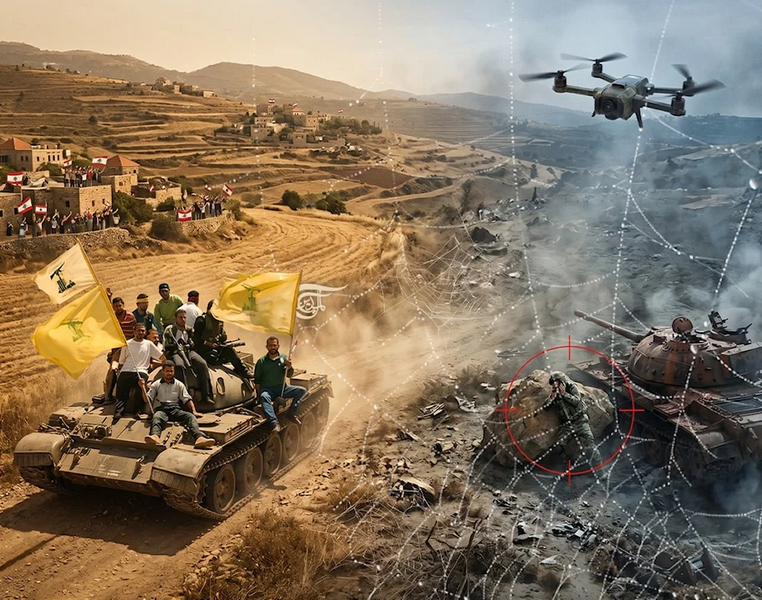
Twenty-six years on from the liberation of South Lebanon, the message has become clear: as long as the Israeli regime remains, peace will never be possible. This year’s Liberation Day anniversary will be observed by a population that is now fighting another struggle against occupation, one that will have implications beyond the freeing of Lebanese lands alone.
On May 25, 2000, the Israeli occupation forces withdrew from most of the Lebanese lands they had occupied illegally in 1982; a move that came following nearly two decades of brutal oppression and was triggered as a result of the fierce resistance waged by the local population. For the Arab World, and specifically for the Palestinian cause for national liberation, that day became a signal that resistance does work.
A day later, former Hezbollah Secretary General, martyr Sayyed Hassan Nasrallah, delivered his famous ‘Spider’s Web’ speech from a small football stadium in Bint Jbeil, arguing that the Lebanese model of armed resistance is a blueprint for the Palestinian people. This address has haunted the Israeli senior leadership ever since.
What Sayyed Nasrallah laid out was the theory that the Zionist regime was frailer than a spider’s web, meaning that despite its exterior, internally it was weak and could easily be cut down. He paid particular attention, when stating this metaphor, to ensuring the public knew precisely what he meant, which was that the Israeli society was incapable of enduring the repercussions of the regime’s policies. Today, this speech could not be more relevant.
The Israeli military doctrine, since the entity’s founding, has been based on the concept of always fighting short wars and avoiding wars of attrition. David Ben-Gurion, the first Israeli Prime Minister, was the first to ensure that his settler project implemented this doctrine, arguing that because his military was more advanced, they could manage to inflict defeats on the enemies, but that the wars it fought had to be limited due to the overwhelming numerical advantages on the Arab side.
If you look back through Israeli military history, you will also notice a pattern of short wars, especially those in which the Zionist entity achieved significant gains. Their most successful war was the “6-Day War” for example. Even last year, their attack on Iran became the “12-Day War”.
The Israelis withdrew from South Lebanon because they understood that the fight they were facing was going to bog them down and drain them, especially as the Lebanese Resistance was gradually growing in strength. In the Gaza Strip, the same concept applied in 2005. They ran cost-benefit analyses and decided it was best to leave.
Over the years, having only fought short wars against militarily inferior opponents, the Israeli society was able to live in its own bubble world. The consequences of their actions were a small price to pay, especially if these consequences were only felt during shorter periods of time. Other than this, they maintained belligerent occupations, meaning that their army was transformed into more of a riot police force than a proper standing army.
During the Second Intifada, which began in 2000, only months after the liberation of South Lebanon, the Israelis then transitioned into a method of warfare that depended more heavily on “targeted assassinations” and special forces raids. They implemented this strategy, alongside their counterinsurgency approach to warfare, and specialized in occupying civilian populations.
In 2006, they encountered a new obstacle, sustained rocket fire on their settlements, managing to blast as deep into occupied Palestine as Haifa. Later on, the Palestinian Resistance would develop its own rockets and eventually reach Tel Aviv and beyond. However, due to Gaza’s resistance being significantly weaker than Hezbollah, they settled for limited wars of aggression where they would implement the infamous “Dahieh Doctrine” – targeting the civilian population as a means of achieving future “deterrence”.
Lebanese Hezbollah managed to deter the Israelis for 17 years, even managing to force the Zionists to accept an agreement demarcating Lebanese maritime borders. However, the October 7 Al-Aqsa Flood operation jolted the Israelis into a reactionary and accelerationist mindset; they were no longer willing to slowly achieve their goals; instead, they had to do things at a pace in their minds.
But they fell into a trap; they were dragged into a war of attrition. In Gaza, this was something they could survive because the rocket fire gradually dwindled, and their soldiers refused to actually fight the Palestinian Resistance head-on. Instead, they carried out a genocide from a distance, mainly, with their main goal being to destroy buildings.
Which brings us back to South Lebanon. As you read this, the second guerrilla war of liberation is being waged, aiming at achieving an even bigger goal than was achieved in 2000. Hezbollah is now facing a similar predicament to what occurred in 1982 when the Israelis declared a “security zone” in southern Lebanon, which they maintained until the formal occupation was declared in 1985.
The major difference is that the Lebanese Resistance was still in its infancy in the 1980s, and the Palestinian Resistance had left in 1982. This time, the Israelis have been drawn into a trap, one that they cannot easily get out of. It is the beginning of the spider’s web theory proving itself in real time.
Although the war is being fought at a somewhat lower intensity since the announcement of a temporary ceasefire, the invading Zionist militants are being dealt blows on an hourly basis in the south and northern occupied Palestine. You need only look at their media to realize that Israeli society is under pressure in the north already, and the war of attrition has just begun.
The people of Lebanon and Palestine, who form the backbone of their national liberation movements, have proven themselves hardy and capable of enduring the hardships of war, while standing behind their Resistance fighters who come from amongst them. In the case of the Zionists, their army is formed of their public, who are conscripted into it, meaning it is a settlers’ armed forces, but they are a fundamentally weak society.
For the Israelis, they are more interested in living a Western European style of life and aren’t willing to make the necessary sacrifices to win wars of attrition, despite the superiority of their military equipment and intelligence services. A few occasional rockets are enough for tens of thousands to flee their homes, while a Lebanese farmer will remain in his fields as the bombs drop on his village. Right after the so-called ceasefire of November 2024, the people of the South immediately returned home; the settlers did not.
The Israeli army is also suffering a manpower shortage, has drawn back its presence in South Lebanon already due to the FPV drone threat, and has to score fake symbolic victories, such as planting flags in Bint Jbeil, while failing to properly maintain control of the area where Hezbollah fighters continue to watch and target them.
While the initial period between 1982 and 1985 was simple for the Israelis in the way of securing their occupation of the South, this time they are already being battered and have not achieved one goal yet. Desperately, they cling to their targeted assassinations, believing this will transform the battlefield. Another mistake born out of arrogance.
South Lebanon’s liberation in May 2000 birthed the Spider’s Web Theory of Sayyed Hassan Nasrallah. In May 2026, that theory is being put to the test. So far, we see that the fighters on the ground are proving Sayyed Nasrallah correct.
source: Al Mayadeen