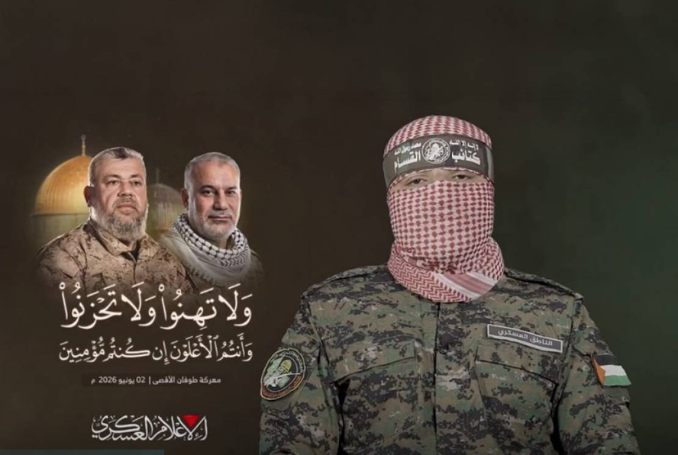
The “settling of accounts” with “Israel” will remain open until a full and heavy price is paid, the spokesperson for the Izz ad-Din al-Qassam Brigades, Abu Obeida, stated on Tuesday, stressing that the “cowardly enemy” is deluded if it believes that it can weaken the Resistance through the assassination of its leaders.
In a statement, Abu Obeida said that “to anyone with insight and sound judgment, it has become clear that we are facing a vile enemy that possesses no morality except its opposite, does not abide by agreements, and has fundamentally misread the situation,” noting that the spilled Palestinian blood has continued unabated despite existing agreements.
He added that the blood of the martyred leaders is “the fuel that drives our ship to overcome hardships,” affirming that “there remain leaders among us who were forged in the fields of steadfastness and preparation, refined by experience and hardened by wars.”
Abu Obeida to the people of Gaza: It is forbidden for us to betray this blood
In a message directed to the people of the Gaza Strip, Abu Obeida said, “Our people in Gaza, we have heard your words, listened to your chants, and witnessed your majestic marches in farewell to the martyred leaders, and it is forbidden for us to betray this blood.”
He continued, “We will remain faithful to you and to embracing your freedom-fighting sons, and these sacrifices, great and immense as they are, will, God willing, yield a clear and decisive victory.”
Abu Obeida also recalled the martyred commander Izz al-Din al-Haddad (Abu Suhaib), head of the General Staff of the al-Qassam Brigades, noting that he played a central role in planning, preparing, and directly overseeing the October 7 operation.
He also highlighted the role of the martyred senior commander Mohammed Odeh, explaining that he left his mark on every field, as he was among the founding core of the brigades’ military manufacturing, before moving on to lead the military intelligence apparatus, where he played a key role in planning the October 7 operation.
Call to mediators and the Arab, Islamic nations to restrain the occupation
On the political and international level, Abu Obeida stressed that the ongoing Israeli crimes place mediators and guarantors of agreements before a moment of truth, considering that “remaining silent or neutral is no longer acceptable.”
He called for unifying and intensifying all efforts to restrain the occupation and compel it to fulfill its commitments, praising Resistance factions that have inflicted losses on the enemy, pointing out the fighters of Lebanon who, he said, have “written epic acts of heroism in confronting Zionist arrogance.”
In conclusion, Abu Obeida renewed his call to the Arab and Islamic nations, urging them to set aside differences and redirect focus toward “the sole enemy of the Ummah.”
Despite ongoing ceasefire arrangements, the occupation continues to carry out assassinations, which Palestinian factions and Resistance movements across the region have consistently condemned as war crimes and violations of international law.
Al-Haddad’s role in rebuilding and leading Al-Qassam Brigades
Al-Haddad, born in Gaza City in 1970, joined Hamas shortly after its establishment in 1987 before emerging as one of the most prominent military leaders within the al-Qassam Brigades. He began his armed activity among the movement’s earliest armed formations and steadily rose through the ranks, serving as a field commander, battalion commander, and later commander of the Gaza Brigade following the assassination of commander Bassem Issa by “Israel” in 2021.
Over recent years, al-Haddad became one of the leading members of the Brigades’ general military council and was tasked with overseeing northern Gaza and rebuilding military capabilities following successive Israeli wars on the Strip. “Israel” accused him of participating in the planning of the October 7 operation and considered him among the key military figures directing combat operations throughout the ongoing war.
Following the assassinations of Mohammad Deif, Marwan Issa, and Mohammad Sinwar, al-Haddad emerged as the most senior military commander within the al-Qassam Brigades, assuming leadership of the Brigades’ General Staff. He became the fifth Chief of Staff in the movement’s history after Salah Shehadeh, Ahmad al-Jaabari, Mohammad Deif, and Mohammad Sinwar.
For years, al-Haddad remained among “Israel’s” most wanted Resistance leaders, surviving several assassination attempts while living between tunnels and secret locations away from public view. With his assassination, the al-Qassam Brigades bid farewell to another commander in its history of resistance and liberation, one regarded as among the movement’s most influential military figures who played a central role in building and directing its armed wing over the past decades.