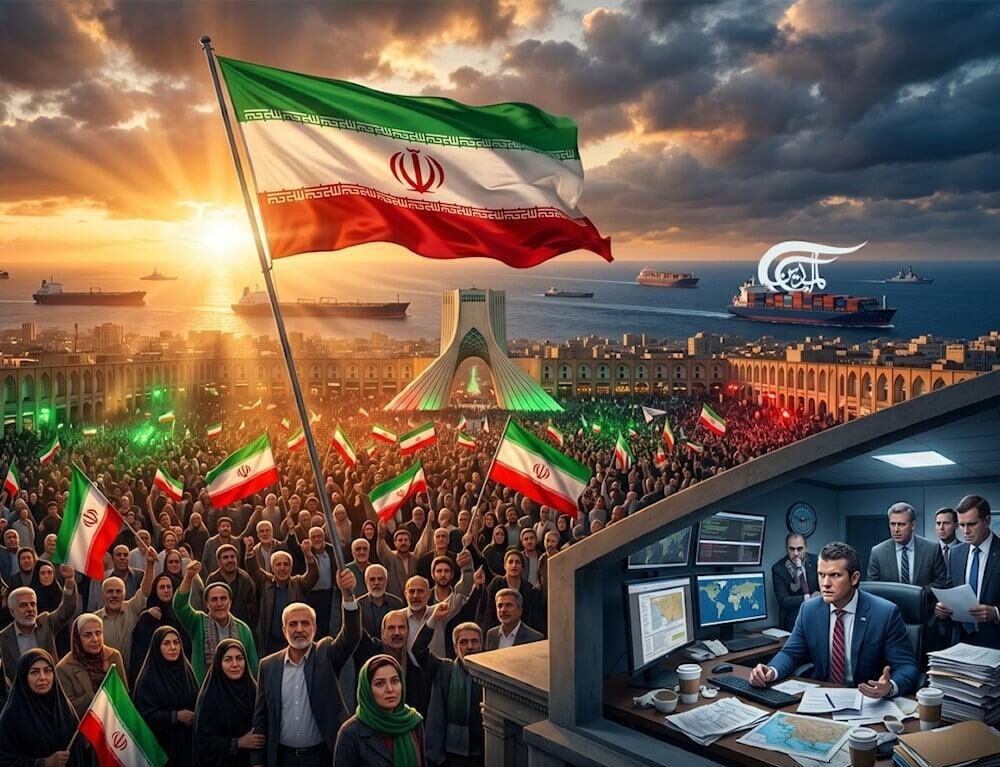
In the past year, “Israel” and the US have twice used their advanced technology and massive firepower to launch surprise attacks on Iran and Lebanon, killing thousands of civilians and destroying “enemy” weapons and boats, as well as mosques, churches, hospitals, museums, highways, and bridges. Notwithstanding Trump’s pompous claims, Iran has defeated the US and “Israel”.
Although “Israel” has continually had a laser-sharp focus on its goals, the US never had a clear view of why it was fighting. Unwilling to appear devoid of a rationale for his killing spree, Trump has recently begun to mechanically parrot Israeli fears of an Iranian nuclear bomb. Every time he repeats this war aim, the American public understands that the US is fighting a war for “Israel”, no matter how much Trump and his yes-boys deny it.
None of “Israel’s” goals have been achieved, not the overthrow of the Islamic Republic, not an end to the Iranian nuclear program, and not a popular uprising against the regime. Immediately after the attacks of February 28, 2026, Iran took control of the Strait of Hormuz, the first successful contestation of US naval power since World War 2. Three US aircraft carriers were compelled to depart from the Gulf. Besides its successful targeting of “Israel”, Iran rained destruction on the US and “Israel’s” regional allies, including the UAE, Kuwait, Bahrain, Jordan, and Qatar—all of which facilitated attacks on Iran. The Islamic Republic so badly damaged nearby American military bases that many have been closed, and US troops billeted in hotels, proving to many small countries that US bases can be liabilities as much as they may be assets. Huge radar installations in Bahrain were destroyed, as were tens of billions of dollars of military infrastructure, including dozens of jets, helicopters, radar systems, and drones. At least 13 US troops were killed and 380 wounded, while more than 3,400 Iranians lost their lives, possibly as many as 7,000, half of them civilians. Facilitated by the US, Israeli attacks have killed at least 3,700 Lebanese.
On June 15, the day after Trump announced the coming MOU, an editorial in The New York Times accepted bitter defeat: Headlined, ‘The President Has Lost This War’ they called the settlement, ‘a humiliating comedown for him and the nation he leads.’ Although the magnitude of the debacle may not yet be clear, Alfred McCoy has already clarified the historic meaning of the US defeat: ‘…when the bombs stop falling and the rubble is finally cleared from the streets of Tehran and Beirut, the impact on U.S. global power of such a de facto defeat will become all too clear — as alliances like NATO atrophy, American hegemony evaporates, legitimacy is lost, global disorder rises, and the world economy suffers.’
In the remarks below, I focus on specific ways the Islamic Republic’s battlefield superiority was achieved.
Specific reasons for Iran’s victory
1- On the battlefield, Iran’s successful asymmetric warfare is key to its victory. Analogous to guerrilla war in Vietnam, Iran has inflicted significant damage on much larger military assets. Large US warships cannot easily maneuver in the narrow Hormuz Strait while Iran’s hundreds of small speedboats, some loaded with missiles and torpedoes, can suddenly attack from inlets, islands, and coastal caves. Mini submarines have reportedly been able to hide underneath giant American aircraft carriers. Iran’s asymmetric swarm tactics, simultaneously combining dozens of drones, missiles, and its mosquito fleet, overpowered the larger US Navy. After brief incursions in May and June, the US Navy suspended its efforts to reopen the Hormuz Strait and unceremoniously withdrew.
In the air, Iran’s ‘mosaic’ defense has caused far more damage than the US acknowledges. Dozens, possibly hundreds, of aircraft have been downed, including seven Stratotankers, two MC-130s, one AWACS, one F-35, one F-15, and dozens of drones. Many others have been destroyed on the ground or by ‘friendly fire.’ Israeli cities have been continually attacked, and Hezbollah’s FPV drones have decapitated Israeli occupation forces in the south. During the war, the US and “Israel” expended a large majority of available stocks of “Tomahawk” missiles, Patriot interceptors, and more advanced ATACMS, while Iran retains 70% of its prewar stockpile of launchers and missiles, as reported by The New York Times. In response to those articles, Trump called The Times’ reporting “virtual treason.”
2- Fighting a war made for “Israel” versus a war of survival. Iran fights on its homeland with millions of people ready to give their lives for national independence. “Israel” and the US embarked on their ‘war of choice’ by killing Iran’s leader and much of his family in its murderous opening salvo, compelling Iran to fight for its ‘existential existence.’
The Israeli-American strategy of killing key leaders (from Hezbollah’s Secretary-General Sayyed Hassan Nasrallah to Iranian Leader Sayyed Ali Hosseini Khamenei) fails to understand that the Resistance movement is based upon stoic endurance and a mosaic defense doctrine, ‘a state-scale guerrilla geometry of autonomous provincial commands.’ Just as the killing of US president John Kennedy made him an American hero, so murders of key leaders in Iran and Lebanon strengthened resistance against enemies and gave more power to autonomous fighting units arrayed across the region.
Since the CIA overthrew democratically elected Prime Minister Mohammad Mosaddegh in 1953, Iran has been fighting US imperial dictates. For the full 47 years of its existence, the Islamic Republic has been under attack, first by a proxy war led by one-time Iraqi CIA collaborator Saddam Hussein that cost the Iranian and Iraqi people at least half a million dead from 1982 to 1988. Although the US has never developed a coherent strategy, it now is close to an MOU that is less restrictive of Iran than the Obama administration’s 2015 JCPOA agreement, from which Trump arbitrarily withdrew in 2018. Given the long history of the US breaking nearly every treaty it signs, it is highly doubtful that the Trump administration will adhere to the terms of any MOU. “Israel” has already claimed it does not accept it.
3- US battlefield decisions are largely made by political appointees with limited competence. The Secretary of War, Peter Hegseth, is himself a Trump appointee with military experience limited to platoon command in the National Guard. His qualifications are unlimited fealty to Trump, white Christian nationalism, disdain for Congress, and service as a host on Fox News. He has removed women and minorities from promotions rather than assigning duties based upon ability and expertise.
For new Director of National Intelligence, Trump originally chose Bill Pulte, Director of the Federal Housing Finance Agency, a man who ‘stands out for having absolutely none of the experience, knowledge and skills needed for the critically important job Trump has given him.’ Among Pulte’s other qualifications were having given nearly $1 million to Trump and other Republican candidates, having posted on X that Trump is ‘the greatest president in history,’ and having invented unsupported charges of fraud against California Senator Adam Schiff and other Trump antagonists. After a widespread outcry that Trump was putting his own interests above those of the nation, Trump switched his choice to Jay Clayton, a federal attorney and former Chair of the Securities and Exchange Commission. While his loyalty to Trump is unquestioned, he is a New York criminal prosecutor with no intelligence background.
Poor American intelligence and stupidity at the top can be readily observed in Trump and Hegseth’s repeated public claims that Iran has no navy or air force. Last year, Trump threatened to invade Greenland; this year he has kidnapped the president of Venezuela and attacked Iran, and next he has Cuba in his sights, where he no doubt will be greeted with surprises aplenty.
4- While the 12-day war of Israeli-American aggression in 2025 and the 40-day war of 2026 have galvanized national unity in Iran, a solid majority of Americans oppose the war. Trump’s popularity has plummeted to its lowest levels while the price of oil has risen, leaving him desperate to sign an MOU. One widely cited reason for popular dissatisfaction is the war’s economic impact. While oil companies are projected to garner increased profits of hundreds of billions of dollars, US consumers have already spent more than $45 billion more on diesel and gas since February 28. Costs for basic foods like tomatoes, coffee, and beef are up over 20%, and consumer inflation is currently 4.3%. Producer inflation at the end of May, an even more important predictor of the future, rose to 6.5%. Before he left for his recent trip to China, Trump declared he does “not even think about it,” that he is “not even a little bit concerned” with the economic pain the war inflicts on Americans. Pentagon officials have yet to reveal the war’s real cost in dollars, nor have they fully accounted for innocents murdered, for hospitals, schools, and mosques destroyed.
Economic factors are one reason Americans do not support Trump and Satanyahu’s war of choice, but many people are horrified by the murder of innocent Iranians and Lebanese. The dozens of Minab schoolgirls murdered on February 28 deeply affected people’s consciences. The Pope’s opposition to the war is supported by many Catholics.
Toward a real anti-war movement
It is long past time for people to tolerate continuing war after war by nation-states armed with weapons of mass destruction. As Howard Zinn bluntly concluded, war itself is a crime. Rather than debating whether specific acts such as “Israel’s” genocide in Gaza are criminal, a real anti-war movement should oppose all state violence targeted at other states and peoples as themselves the problem. Weapons of mass destruction should be banned internationally, arms manufacturers criminalized, and advocates of war imprisoned.
Within the Vietnam anti-war movement in the US, Ho Chi Minh was romanticized as a sincere leader dedicated to the peace and freedom of his people. He famously said, ‘Nothing is more precious than independence and freedom.’ Ho was more popular on college campuses in 1970 than then-US president Richard Nixon. Whether or not it is a result of constant Islamophobic propaganda, no comparable individual can be found in Iran.
Not only has Iran dealt the US a major defeat, but it has also punctured the long-term American strategy of surrounding China with military bases in preparation for what many US policymakers consider the coming war with China, which has emerged ever stronger from the ill-advised US/Israeli wars.
On a recent visit to the Bandung Asia-Africa Museum that commemorates the 1955 conference that birthed the non-aligned movement, US newspapers from the early 1950s were displayed that consistently blared headlines warning of the imminent Chinese invasion of Taiwan, a scare tactic that has been repeated daily for more than 70 years. Since the 1949 Communist triumph, the government of China has been regarded as an ‘enemy’ just as the Islamic regime has been cast out, attacked and continually pressured since its inception in 1979.
American fear-mongering today about an Iranian nuclear bomb serves to constrain humanity in a prison of wasteful and destructive military spending that squanders our vast social wealth. Militarism subverts enormous technological achievements of recent centuries by turning them into a form of domination, not liberation from drudgery and oppression. It is too soon to celebrate the demise of American world power and uninhibited wars of choice, but if we fail to recognize the resolve and steadfastness of the Iranian people, whose blood and steadfastness won a victory that has wounded a savage beast, we miss the chance to envision the future demise of a world system that privileges billionaires and corporations at the expense of billions of human beings.