Beginnings:
While we were facing a barbaric aggression in Gaza, overflowing with Talmudic hatred and Nazi behavior, and waiting at any moment for heavy, destructive, and incendiary bombs to surprise us, we were watching with deep pain the “israeli”-American aggression against a Muslim country that stood by our side, supporting, backing, and defending our rights in facing zionist injustice and American arrogance, tearing down its structures, killing its people, and destroying its capabilities. While we were receiving news about the targeting of scientists and military and political leaders among them, the name of one of these great men reached my ears, making me confused and thoughtful, repeating to myself, could it be him? Then I would return to pray to my Lord that it would not be him. Hours later, the truth was revealed, and the news was as heavy as the weight of his role in supporting the resistance over two decades or more. Perhaps the reader asks: who is this man?
He is the man I knew twenty years ago, who devoted himself and his time to the sake of Allah, and lived as a fighter for the sake of Al-Quds and Palestine. I bear witness that he was a man of character and faith, who thought deeply, planned deliberately, built silently, and struggled with persistence.
The zionist enemy did not overlook him, and never tired of pursuing him. He is the man who stood tall on the southern Syrian mountains, watching Palestine with his own eyes, his tongue stating, “We are coming, God willing,” and then defiantly on the coast of Naqoura in Lebanon, saying, “We will shatter your dreams, you usurping occupiers.” He then remained stationed, sometimes in Damascus and other times in Beirut, his concern being Al-Quds and Palestine, until he was able to create the miracles that immortalized his memory after his departure. The poet’s words were true of him: “Be a man who, when they come after him… they say he passed by, and this is his mark.”
He is the man who was loved by the Supreme Leader of the Iranian Revolution, the martyr Sayyed Ali Khamenei, who reserved a space for him in his heart. He often praised him and his work on the Palestine file, to the point that he did not replace him and kept him in his position until God chose him as a martyr.
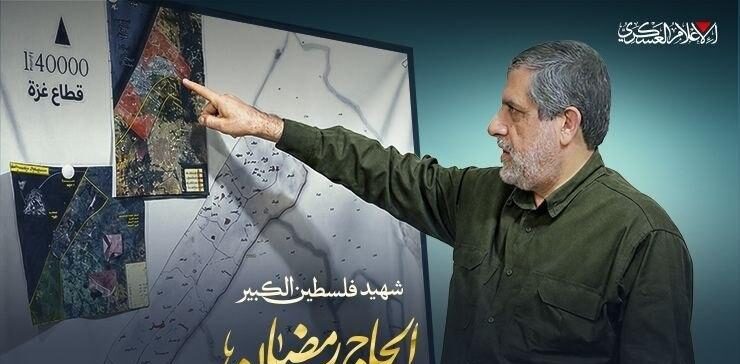
He is the man whom the enemy pursued, and pursued until it reached him—may God grant him abundant mercy. He is the martyr—we count him as such, and we do not purify anyone before Allah—Major General Mohammad Saeed Izadi (Hajj Ramadan), who was martyred on 21/06/2025 in his city of Qom, following a brutal “israeli” aggression on Iran in the heat of the war that began on 13/06/2025, to bid farewell to this world with his body, while remaining immortal with his deeds and his struggle in the Axis of Resistance for the sake of Al-Quds and Palestine.
My acquaintance with him, described as the “Shadow Man,” began in Damascus around 2005, as the coordinator of resistance relations. The relationship and acquaintance continued for many long years. My last meeting with him was in Haret Hreik in the Southern Dahiya of Beirut in 2022. Reaching him was not easy, for the enemy classified him as a “dangerous man,” so it was the duty of Hezbollah, the host, to protect him. I entered to see him that day, accompanied by some Al-Qassam brothers from Gaza, to discuss some issues of concern to the resistance. I became more certain of what I knew about him: that he was a man of few words and much action; his tongue did not stop remembering God, and in his gaze was the concern for work and the passion for achievement. I was drawn to a picture hanging on the glass door of the salon cabinet in front of the dining table, showing him with Dr. Rantisi—may God have mercy on him. He said to us, proudly, that it was in Marj al-Zuhur, to confirm to me my conviction of the extent of his sincerity and the truth of his belonging to Palestine and its people. I learned that his visit to the deportees in Marj al-Zuhur was a visit of support and backing, in his name and on behalf of the Revolutionary Guard and the Iranian Republic. The visit ended with great welcome from him and a sincere promise to support the resistance and its men with all forms of support, as we had known him.
His efforts in supporting and developing the resistance system and his role in the Al-Quds Axis:
Hajj Ramadan dedicated his time to serving the fighters in various fields, and was a true partner in supporting and backing the Palestinian resistance with all its diverse orientations. Indeed, his fingerprints are clear in developing its manufacturing and technological capabilities, in rockets and their guidance, and in drones of all kinds. He is the one who coordinated and supervised hundreds of military courses, within the framework of building and preparing the fighter for various Palestinian factions. He was also the one who worked on establishing a project for the resistance in southern Lebanon, so the Radwan Force was the product of his insistence on moving forward with the actual and quantitative building of the resistance forces, for the sake of complete readiness to do what is required when needed. He also contributed to developing the military understanding among the men of the resistance inside and outside Palestine. One of his most important coordinations in this regard was his keenness to establish the Command and Staff course for the military and security leadership of Hamas, which lasted for nearly two years, with trainees moving between Damascus and Tehran until its completion. This course was one of his good deeds and lasting marks. I will not forget that the resistance in Gaza and Palestine benefited from the scientific material of this course, the day they made part of it into the curricula of the Military Academy of the Martyr Izz El-Din Al-Qassam Brigades.
He was a true partner in logistical support, providing the resistance with various types of weapons. He was a true heir to the path of Hajj Radwan, Imad Mughniyeh, may Allah have mercy on him, whom we knew for his boundless belonging to Al-Quds and Palestine. His primary concern was how to deliver large and varied quantities of weapons to the resistance forces in Gaza. Therefore, Hajj Ramadan continued with significant financial spending to open smuggling routes to Gaza and to build warehouses in various places until he ensured the arrival of weapons to the resistance forces. Thus, an important part of the resistance’s arsenal was built through his efforts in financing, planning, and supervision, until he came to have a real share in the battles of the fighters against the “israeli” enemy.
Hajj Ramadan was not satisfied with his actions in supply, training, and construction. Rather, we found him eager to participate effectively in following up on the confrontations between the resistance forces and the zionist enemy. He was an advisor, a guide, a financier, and one who harnessed everything possible for the resistance during the confrontations. He remained stationed, whether in Beirut or Damascus, in the follow-up cell until he was completely reassured about what could be offered in this regard. Among the most prominent of these follow-ups was his participation and daily monitoring in the crisis cell established by the Foreign Military Operations Department to follow up on the Al-Furqan war in December 2008. He remained, may Allah have mercy on him, stationed in this cell until the end of the war, which lasted twenty-three days, in which the enemy poured out the fires of its hatred, calling it “Cast Lead”. This war claimed the lives of hundreds of martyrs in Gaza of steadfastness and resistance. He was among those who carried the burden of supporting the resistance with weapons, money, guidance, and operational coordination between the resistance in Palestine, the Quds Force, and the Axis of Resistance, throughout his life until he passed away.
He, may Allah have mercy on him, was keen to accomplish his work through constant and direct follow-up with military leaders. He had direct relationships with senior leaders, including the martyr Yahya Sinwar, the martyr Abu Al-Abed Haniyeh, the martyr Saleh Al-Arouri, the martyr Mohammed Deif, and the martyr Abu Al-Baraa Marwan Issa. In addition to numerous meetings with all the heads of the political bureaus of Hamas, the Islamic Jihad, the Popular Front, and other Palestinian resistance leaders, in order to overcome obstacles and facilitate tasks. The last of these were the shuttle meetings with the martyr Hamas leader Ismail Haniyeh shortly before his martyrdom, in Beirut and Tehran.
Hajj Ramadan’s almost permanent residence in Beirut, where he remained stationed, reflects the extent of his attachment, love, and belonging to Al-Quds and Palestine. His presence close to the Secretary-General of Hezbollah, the martyr Sayyed Hassan Nasrallah, played an important role in forming a common opinion regarding ways to support the resistance in Palestine, and developing every idea that would serve the fighters, support them, and strengthen their determination. This actually contributed to numerous meetings with all the resistance forces in order to coordinate joint work. There were many meetings with the martyr Sheikh Saleh Al-Arouri in the presence of the martyr Sayyed Hassan Nasrallah to develop, support, and assist the resistance work in the West Bank. The arena of Jenin and the armed action cells spread across the governorates of the West Bank are but a product of the efforts of the martyr Sheikh Saleh and his companions with Hajj Ramadan and the Sayyed, may Allah have mercy on them all.
Also, within the framework of his movement, may Allah have mercy on him, in strategic issues stemming from his deep understanding, he worked to strengthen the Axis of Resistance and preserve the unity of the arenas, the supportive effect of which we recently saw in the Al-Aqsa Flood war, with the participation of fighters in Lebanon, Yemen, and Iraq. His targeting, may Allah have mercy on him, was nothing but a testament to the enemy’s conviction of the extent of his danger to them throughout the years of his life, which he dedicated to participating in a great structure built on solid ideological foundations, mixed with the blood of great martyrs, until the banners of pride, dignity, and glory rise above the minarets of Al-Quds and the lands of Palestine.
Finally, a limited article cannot fulfill even a small part of what this giant man provided for Palestine. He truly lived for Palestine, gave it what nations failed to provide, was martyred for its sake, and left a great, clear impact that will remain standing before generations, saying: “He passed by, and this is his legacy.”
Written by: Dr. Majid Abdullah