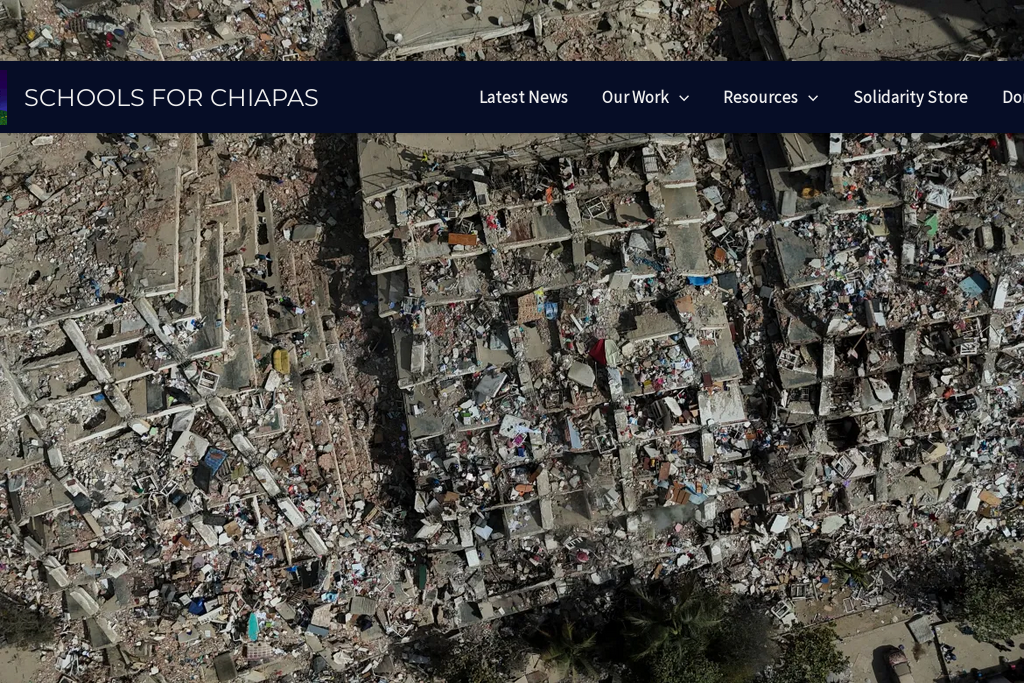
Last Wednesday, June 24th, two consecutive earthquakes of magnitude 7.2 and 7.5, separated by a mere 39 seconds, shook north-central Venezuela, leaving collapsed buildings in La Guaira, incalculable material destruction in Caracas, more than a thousand dead, thousands injured, and 50,000 missing as of this writing. It immediately became clear that the Venezuelan state is overwhelmed by the catastrophe: hospitals lack the capacity to care for the victims, and rescue teams cannot fully operate because excavators and other vehicles are out of service.
Like vultures, right-wing politicians and media outlets across the continent pounced on the tragedy to exploit it for political gain, accusing the Chavista administrations of the institutional decay that has prevented an adequate response to earthquakes. However, any honest look at the situation makes it clear that the main culprits for turning the natural disaster into a social and humanitarian crisis are in Washington and, to a lesser extent, in Brussels.
Since the Barack Obama administration issued Executive Order 13692 in 2015, declaring Venezuela an “unusual and extraordinary threat,” the country has been subjected to an economic siege that violates the UN Charter, as it was implemented outside the framework of the Security Council. The intensification of this harassment during Donald Trump’s two terms (and Joe Biden’s) deliberately crippled the Venezuelan economy with oil embargoes and financial blockades from which no state can emerge unscathed, much less one that for half a century has depended on oil exports to cover virtually all of its expenses.
Under the illegal US sanctions, the health sector cannot acquire high-tech medical equipment, spare parts for emergency power generators, or vital trauma medications for disasters. The Venezuelan electrical system is in ruins because international companies are prohibited from providing maintenance, turbines, or spare parts. The embargo on the state oil company PDVSA and the ban on importing diluents and spare parts for refineries have limited the ability to mobilize heavy machinery. Today, the movement of backhoes, cranes, and ambulances is directly hampered by a structural shortage of refined fuel and automotive parts, a direct result of the sanctions. The buildings themselves were weakened by a lack of maintenance or the substandard quality of construction materials due to the obstacles to manufacturing or importing even the most basic components.
Assigning responsibility doesn’t require speculation, as the figures speak for themselves. Until December of last year, the media and academic consensus held that the drop in hydrocarbon production and exports was solely due to the ineptitude and corruption of the governments of Nicolás Maduro and his predecessor, Hugo Chávez. But after the first tanker was seized by the U.S. armed forces, crude oil exports surged 144 percent, rising from 0.62 million barrels in January to 1.5 million barrels by mid-June. What changed in those six months was not the structure of the Venezuelan government, but the lifting of some sanctions through “export licenses.” The blatant imperialism practiced by Trumpism is not limited to the affront of a nominally sovereign country needing licenses from another to sell its own resources; it also means that all the money from Venezuelan crude is managed by the Treasury Department. In other words, Caracas cannot allocate its revenue to meet the needs of the population, but only to what the White House dictates.
U.S. and European sanctions were already killing innocent people around the world long before this week’s earthquakes. According to a study published in the scientific journal The Lancet, between 1970 and 2021, unilateral economic sanctions imposed by the United States and the European Union caused approximately 38 million deaths; 800,000 of these occurred in the last year of the study alone. It is clear, then, that the best help Western powers can offer Venezuela and all developing countries is to refrain from interfering in their internal affairs and from using the economy as a weapon.
Original article at La Jornada, June 27th, 2026.
Translated by Schools for Chiapas.