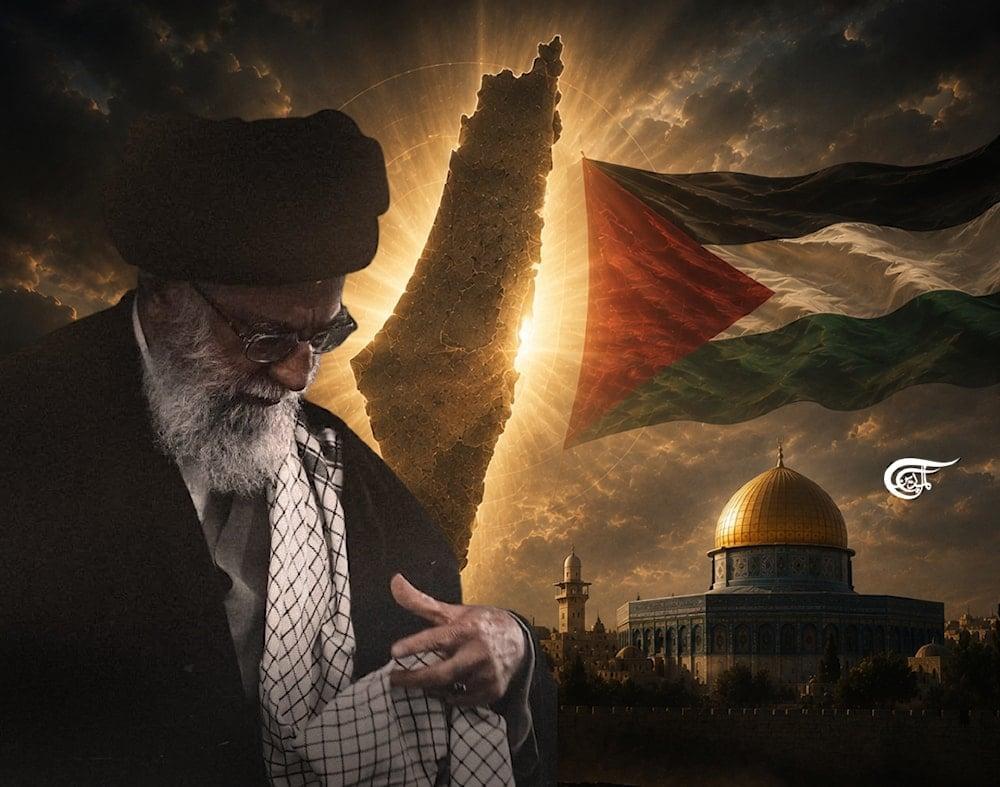
As Iran marks the fourth day of funeral ceremonies for the martyred Leader of the Islamic Revolution, Sayyed Ali Khamenei, with massive crowds taking part in the main farewell procession in Tehran, one cause stands out at the heart of his political and ideological legacy: Palestine.
Across decades of speeches, written positions, and direct messages to Palestinian Resistance leaders, Sayyed Khamenei presented Palestine not as a passing political file, a border dispute, or a cause limited to Palestinians alone, but as a central question of the Islamic Ummah, a human and moral issue, and the axis around which the wider movement of Resistance in West Asia revolved.
In his discourse, Palestine was not merely occupied land. It was the heart of the confrontation between the Islamic Ummah and the Front of Arrogance; a wound in the body of the Muslim world and in the conscience of humanity, whose liberation was tied to the restoration of dignity, independence, and authority for the region’s peoples.
This position was clearly reflected in his April 2018 response to a letter from the martyred Hamas leader Ismail Haniyeh, in which Sayyed Khamenei reaffirmed Palestine as an “important issue of the Islamic Ummah” and insisted that Resistance was not one option among many, but the only path capable of restoring Palestinian rights.
“No doubt, resistance is the only way to free an oppressed Palestine, and it is the only cure for wounds on the body of that brave and proud nation,” Sayyed Khamenei wrote.
Palestine as an Islamic, human, and moral issue
Sayyed Khamenei repeatedly described Palestine as the most important international issue facing the Islamic world. In one of his clearest formulations, he said:
“Undoubtedly, in Muslim life and across the world of Islam, nothing is as important and serious as the issue of Palestine.”
In his speeches, the occupation of Palestine is not presented as an isolated tragedy, but as part of a broader project aimed at weakening Muslim unity and imposing Western and Zionist domination on the region. He argued that the occupation created a hostile base at the heart of the Islamic world, separating its eastern and western parts and turning Palestinian land into a platform for pressure against surrounding Arab and Muslim nations.
Within this framework, Sayyed Khamenei situated the Zionist entity as the forward front of Western hegemony in West Asia, a project planted in the region to fracture Muslim unity, protect colonial interests, and extend the reach of global arrogance. This is also why he repeatedly treated the entity as historically unsustainable: not a natural state rooted in the will of the region’s peoples, but an artificial structure imposed by force, sustained by Western backing, and weakened by its own lack of legitimacy.
From this view, Palestine’s significance is religious, humanitarian, political, security-related, and economic. Religiously, Sayyed Khamenei frames the defense of Palestine as a duty because occupied Palestine is part of Muslim land. Humanitarianly, he presents Palestinians as a people denied their homeland, rights, and dignity. Politically and strategically, he sees the Zionist entity as a Western-backed project designed to dominate the region and prevent its peoples from achieving real independence.
One can clearly see here how Palestine became inseparable from the revolutionary identity of the Islamic Republic itself. Imam Khomeini’s designation of International Quds Day turned Palestine into a permanent revolutionary commitment, not a seasonal slogan or a diplomatic position. For Sayyed Khamenei, Quds Day embodied the Islamic Revolution’s wider doctrine of standing with the mustazafin, the oppressed and dispossessed, against the mustakbirin, the arrogant powers that seek domination over nations. Palestine, in this sense, was not only an Islamic cause but a test of humanity’s moral position toward occupation, dispossession, and resistance.
Al-Quds also occupies a central place in this vision. Sayyed Khamenei described al-Quds as “the capital city of Palestine,” stressing that the city belongs to the Palestinian people and the Islamic Ummah, and that defending it is inseparable from the wider struggle against occupation.
This is why Sayyed Khamenei consistently rejected efforts to reduce Palestine to negotiations, diplomatic formulas, or limited territorial arrangements. For him, the issue is not only about the 1967 borders but about the usurpation of Palestine itself and the denial of the Palestinian people’s right to determine their own future. As he put it:
“There is no difference between territories occupied before or after the year 1967. Every inch of Palestinian lands is part of Muslims’ homeland.”
Resistance as doctrine, not reaction
One of the clearest constants in Sayyed Khamenei’s speeches is his insistence that Resistance is the basis of any real solution. He repeatedly argued that negotiations with the Zionist entity only delay Palestinian victory and allow the occupation to strengthen itself.
In his 2018 letter to martyr Haniyeh, Sayyed Khamenei warned that “moving towards negotiations with the cunning, usurper, and untruthful regime is an irreversible mistake,” adding that such a path would “delay the victory of the Palestinian nation” and bring “nothing other than detriment” to the oppressed Palestinian people.
This language reflected a wider doctrine: Palestine could only be liberated by the steadfastness of Palestinians themselves, supported by Muslim nations and Resistance movements across the region. Elsewhere, Sayyed Khamenei put the matter more directly, saying:
“It is not possible to save Palestine through begging the United Nations and the domineering powers, or the Zionist regime for that matter. The only way to save Palestine is to resist.”
Sayyed Khamenei also emphasized that the Palestinian uprising was not manufactured from outside. In his view, the Intifada was born from Palestinian suffering, anger, faith, and determination.
“The Palestinian uprising was not caused by the Islamic Republic or the people of Lebanon…It was sparked by the people of Palestine.”
Iran’s role, as he framed it, was not to replace the Palestinian people by fighting in their stead, but to support their Resistance and prevent the cause from being buried under pressure, normalization, or compromise.
Arab betrayal and the politics of abandonment
Sayyed Khamenei’s response to martyr Haniyeh also directly addressed what the Hamas leader described as the betrayal of Palestine by some Arab states. Sayyed Khamenei confirmed that assessment, saying martyr Haniyeh had correctly pointed to “the conspiracy and hypocrisy of some Arab countries” and their “vicious plots” carried out behind the United States.
For Sayyed Khamenei, support for Palestine was not a temporary political position, nor something that could shift with regional alignments. “This [support of Palestine] is a religious duty and a humane responsibility that goes beyond political events and changes,” he wrote, adding that “all Muslim governments, Muslim nations, and Islamic movements” were obligated to carry out this task.
He linked Arab betrayal and negotiations with the occupation to the same objective: delaying Palestinian victory and weakening the Resistance. “The matter of Palestine is at the heart of all international challenges that the Islamic Ummah faces while fighting against the Front of Arrogance,” Sayyed Khamenei said, warning that negotiations with the Zionist entity would only harm the Palestinian people.
“[This] act of Betrayal by some Arab leaders, which is gradually revealing itself, pursues the same goal.”
For Sayyed Khamenei, normalization and Arab silence were not neutral positions. They formed part of a political chain that enabled the Zionist entity to continue its occupation, expand its crimes, and attempt to erase Palestine from regional and global consciousness.
In his wider speeches on Palestine, he argued that the silence of many Arab governments, and in some cases their open treachery, allowed the occupation to grow more aggressive and emboldened the Zionist project to speak openly once again about expansion.
This is why Sayyed Khamenei placed special emphasis on Muslim and Arab peoples, especially the youth. Even when governments retreated, he argued, nations remained capable of carrying the Palestinian cause forward. As he put it in the same letter:
“The only cure is strengthening the resistance within the Muslim World, reinforcing the fight against the usurper Zionist regime and its allies.”
The Axis of Resistance around Palestine
Sayyed Khamenei’s Palestine-centered worldview is also the ideological foundation of his approach to the Axis of Resistance. He did not treat the Resistance fronts in Palestine, Lebanon, Iraq, Yemen, Syria, and Iran as disconnected arenas, but as parts of one broader confrontation with occupation, domination, and the US-backed Zionist project.
In this framework, Palestine is the compass. It is the cause that gives the Resistance axis its moral legitimacy and strategic direction. As Sayyed Khamenei put it, “Today the issue of Palestine is the pivot of this movement.”
Sayyed Khamenei has repeatedly pointed to the Lebanese Resistance as proof that steadfastness can force the Zionist entity to retreat without concessions. In his speeches, the liberation of southern Lebanon became a model for Palestinians and for the wider Islamic Ummah: a demonstration that armed Resistance, patience, and faith could achieve what negotiations and summits had failed to deliver.
“As a successful paradigm for the Islamic Ummah, resistance could for the first time liberate the occupied lands without making any concessions to Israel,” he said, presenting Lebanon’s experience as evidence that the Zionist entity could be forced into retreat through Resistance rather than compromise.
At the same time, Sayyed Khamenei sought to underline that Palestinian Resistance was not an imported project or the product of outside direction. Rather, he presented it as an organic uprising born from the Palestinian people’s own suffering, accumulated grievances, and determination to reclaim their rights. In this reading, Iran and Lebanon stood as supporters of an already existing Palestinian will to resist, not as the source of that will.
He also described Palestine as the pivot of Islamic Awakening, saying “the al-Aqsa Intifada managed to go beyond the borders of Palestine and engage all Muslim and Arab nations.” In this view, Palestine is not only a cause supported by the Resistance; it is the cause that helped shape the Resistance and gave the region’s movements a shared direction.
Against erasure and normalization
Another central theme in Sayyed Khamenei’s speeches is the struggle against forgetting Palestine. He warned that the Zionist entity and its supporters sought to erase the name of Palestine from history, political discourse, and public consciousness.
“Today the leaders of the usurping Zionist regime and their American supporters… are trying to erase the name of Palestine from history and from the minds of the world’s people.”
For this reason, he insisted that Palestine remain present in speeches, media, art, public mobilization, and political action. He argued that the global media system worked for decades to portray the occupier as the victim while concealing the suffering of Palestinians. In that context, he also called for cultural and artistic work to expose the reality of occupation.
“This must be expressed in an appropriate way. Films must be made in this regard, and artistic works have to be produced in order to tell the world what is happening in Palestine.”
This concern became even more urgent during the genocide in Gaza, as Sayyed Khamenei warned that attention must not be diverted from Palestine. In his view, distraction is itself a weapon used by the enemies of Palestine, especially when the scale of Israeli crimes produces global outrage.
A proposed political solution rooted in return
Although Sayyed Khamenei rejected negotiations with the Zionist entity as a path to liberation, he repeatedly presented a democratic political solution, consistent with international law and the right to self-determination: a referendum among the original people of Palestine, including Muslims, Christians, and Jews, whether they live inside Palestine or in exile.
“The logical solution is to hold a referendum among the people of Palestine, including all those who have been displaced from Palestine and who, of course, are willing to return to their homeland.”
Under this proposal, displaced Palestinians would return to their homeland, take part in determining the political system, and decide the future of the land. Sayyed Khamenei said the referendum should include “all those who used to live in Palestine before the year 1948,” including Muslims, Christians, and Jews.
He framed the proposal as a question of basic political rights, asking: “Why is democracy good for all people of the world, but not for the people of Palestine? Why is it that all people of the world have the right to determine their destiny, but not the people of Palestine?”
At the same time, he maintained that such a solution could not be achieved through reliance on the United States, Western governments, or international bodies that have shielded the occupation for decades. It required Resistance, pressure, unity, and the refusal to abandon Palestinian rights.
Palestine as destiny
In Sayyed Khamenei’s thought, Palestine was not only a symbol of oppression. It was also a symbol of certainty: the belief that occupation cannot last forever, that peoples who resist cannot be erased, and that the future belongs to those who remain steadfast.
His speeches repeatedly returned to one idea: Palestine will remain, while the Zionist entity is temporary.
“They will not be able to annihilate the name of Palestine,” he said, stressing that “Palestine and the Palestinian nation will stay.”
This conviction was tied to his belief that the occupation was facing not only a political struggle, but a historical reality it could not escape.
“Palestine belongs to the Palestinian nation,” Sayyed Khamenei said. “Sooner or later, the usurpers will inevitably surrender to this reality.”
That is why Palestine occupied such a central place in his worldview. It defined the confrontation with the United States and the Zionist entity. It exposed Arab normalization and betrayal. It united the Resistance fronts. It gave the Islamic Ummah a shared political and moral compass.
For Sayyed Khamenei, Palestine was not a memory to be preserved, nor a slogan to be repeated. It was the heart of the region’s struggle for liberation and the cause around which the Resistance continued to organize itself until victory.
Janna Kadri
Source: Al Mayadeen