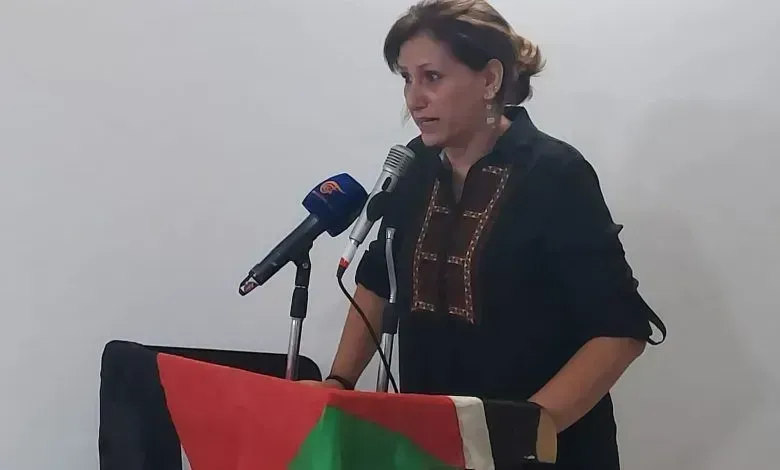
Palestinian activist Jaldía Abubakra has expressed to Masar Badil her rejection of the call for Palestinian legislative elections while the genocide in Gaza and the occupation and colonization of Palestine continue. Abubakra questions the legitimacy of an electoral process that excludes millions of Palestinians and argues that the priority must be to build a unified national resistance front advancing on the path of liberation and return.
“Our people continue to face an ongoing genocide in Gaza. In the West Bank and Jerusalem, colonization, forced displacement, military raids, killings and arrests continue. Thousands of Palestinian prisoners remain in occupation prisons, while millions of Palestinians continue to live as refugees and in exile, far from their homeland. We are not living under normal political conditions, nor do we have a sovereign state that simply needs to renew its parliament. We remain in a stage of national liberation confronting a settler-colonial project,” Abubakra said.
For the Palestinian activist, rejecting these elections under the current circumstances does not mean rejecting the right of the Palestinian people to democratically choose their representatives. Rather, it means questioning what democracy and national representation can mean when a large part of the Palestinian people is excluded from the process altogether.
“The Palestinian people are not limited to the West Bank and Gaza. Our people also include Palestinians in the territories occupied in 1948, refugees in the camps, and the millions of Palestinians living in exile and the diaspora as a result of the Nakba and decades of displacement and expulsion. Elections that exclude a large part of our people may elect representatives to certain institutions, but they cannot claim to express the Palestinian national will.”
Abubakra also stressed that even those who formally have the right to vote cannot exercise that right under genuinely free conditions. In the West Bank, the apartheid wall, Israeli military checkpoints, road gates, closures and the permit system fragment Palestinian territory and determine the daily movement of millions of Palestinians.
“The occupying power can close a military checkpoint or a road, besiege a city or prevent movement between Palestinian communities. It can even prevent someone from reaching the place where they are supposed to cast their vote. How can we speak of free elections when Israel retains the material power to decide whether Palestinians can even reach the ballot box?”
In Gaza, she added, the contradiction is even more evident.
“Under what conditions are people supposed to conduct an election campaign while our people continue to face genocide and struggle simply to survive? The priority must be to stop the genocide, break the siege, defend our people and strengthen their resistance, not to create the appearance of an institutional normality that simply does not exist.”
Abubakra also questioned the political conditions imposed on candidates. The electoral regulations require those seeking to stand for election to recognize the Palestine Liberation Organization as the sole legitimate representative of the Palestinian people and to commit themselves to its political and national program and to the international resolutions it has adopted.
Although the electoral provisions do not literally establish “recognition of Israel” as a requirement, Abubakra stressed that this condition cannot be separated from the political program and commitments adopted by the PLO leadership, including its recognition of Israel and the political framework subsequently established through the Oslo Accords.
“The exclusion does not end with millions of Palestinians being denied the right to vote. The political boundaries within which candidates are permitted to compete are also established in advance. What kind of political pluralism exists when candidates must first accept the program of an institution from which major Palestinian forces are absent and which has been tied for decades to the political framework created by Oslo?”
For Abubakra, the experience of the 2006 Palestinian legislative elections also demonstrates the limits of any electoral process conducted under occupation and external tutelage. When the result of the ballot box did not correspond to the interests of Israel, the United States and Western powers, they refused to accept its political consequences.
“Twenty years ago, our people voted and their decision was not respected. Today, the political framework that forces and candidates must accept is being determined before they are even allowed to compete. We therefore have to ask whether our people are genuinely free to choose their political project, or whether they are only permitted to choose among projects that have already been deemed acceptable.”
Abubakra argued that the election call cannot be separated from the deep crisis affecting existing Palestinian institutions. The Palestinian Authority remains politically and economically dependent on the system created by Oslo and continues its security coordination with the occupation, which has also been used over the years to pursue, arrest and repress activists and sectors of the Palestinian resistance.
For this reason, she rejects the idea that the solution lies in renewing the existing institutions or simply rebuilding the PLO in its current form. In her view, the organization has been progressively emptied of its historic role and subordinated to the structures of the Palestinian Authority, while numerous Palestinian forces and broad sectors of the Palestinian people have for decades lacked effective representation within it.
“We do not need to renew the legitimacy of Oslo or decide who will administer a fragmented autonomy without sovereignty. We need to reclaim our national liberation project.”
Instead, Abubakra calls for advancing the construction of a unified Palestinian national resistance front, capable of bringing together forces committed to the historical rights of the Palestinian people and building genuine unity around a program of struggle for liberation and return.
“We need national unity, but not unity built around Oslo or the administration of occupation. We need unity built through resistance and around our historical rights: stopping the genocide, liberating our land, defending the resistance, freeing our prisoners, and guaranteeing our people’s right of return.”
For Abubakra, the fundamental question is not who will occupy the seats of the Palestinian Legislative Council over the coming years, but how to rebuild the political and organizational tools capable of uniting a people fragmented by occupation, borders and exile.
“Palestine remains in a stage of national liberation. While Gaza faces genocide and our people remain divided by walls, military checkpoints, prisons, borders and exile, our priority cannot be to give the appearance of democratic normality to a colonial reality. Our historic task is to unite our forces, strengthen the resistance and build a unified Palestinian national resistance front that advances on the path of liberation and return.”
Statements by Jaldía Abubakra to Masar Badil – Palestinian Alternative Revolutionary Path Movement
source: Revolutionary Path Alternative