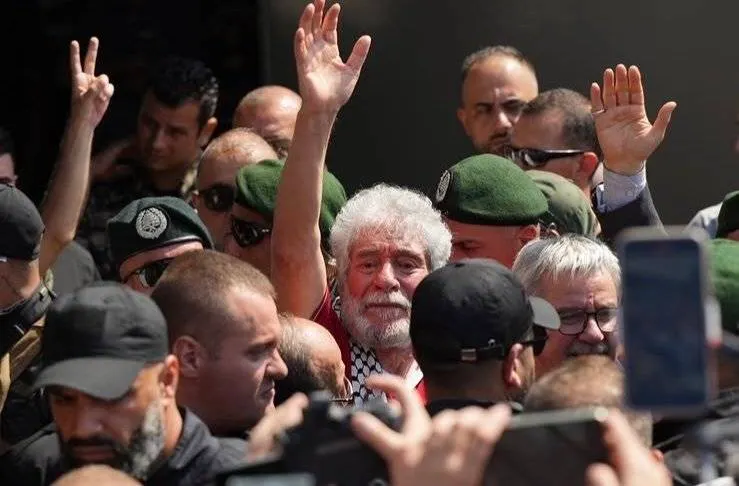
On August 6, I interviewed freed political prisoner and Lebanese revolutionary Georges Ibrahim Abdallah in the Burj al-Barajneh Palestinian refugee camp in Dahieh, the southern suburb of Beirut. We were there to attend the opening of the new Palestine International Center in the camp, which I reported on here.
A former schoolteacher from northern Lebanon, Georges Abdallah became involved in the Palestinian liberation movement and gained political consciousness during the peak of the internationalist revolutionary movement in the 60s and 70s. Arrested in France in 1984 on political charges, he spent more than four decades in prison and became one of Europe’s longest-held political prisoners, largely because of US pressure on France to not release him.
Despite being falsely accused of involvement in the 1982 murders of US military attache Charles Robert Ray and Israeli diplomat Yacov Barsimantov, Abdallah maintained that such accusations were an honor, famously declaring in his 1987 trial, “Even if the people did not grant me the honor of participating in the anti-imperialist actions you attribute to me, I at least have the honor of being accused of them, and of defending their legitimacy against the criminal legitimacy claimed by the executioners.” He was finally released and returned to Lebanon on July 25, 2025, having never walked back on his political principles.
We did this interview on the fly, in overwhelming heat, at a busy event. For a more comprehensive sit-down interview, I recommend this one conducted by Masar Badil/the Palestinian Alternative Revolutionary Path Movement and published in Al-Akhbar.
I began recording part-way into our conversation. The interview was conducted in French, translated to English, and lightly edited for clarity. See translation note at the bottom.
Georges Abdallah: Naturally, the future belongs to the movement and the social bloc, insofar as we address the crucial question of what constitutes the Zionist entity. It is an organic extension of the imperialist West…The genocide did not begin on October 7th; it began a century ago.
And so far, the genocidal war has been a complete failure. But the international community has not been defeated. The structuring of the social bloc requires an ideology, a theory, or theories that address these challenges. And therefore, this unfolds within the overall dynamic of the class struggle within the social bloc. Because the social bloc is composed of social strata.
And quite naturally, there’s bourgeois ideology, which has a whole history behind it. It’s bourgeois ideology that controls the media, it’s bourgeois ideology that controls the writers, it’s bourgeois ideology that controls literature—it’s bourgeois ideology, it’s bourgeois ideology, it’s bourgeois ideology. And within the overall dynamics of this social bloc, within the overall dynamics of this struggle, the emergence and affirmation of a proletarian line within this social bloc is what ensures victory. The proletariat at the international level, with its existential precarity and the precarity of production as well, involves theoretical and practical dynamics that are far more complex than before.
If we consider the global crisis of globalized capital, and we consider the overall dynamics of this global machinery of production, we see that the place of the human being has been erased. If we consider that individualism existed and asserted itself under capitalism, then with digital globalization and cybernetics, the human being has disappeared, transformed into an auxiliary of the machine. In this substitution of the machine for the human, the crisis of civilization is blocked, because in the global dynamic of production, the antagonism of capital is no longer generated.
At the international level, the global antagonism of capital resides within this historical social bloc. And this historical social bloc is composed of several layers. Hence the necessity of the dynamic of struggle within the social bloc, so that the anti-capitalist line can emerge within this global, precarious magma.1
Today, we have proletarians, but proletarians who are existentially precarious. It is not the factory that produces men and women who are workers; it is a global magma that occupies a very particular place as an aid to the machine. This is the crisis of capitalist civilization. And this crisis cannot be overcome except by overthrowing capital. Today, if language, memory, and logic constitute humanity, when we define what humanity is historically, from Platonism to Socrates, to the present day, we consider that humans are endowed with a language that has logic and a memory.
Today, the global language that produces and manages machines is the algorithm. And the algorithm is not a language of human communication. It is neither English, nor Arabic, nor Persian, nor anything else. It is a language of machines. And it’s the algorithm that manages the machines, that manages humans as appendages of the machine.
Hence the crisis of global civilization. And this crisis happens to have a small window of opportunity, and it lies in the peripheries of the system, where there is a magma, a global, precarious magma. And there, the necessity of the dynamics of class struggle produces the line, and should produce the ideological or theoretical line that allows the working class, assuming there is a magma today, to have its civilizational perspective. Hence the importance of the struggle here and elsewhere. Now, we are in the international center.
Calla Walsh: So, what do you think is the role of the proletariat in the West, which in many ways benefits from genocide and imperialism?
Georges Abdallah: The proletariat, they are the ones who can provide the answer. That means it’s in this magma of the proletariat. Because, as I said, unlike from the 19th century until the mid-20th century, there was a proletariat, who was a worker, male or female.
Today, what we should call proletariat, in quotation marks right away, is a magma of people, men and women, who are less precarious, who work part-time, who do this kind of work, this kind of work, this kind of work, small jobs. They don’t have job security. They’re not part of a Fordist assembly line.
It’s over, it’s behind us, it’s history. Today, we have a global magma, the magma of people, men and women, which constitutes the historical social bloc, made up of men and women whose lives are precarious. Today they work, tomorrow they prostitute themselves, the day after tomorrow they deal drugs, today they steal.
This magma constitutes the historical social bloc. But for the historical social bloc to be built, it must be aware of its own existence. And that is the role of struggle today. The role of struggle is the structuring of the social bloc. This social bloc cannot play its role without struggle. It is in struggle that it is built.
In building itself, it acquires an awareness of its interests and its history. And in acquiring an awareness of its interests and its history, it acquires an awareness of history itself. And so, the victory and the necessity of communism in place of capitalism.
Calla Walsh: We’re in a Palestinian camp here in Lebanon today, but right now, the West Bank is on fire. The Israeli occupation, in collaboration with the Palestinian Authority, wants to liquidate the Palestinian struggle.
Georges Abdallah: Yes, the genocide continues. This genocide continues at different paces, but it didn’t start today. We must realize that the genocide began a century ago. Genocide is a process. It’s the imperialist West. It builds itself through genocides. It’s not specific to this place.
That means that the United States built itself as the United States through a genocide that cost the lives of 25 to 35 million men and women. America became Latin America. Whether it’s Central or South America, hundreds of millions of men and women have been victims of genocide. The Aboriginal people, the first inhabitants of planet Earth, were eliminated so that Australia could emerge. In other words, genocide served as an existential mechanism for capital as it coalesced into Western imperialist capital; it was built through a genocidal process. Israel is the latest incarnation of these Western capitalist genocidaires.
Naturally, to confront this, one must be aware that one is facing the dynamics of capital, rather than mere subterfuges—that is, things linked in one way or another to the dynamics of capital. In other words, our own national bourgeoisie, whether Palestinian, Lebanese, or Jordanian, is complicit in this phenomenon. We need the social bloc here, the social bloc that exists in Egypt—that means the 120 million men and women who are right next to Gaza—to have mobilized. They haven’t moved yet.
That means they have not yet acquired the consciousness that their historic task is to rid themselves of capital, of the capital that exists in Egypt just as it exists in Gaza, just as it exists in the West Bank, albeit at different rates. That is to say, here the killing happens much faster, while there it happens much less, but tomorrow, the killing will intensify there and elsewhere.
So this is the global dynamic, and it is the entire problem of structuring the historic social bloc. The historic social bloc is structured through struggle, and it is through struggle, as it advances, as the emerging consciousness of the social bloc reaches maturity, that it becomes capable of creating the tomb of genocidal capitalism, or capitalism in any other form.
Calla Walsh: Will the fire in the West Bank spread to the camps here in Lebanon?
Georges Abdallah: They’re connected. That means the rhythm and the dynamic are the same, and the rhythm and the dynamic of the forces opposing this repression, this genocide, are also the same.
We can consider that the last stronghold before Palestine is Lebanon, it’s the Lebanese resistance. This resistance in Lebanon, its head is being demanded. Its head is being demanded for the simple reason that the Arab bourgeoisie cannot live with the existence of resistance anywhere. Not only in Palestine, but particularly in Lebanon. That’s why we have this situation in Lebanon today. And we have the bourgeoisie in front of everyone, and they say these are rebels, this isn’t resistance. They talk about peace agreements with Israel, etc.
It’s the Arab bourgeoisie, whether Lebanese or Jordanian, it’s the same bourgeoisie. And this bourgeoisie has fulfilled its so-called patriotic role—the word “patriotic” is irrelevant here. This bourgeoisie, which from the 1950s to the 1970s was at the forefront of the anti-imperialist struggle, has now lost its role. It has shifted its focus, and its interests are now embedded within the global genocidal dynamic. Any resistance to this position is met with widespread repression, whether in the West Bank, Jordan, Beirut, or Morocco. It’s the same dynamic.
Now, the pace, the violence, the intensification is much greater there. Here, the pace depends on the existing balance of power. For the moment in Lebanon, the balance of power favors resistance because the Lebanese people have a long history, the Palestinian people have a long history of struggle, and this struggle allows us to confront the entire reactionary dynamic.
Now, will we be able to move forward? Certainly, we will be able to move forward thanks to our relationship with international forces. We will have an international awareness like everyone else, like you, like him, and like her. There you go.
Here, the “magma” (le magma in French) is translated in the literal geological sense used metaphorically, meaning a molten, amorphous social mass that hasn’t yet solidified into fixed forms, as opposed to something crystallized or structured. The industrial proletariat was solid rock (fixed, formed, class-conscious-in-potential), while today’s international proletariat is “magma,” with the same underlying material/substance, but shapeless, dispersed across precarious non-positions, and needing the line (le ligne idéologique) of class struggle to give it form/consciousness, in the way magma needs to cool and crystallize to become solid rock.
source: Calla Walsh Substack