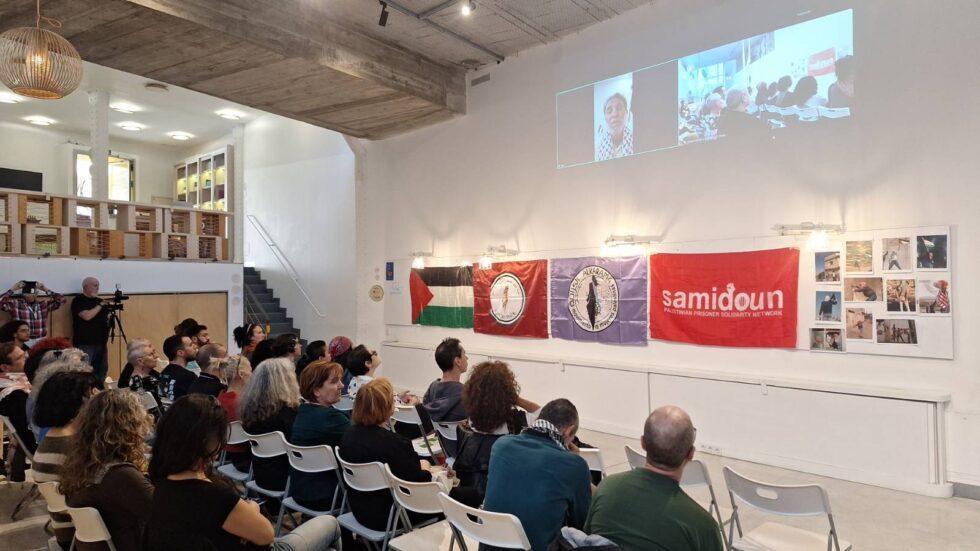
To mark Palestinian Prisoner’s Day, an international discussion was held, organized by Masar Badil: Palestinian Alternative Revolutionary Path Movement, Alkarama, Tariq el-Tahrir, and Samidoun, bringing together dozens of participants in Madrid, Budapest, and online. The event, dedicated to the released prisoner Nael Barghouti, focused on the struggle of Palestinian prisoners as a fundamental pillar of the national liberation process.
An international call for the prisoners’ cause
The event was attended in person by approximately 50 people in Madrid and nearly 30 in Budapest, in addition to numerous participants connecting via Zoom. The talk was recorded in its entirety in Arabic, Spanish, and English, reflecting its internationalist character and its commitment to broadening the reach of the denunciation and mobilization.
The meeting was jointly convened by Masar Badil – Palestinian Alternative Revolutionary Route Movement, Alkarama , Tariq El-Tahrir and Samidoun , within the framework of a day of political action and global awareness.
Nael Barghouti: a testament to resistance and dignity
The main guest was the released and deported prisoner Nael Barghouti , known as Abu al-Nour, who spent more than 45 years in occupation prisons.
During his presentation, he shared his direct experiences in prison, offering a political and human testimony about the conditions of incarceration, the daily resistance of the prisoners, and the central role they play within the Palestinian national movement.
He stressed that the prisoners are not only victims of repression, but living symbols of resistance and the struggle for return and liberation .
The current situation: repression, isolation, and new threats
The debate addressed the current grave situation of Palestinian prisoners, marked by:
- The intensification of repression in the prisons of the occupation
- The suspension of visits by international organizations such as the Red Cross since October 7th
- The legal difficulties and limitations of the judicial system regarding squatting
- The growing criminalization of journalists and humanitarian workers
The approval of the so-called “execution law” in the prisons of the occupation was also analyzed, noting that it responds to political objectives and that, far from weakening the resistance, it has historically contributed to strengthening it.
Deported prisoners: an invisible humanitarian crisis
One of the central themes of the meeting was the situation of Palestinian prisoners deported to third countries, especially Egypt.
The following were reported:
- Forced separation from their families
- Inability to receive visitors
- Legal insecurity and lack of rights in host countries
The participants stressed that this situation constitutes a flagrant violation of human rights and is part of a systematic policy of collective punishment.
Attempts at criminalization and media attacks
The holding of this meeting was not without attacks from media outlets linked to the Zionist movement, which attempted to criminalize the initiative and obstruct the dissemination of the voices of Palestinian prisoners beyond occupied Palestine and the Arab world. These attempts demonstrate the extent to which it is uncomfortable for the public in Europe and other Western countries to hear directly—and without intermediaries—the testimonies of those who have endured decades in the prisons of the occupation.
The role of the organizing groups as a bridge, translating and disseminating these voices in different languages, breaks the information blockade imposed by the dominant narrative. Precisely for this reason, campaigns of pressure, censorship, and criminalization are intensifying.
Given this situation, it is essential to denounce the fact that countries that present themselves as guarantors of democracy, freedom of expression, and freedom of opinion allow the persecution of activists and solidarity organizations. These practices must be combated politically and socially, defending the right to inform, to organize, and to give voice to the struggle of Palestinian prisoners without intimidation or restrictions.
The international role: responsibility and active solidarity
The meeting stressed the need to strengthen international pressure, especially in Europe, to respond to the systematic violations against Palestinian prisoners.
The role of peoples and movements in building effective solidarity campaigns, capable of breaking the isolation imposed by the occupation, was also highlighted.
Next steps: campaign for family reunification
As a result of the meeting, it was agreed to launch an international campaign focused on:
- The reunification of the families of deported Palestinian prisoners
- Pressure on European institutions, including the European Parliament
- A direct call to the Spanish State Government to raise this issue at an institutional level
An appeal was made to activists, organizations and movements in Europe to adopt and promote this campaign in their respective contexts.
The struggle of the prisoners is the struggle for Palestine
The talk concluded by reaffirming that the issue of Palestinian prisoners is not a secondary matter, but a central axis of the struggle for the liberation of Palestine .
As Nael Barghouti emphasized, the resistance in prisons is an inseparable part of the liberation movement, and its cause demands an international response commensurate with its sacrifice.
From Masar Badil and the convening organizations, we reiterate our commitment to continue strengthening the international mobilization until we achieve the freedom of all Palestinian prisoners, the end of deportations, and the right of all families to reunite.
Freedom for all Palestinian prisoners!
For the return and liberation of Palestine!
Link to the video of the talk (Arabic with English Subtitles)
source: Masar Badil